The Prayer of Ibrahim for Himself and for His Father
Here Ibrahim, upon him be peace, asks his Lord to give him Hukm. Ibn `Abbas said, "This is knowledge."
وَأَلْحِقْنِى بِالصَّـلِحِينَ
(and join me with the righteous.) means, `make me one of the righteous in this world and the Hereafter.' This is like the words the Prophet said three times when he was dying:
«اللَّهُمَّ فِي الرَّفِيقِ الْأَعْلَى»
(O Allah, with the Exalted Companion (of Paradise)).
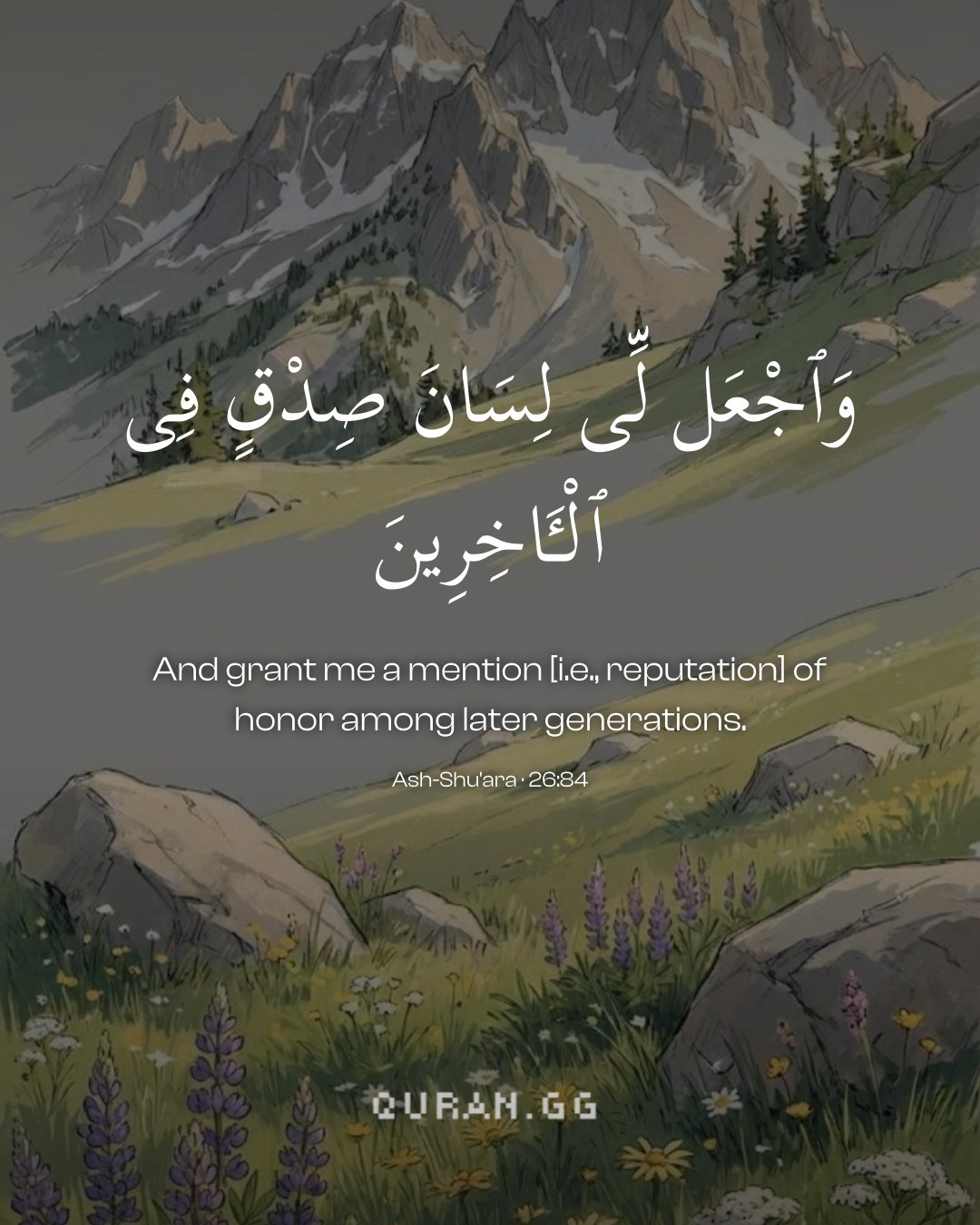
وَاجْعَل لِّى لِسَانَ صِدْقٍ فِى الاٌّخِرِينَ
(And grant me an honorable mention in later generations.) meaning, `cause me to be remembered in a good manner after my death, so that I will be spoken of and taken as a good example.' This is like the Ayah,
Continue reading the tafsir of ayahs 83–89 Commentary
وَاجْعَل لِّي لِسَانَ صِدْقٍ فِي الْآخِرِينَ
And destine for me a truthful description among the next generations. (26:84)
The word لِسَانَ (lisan, which literally means tongue) is used in this verse in the sense of description and 'for me' means 'for my benefit. Thus meaning of the prayer is ` 0 Allah, grant me such delectable ways and nice signs that others may follow until the Dooms Day, and they remember me with good words and nice attributes'. (Ibn Kathir and Ruh al-Mani) Allah Ta’ ala has accepted the supplication of Sayyidna Ibrahim (علیہ السلام) ، including Jews, Christians and even the disbelievers of Makkah, have feelings of love and affection for the creed of Ibrahim and attribute themselves to it. Although their ways are in conflict with those of Sayyidna Ibrahim (علیہ السلام) based on infidelity and polytheism, but they claim to be following his ways. As for the Ummah of the Holy Prophet ﷺ ، they rightly claim to be on the ways of Ibrahand feel proud of it.
Love for being praised is contemptible but allowed with certain conditions
Love and aspiration for being praised and respected by others is contemptible under Islamic law. The Holy Qur'an has made the bounties of the Hereafter dependent on desisting from the love for being praised by saying تِلْكَ الدَّارُ الْآخِرَةُ نَجْعَلُهَا لِلَّذِينَ لَا يُرِيدُونَ عُلُوًّا فِي الْأَرْضِ وَلَا فَسَادًا (As for that Ultimate Abode (the Hereafter) We assign it to those who intend neither being high on earth nor mischief - 28:83) In the present verse (84) the supplication of Sayyidna Ibrahim (علیہ السلام) for his praise and eulogy by the coming generations apparently looks like a wish for being praised. But if the- wordings of the verse are examined carefully, it would become quite evident that it was not the love for being praised, but the real purpose of the supplication was to invoke the Divine help for performing such righteous deeds which could help him in the Hereafter. Moreover, others should also get attracted towards the righteous deeds by following his example, and so should the posterity. By declaring the love for being praised as unlawful and contemptible the Holy Qur'an and hadith actually meant the love for mundane position of importance and profit which is not the case in the. prayer of Ibrahim (علیہ السلام) .
Imam Tirmidhi and Nasa'i رحمۃ اللہ علیہما have related on the authority of Sayyidna Ka` b ibn Malik ؓ that Holy Prophet ﷺ once said that ` If two hungry wolfs are let loose in a herd of goats, they would not do so much damage to the herd as two traits damage the faith of a man. One is the love for wealth and the other is the aspiration for being praised and respected'. (Tabrani from Abu Said al-Khudri, and Bazzar from Abu Hurairah).
Dailami has reproduced a narration on the authority of Sayyidna Ibn ` Abbas ؓ with a weak chain of narrators that the love for praise and worldly status makes a man blind and deaf. All these alhadith refer to the love that has mundane considerations, or for which one has to indulge in sin or negligence in the matter of faith. When this is not the case, aspiration for praise and high position is not contemptible. It is reported in a hadith that Holy Prophet ﷺ himself had made the following supplication: is اللّھُمَّ الجعلنی فی عینی صغیرا و فی اعین النّاس کبیرا that is "Ya Allah, make me insignificant and disdain in my own sight, but make me great in the eyes of people". Here also the purpose of making great in the eyes of people is that people emulate him in his righteous deeds. That is why Imam Malik (رح) has said that the one who is in fact virtuous and pious is required only to avoid making deliberate efforts to present himself as pious in the eyes of people, otherwise, if he loves to be praised by people, it is not contemptible.
Ibn ` Arabi has said that it is evident from this verse that the desire for a righteous deed which results in people's praise is allowed. Imam Ghazzali (رح) has ruled that the love for being praised and the position of respect is permissible under three conditions. One, when the object is not to proclaim oneself as superior to others and to degrade them to an insignificant position, but for the benefit in the Hereafter, so that others may be influenced to follow his example and try to emulate him. Second, when the object is not to earn false praise against a trait one does not possess, and desire that people should eulogize him for that. Third, when one does not have to indulge in a sin or negligence in the matter of faith in order to achieve it.
Man is an independent being. He has the wisdom to distinguish between good and bad, and make inferences from his continued sustenance on earth. When he falls ill, he finds that there is an abundance of resources from which to derive remedies. But then, man observes that in spite of all his apparent freedom, he is helpless in the face of death. He dies at the end of his allotted lifespan. All these factors can be caused by none other than the one and only God. Then, how can it be legitimate and proper to worship anybody except Him alone? Moreover, a man should be extremely serious and sincere in this matter, because these factors also indicate that whatever God does is in preparation for the day when man will be called before Him to give an account of himself. Death marks the beginning of this process when man will be judged by God on the basis of the performance of his deeds on earth.
Uthmani text of the Madinah mushaf (King Fahd Complex). Translation: Saheeh International. Tafsir via Quran.com.