The Prayer of Ibrahim for Himself and for His Father
Here Ibrahim, upon him be peace, asks his Lord to give him Hukm. Ibn `Abbas said, "This is knowledge."
وَأَلْحِقْنِى بِالصَّـلِحِينَ
(and join me with the righteous.) means, `make me one of the righteous in this world and the Hereafter.' This is like the words the Prophet said three times when he was dying:
«اللَّهُمَّ فِي الرَّفِيقِ الْأَعْلَى»
(O Allah, with the Exalted Companion (of Paradise)).
وَاجْعَل لِّى لِسَانَ صِدْقٍ فِى الاٌّخِرِينَ
(And grant me an honorable mention in later generations.) meaning, `cause me to be remembered in a good manner after my death, so that I will be spoken of and taken as a good example.' This is like the Ayah,
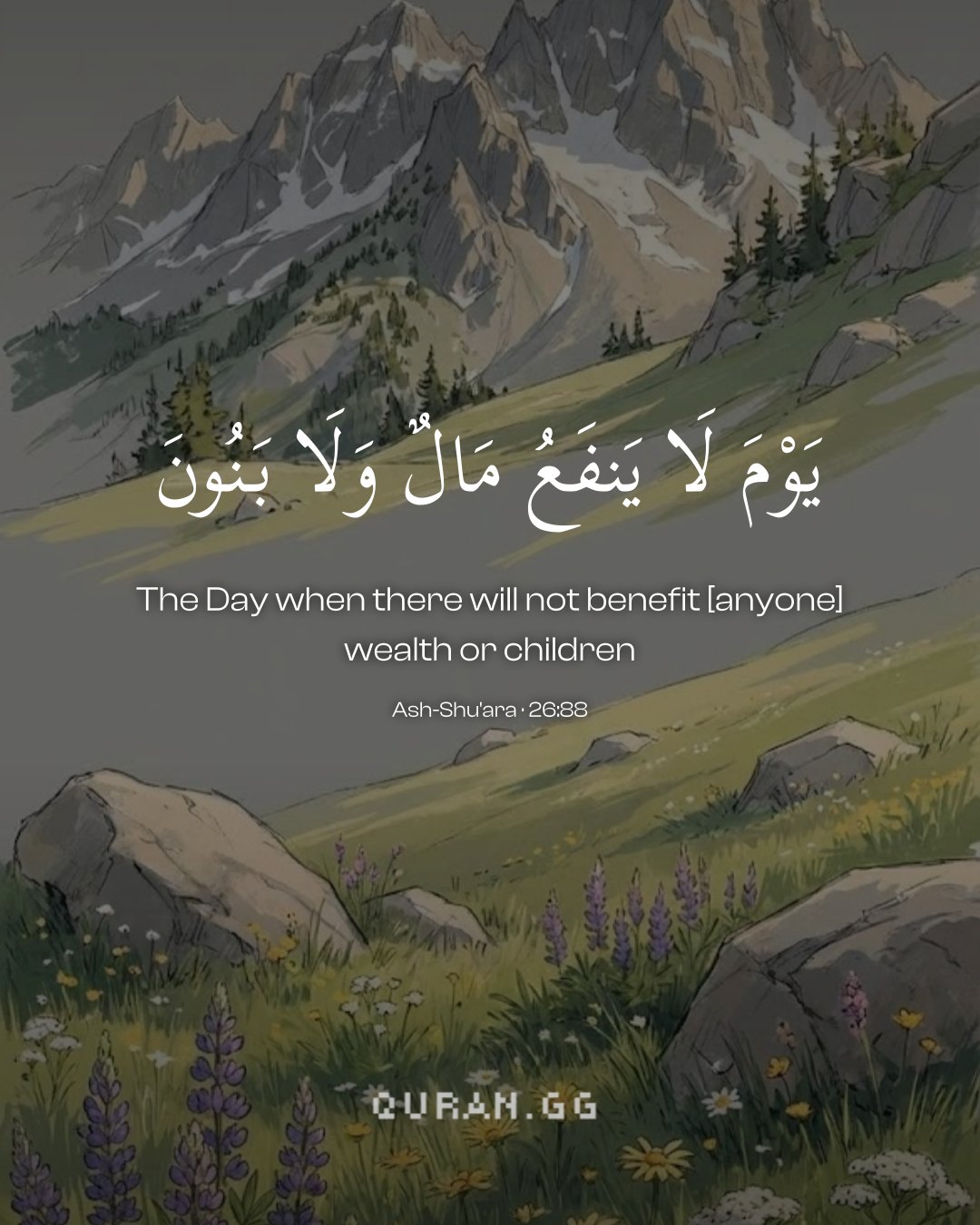
Continue reading the tafsir of ayahs 83–89 يَوْمَ لَا يَنفَعُ مَالٌ وَلَا بَنُونَ ﴿88﴾ إِلَّا مَنْ أَتَى اللَّـهَ بِقَلْبٍ سَلِيمٍ ﴿89﴾
The Day when neither wealth will be of any use (to any one) nor sons, [ 88] except to one who will come to Allah with a sound heart, [ 26:89]
This verse has declared that wealth and children will not be of any help to a person on the Day of Judgment. This declaration is subjected to exception in the words, "except to one who will come to Allah with sound heart". (coming with sound heart means to come to Him with true faith). Now, this exception has been interpreted in two different ways. According to one interpretation adopted by some commentators this exception is not meant to exclude the believers from the rule. It is an exception of a special type which is known in Arabic grammar as "munqati" (This type of exception does not exclude anything from the aforementioned statement. It simply says that the thing negated in the first sentence is found in someone else.) A simple example for this expression is that a person is asked about Zaid whether he has some wealth and children, and he replies, "No, his wealth and children are nothing but his sound heart." The same expression is used in this verse. The gist of the verse, according to this interpretation would be that wealth and children will not be helpful to anyone, neither to a believer nor to a disbeliever; what will be helpful, instead of wealth and children, is one's sound heart, i.e. the true faith and righteous deeds.
The second interpretation, adopted by the majority, is that it is a normal exception which means that wealth and children may be helpful to the one who will come to Allah with sound heart, i.e. with faith and righteous deeds, but these things will not be of any use to a disbeliever.
Another point worth noting in this verse is that while referring to 'children' the Holy Qur'an has used the word بَنُون (Banun) which is literally restricted to the male children. Probably the reason is that it is the male children from whom an effective help is expected in adverse situations. The expectation of help from female children in some calamities is very rare even in this world. Therefore, the male children are specifically mentioned in the context of the Hereafter to indicate that even those who were expected to help in the world will not be of any use there.
It may also be noted that "sound heart" literally means a healthy heart. But according to Sayyidna Ibn ` Abbas ؓ here it means that heart of a believer that testifies the Oneness of Allah and is pure from shirk. The same interpretation is reported from Mujahid, Hasan al-Basri and Said ibn al-Musayyab رحمۃ اللہ علیہم with different expressions. Said ibn al-Musayyab (رح) says that the sound heart is only that of a believer because the heart of a disbeliever is sick. The Holy Qur'an says, فِي قُلُوبِهِم مَّرَضٌ(In their heart there is a malady (2:10).
Wealth, children and the family relationship can also be beneficial in the Hereafter to a believer
In accordance with the commonly adopted explanation of the verse it has now become clear that the wealth of a person could be of help to him on the Dooms Day, provided he is a Muslim. It can be elaborated by saying that the one who has spent his wealth in this world in the way of Allah and in the cause of righteous deeds or has spent in an ongoing charity (Sadaqah Jariyah), will get its benefit in the Hereafter if he dies with the faith of Islam and is listed as a believer on the Day of Judgment. On the other hand if he was not a Muslim or God-forbid became an apostate before his death, then all the good deeds he had done in this world will be of no benefit to him. The same rule will apply in the case of children, that is, if a person is Muslim, he can benefit from them in the Hereafter in that his children supplicate for his forgiveness after his death. Also, if he had tried to train the children to be pious, whatever good they will do, its benefit will also be passed on to him as long as they do righteous deeds. It is also possible that his pious children obtain his pardon in the Hereafter by intercession. In a few Ahadith it is reported about such an intercession and its acceptance, especially the intercession of the young children yet to attain puberty. Likewise, the children will also benefit from their parents on the condition of faith in that if they were Muslims but their righteous deeds could not attain the level of their parents, then Allah Ta’ ala by taking into account their parents good deeds would place them also at the high position of their parents. The Holy Qur'an has elucidated it in these words أَلْحَقْنَا بِهِمْ ذُرِّيَّتَهُمْ (52:21) that is ` We will join together with Our righteous servants their progeny'. The above quoted famous explanation of this verse has made it clear that wherever it is mentioned in the Qur'an or hadith that the family connection will be of no avail in the Hereafter, the reference is to the non-believers. This principle is applicable to the extent that even if the wife and children of the messenger are not believers, they too would not benefit from his prophethood in the Hereafter, as is the case of the son of Sayyidna Nuh (علیہ السلام) the wife of Lut (علیہ السلام) and the father of Sayyidna Ibrahim (علیہ السلام) . The Qur'anic verses فَإِذَا نُفِخَ فِي الصُّورِ فَلَا أَنسَابَ بَيْنَهُمْ "Thereafter, when the Sur صُور (the trumpet) is blown, there are no ties of kinship between them" (23:101) and يَوْمَ يَفِرُّ الْمَرْءُ مِنْ أَخِيهِ ﴿34﴾ وَأُمِّهِ وَأَبِيهِ ﴿35﴾; (upon the day when a man shall flee from his brother, his mother, his father - 80:34) and لَّا يَجْزِي وَالِدٌ عَن وَلَدِهِ "nor will a son be standing for his father in any way" (31:33) all reflect this very theme. (واللہُ اعلم)
Man is an independent being. He has the wisdom to distinguish between good and bad, and make inferences from his continued sustenance on earth. When he falls ill, he finds that there is an abundance of resources from which to derive remedies. But then, man observes that in spite of all his apparent freedom, he is helpless in the face of death. He dies at the end of his allotted lifespan. All these factors can be caused by none other than the one and only God. Then, how can it be legitimate and proper to worship anybody except Him alone? Moreover, a man should be extremely serious and sincere in this matter, because these factors also indicate that whatever God does is in preparation for the day when man will be called before Him to give an account of himself. Death marks the beginning of this process when man will be judged by God on the basis of the performance of his deeds on earth.
Uthmani text of the Madinah mushaf (King Fahd Complex). Translation: Saheeh International. Tafsir via Quran.com.