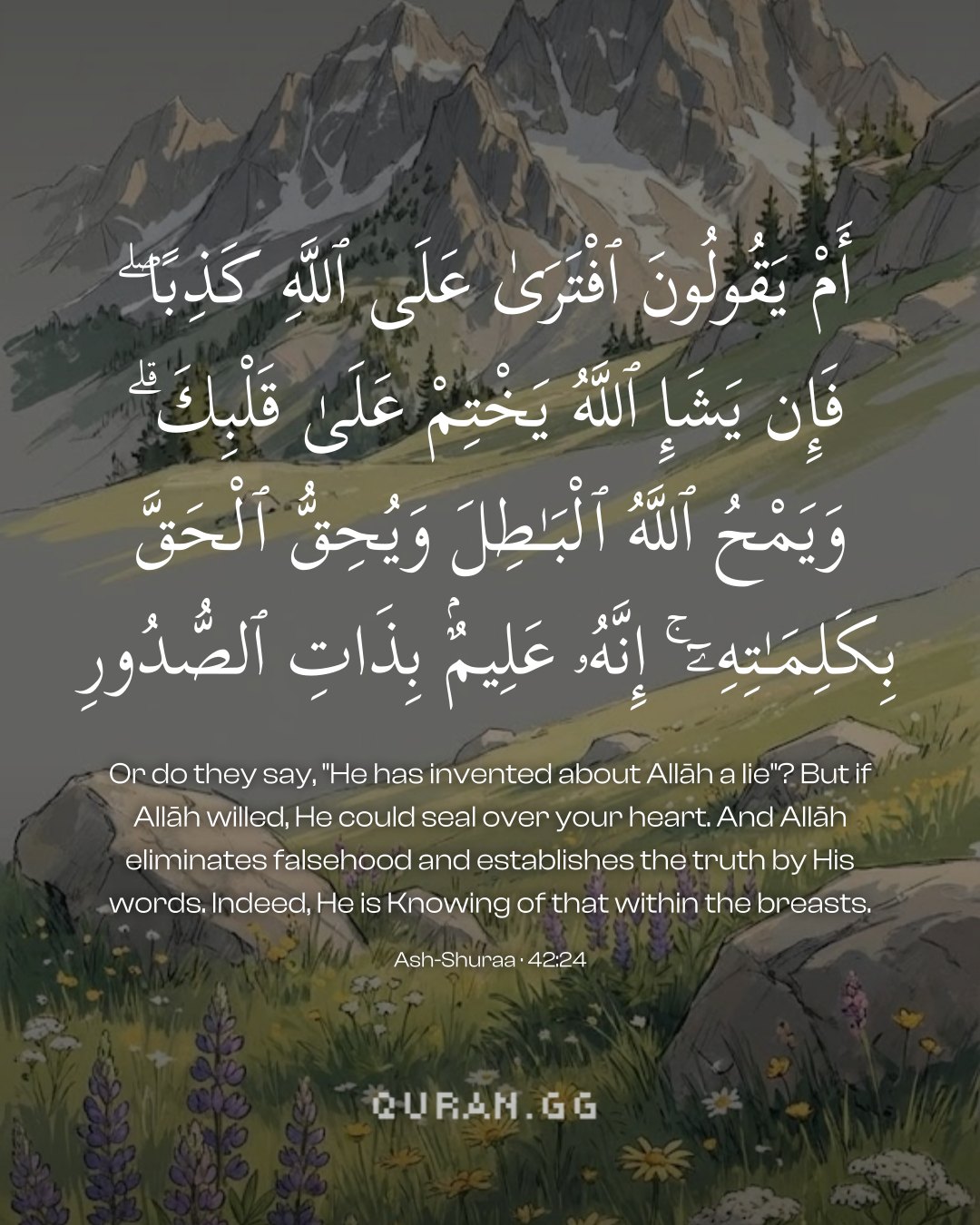
Or do they say, "He has invented about Allāh a lie"? But if Allāh willed, He could seal over your heart. And Allāh eliminates falsehood and establishes the truth by His words. Indeed, He is Knowing of that within the breasts.
(That is whereof Allah gives glad tidings to His servants who believe and do righteous good deeds.) meaning, this will undoubtedly come to them, because it is glad tidings from Allah to them.
(Say: "No reward do I ask of you for this except to be kind to me for my kinship with you.") means, `say, O Muhammad, to these idolators among the disbeliever of Quraysh: I do not ask you for anything in return for this message and sincere advice which I bring to you. All I ask of you is that you withhold your evil from me and let me convey the Messages of my Lord. If you will not help me, then do not disturb me, for the sake of the ties of kinship that exist between you and I.' Al-Bukhari recorded that Ibn `Abbas, may Allah be pleased with him, was asked about the Ayah:
1. It means that the miraculous Qur'an recited by the unlettered Prophet is in itself a clear proof of its being revealed by Allah Ta’ ala. Allah's practice is such that if a person falsely claims to be a prophet, He does not let him show any miracle. Therefore, had there been, God forbid, something forged by the Holy Prophet ﷺ in the Qur'an, Allah would have put a seal on his heart, and he would have never been able to come up with such a miraculous discourse.
Commentary
The first verse conveys Allah Almighty's reply to those who held the prophethood and messenger-ship of the Holy Prophet ﷺ to be false, the Qur'an to be wrong and forged. The reply is based on a divine rule that miracles or events occurring against normal course which cannot be performed by ordinary human beings are created and shown through prophets, by Allah Almighty's Grace, to prove their prophethood, without any discretion of the prophets themselves.
Although some magicians also do perform such magical tricks, but obviously neither the prophets nor the magicians can perform any of these things without Allah Almighty's intent and scheme. He allows the magicians to perform their tricks as a measure of test and trial. However, to differentiate between magic and miracle and between a magician and a prophet, the rule devised by Him is that no false claimant of prophethood can perform any magical trick successfully; magical tricks can be performed successfully by one until he claims prophethood, but the magic vanishes as soon as one lays a false claim of prophethood.
When Allah Ta’ ala bestows prophethood and messenger-ship on anyone, He also favours him with miracles and makes those miracles highly visible. Thus He provides physical and decreed proof of his prophethood. And He also confirms him in His Divine Book.
In view of this rule, it should be understood that the Noble Qur'an is such a miracle that all the humans and all the jins of this world are unable to produce even one verse comparable to the verse of the Qur'an. Their inability to do so was proved in the days of the Holy Prophet ﷺ and continues till today. Such an open and obvious miracle cannot be accomplished by a false claimant of prophethood. The Holy Prophet's claim to ` wahy' and messenger-ship is, therefore, correct and true, and those who hold it to be incorrect and forged are misguided calumniators.
Tazkirul Quran
Maulana Wahiduddin KhanOn ayahs 23–25
‘I do not ask any reward for that, except (that I am inviting you to God because) of love of kinship.’ The Prophet uttered these words at a time when the people of his own tribe, the Quraysh, were putting impediments in the way of his dawah activity. Under these circumstances, the aforesaid statement was meant to convey that they might not accept the Prophet’s religion, if they did not want to, but they should at least take into account their relationship with him and refrain from tormenting him. In other words, he meant to say that even if they had religious differences with him, they should maintain a proper level of politeness, decency and moral values. In this way it was indirectly established that the opponents of his call for Truth were not only his personal opponents but were also morally guilty. They proved themselves wrong according to moral standards, the importance of which was established among them too.
Uthmani text of the Madinah mushaf (King Fahd Complex). Translation: Saheeh International. Tafsir via Quran.com.