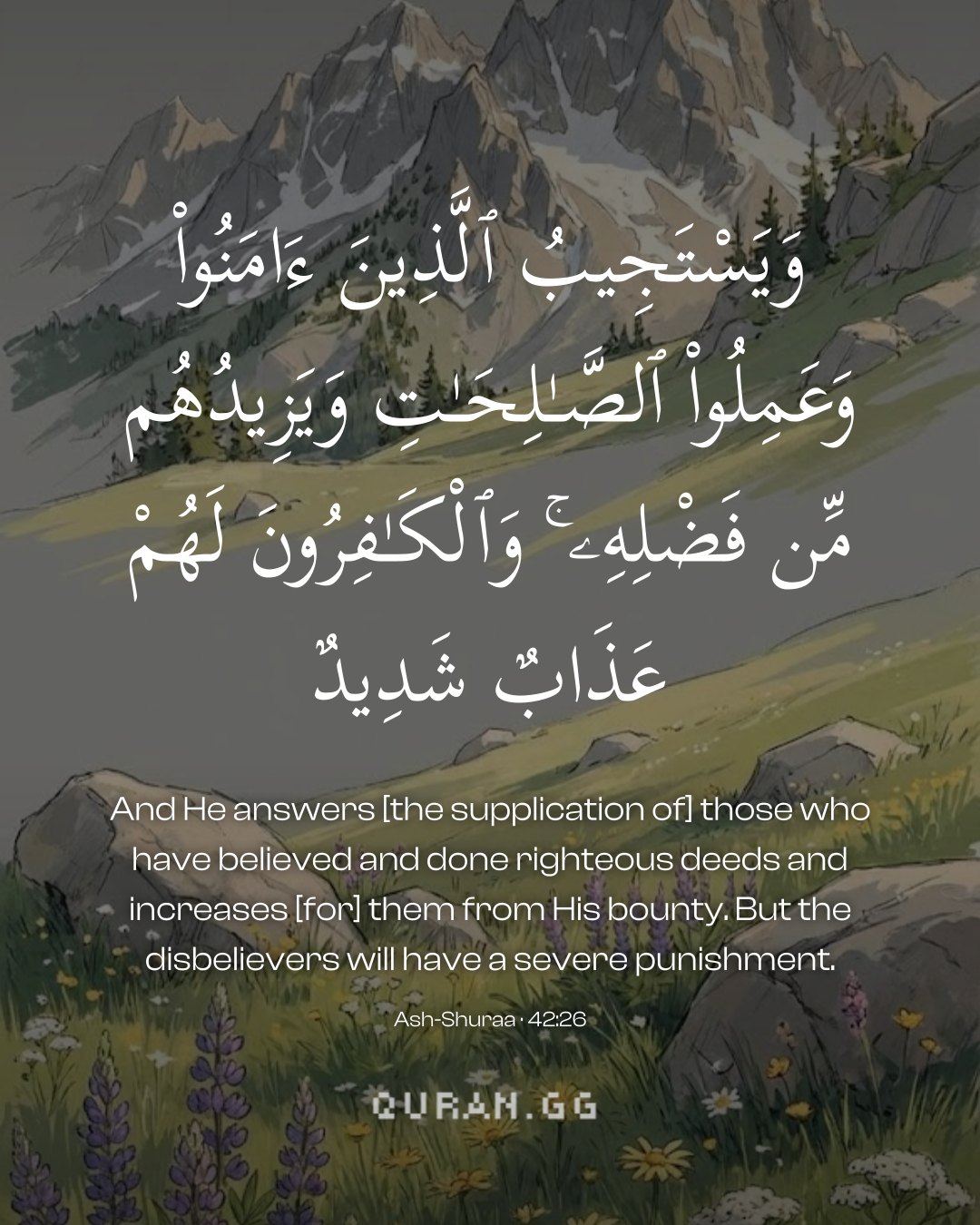
And He answers [the supplication of] those who have believed and done righteous deeds and increases [for] them from His bounty. But the disbelievers will have a severe punishment.
Allah accepts Repentance and responds to Supplications
Here Allah reminds His servants that He accepts repentance. If they turn to Him and come back to Him, then by His kindness and generosity He forgives, overlooks and conceals (their sins), as He says:
(And whoever does evil or wrongs himself but afterwards seeks Allah's forgiveness, he will find Allah Oft-Forgiving, Most Merciful.) (4:110) It was reported in Sahih Muslim that Anas bin Malik, may Allah be pleased with him, said, "The Messenger of Allah ﷺ said:
The deniers and opponents have been advised in the second verse that there is still time to give up and renounce their disbelief and ` kufr'. Allah is very merciful and Most Beneficent; He accepts the repentance of those who truly repent, and forgives their sins.
The Reality of Taubah' (Repentance)
The literal meaning of ` taubah' is to return and turn to; in religious terminology, giving up and renunciation of any sin is called ` taubah'. There are three conditions for its being proper and genuine.
One is to give up, immediately, the sin one is involved in. The second is to repent for the past sin, and the third is to determine firmly not to commit it in future. If it pertains to neglect of any obligatory duty (fard), one has to start observing it or start offering 'gala" (prescribed compensation). If it relates to the rights of another person and if that right is monetary or material and the concerned person is alive, then the material or money has to be returned to him, unless he agrees to forgo, and if that person is not alive, but his heirs are available, then the material or money has to be returned to the heirs; if the heirs are also not available, then the material or money has to be deposited in the Islamic public treasury (bait-ul-mal) - if there is no public treasury, or it is not managed properly, then the material or money has to be given as alms on his behalf. If the right owed to another person is not monetary or material, for example, if another person has been distressed unduly, or he has been abused or his backbiting has been committed, then he has to be pleased and forgiveness has to be sought and obtained from him or her.
According to the law governing this world, Truth appears here in the form of Truth and falsehood in the form of falsehood. A false soul cannot beget Truth. For this reason it is not possible for a non-prophet to use prophetic language. If an individual is not a prophet, but by telling lies, claims to be so, then the style of the false prophet will necessarily creep into his utterances. No ordinary person can speak in the style of a true prophet. ‘If God so willed, He can seal your heart’ means, ‘Had you made false allegations against God, your heart would have been sealed by the will of God.’ Under these circumstances, by the divine laws of nature, you would have found it impossible to deliver the pure, divine discourse, the signs of which are clearly seen in your utterances. The fact is that the sublime words of the Prophet themselves prove him to be a prophet of God. Had he not really been the prophet of God, such utterances would not have fallen from his lips. Those who oppose the Truth do so, not at the dictates of their heart or conscience, but simply out of obstinacy and hostility. Such people are, so to say, held guilty in the court of their own conscience. God’s judgement of them is final, except when they repent and seek God’s pardon.
Uthmani text of the Madinah mushaf (King Fahd Complex). Translation: Saheeh International. Tafsir via Quran.com.