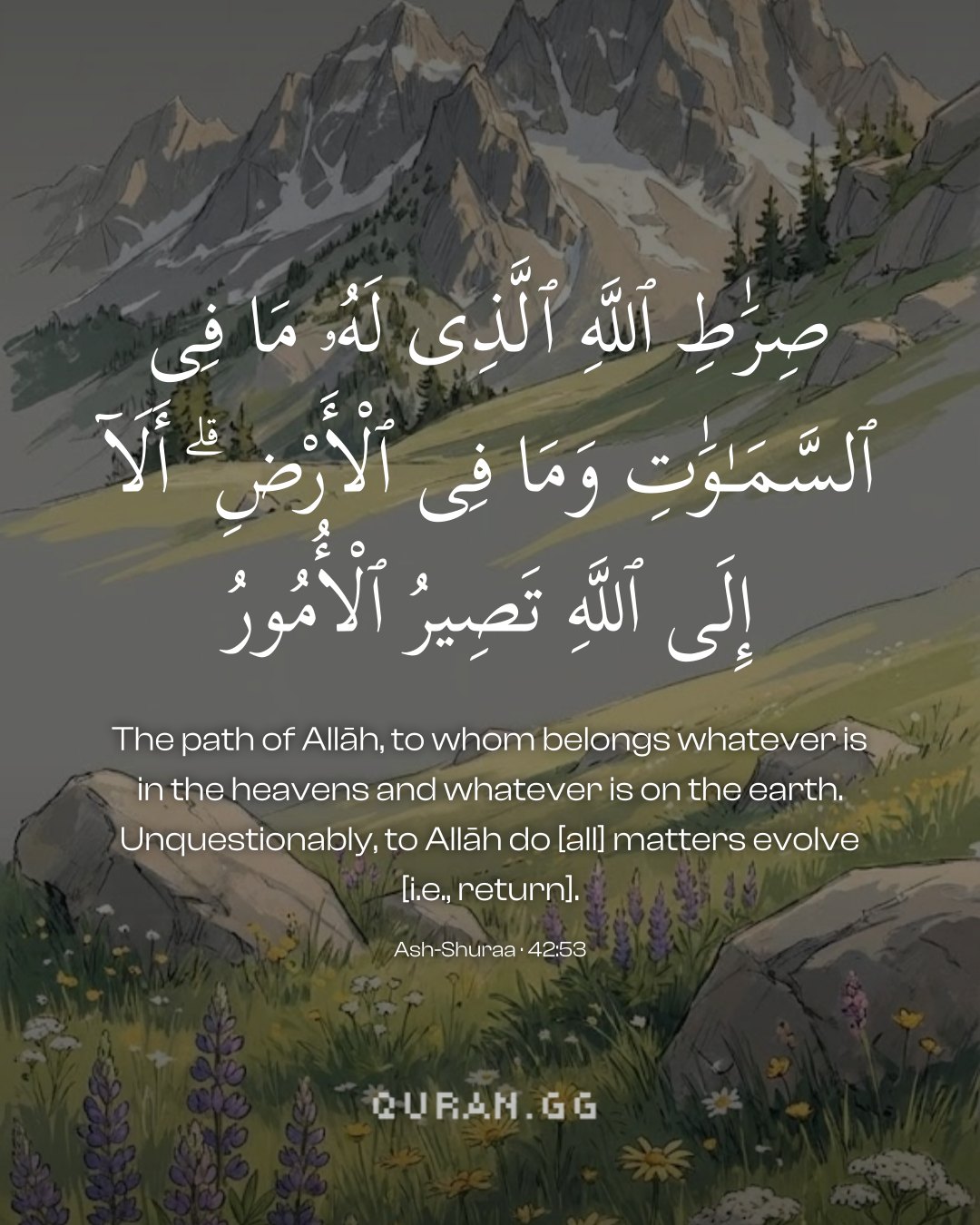
The path of Allāh, to whom belongs whatever is in the heavens and whatever is on the earth. Unquestionably, to Allāh do [all] matters evolve [i.e., return].
This refers to how Allah sends revelation. Sometimes He casts something into the heart of the Prophet , and he has no doubt that it is from Allah, as it was reported in Sahih Ibn Hibban that the Messenger of Allah ﷺ said:
(Ar-Ruh Al-Qudus i.e., Jibril breathed into my heart that no soul will die until its allotted provision and time have expired, so have Taqwa of Allah and keep seeking in a good (and lawful) way.)
أَوْ مِن وَرَآءِ حِجَابٍ
(or from behind a veil) -- as He spoke to Musa, peace be upon him. He asked to see Him after He had spoken to him, but this was not granted to him. In the Sahih, it recorded that the Messenger of Allah ﷺ said to Jabir bin `Abdullah, may Allah be pleased with him:
مَا كُنتَ تَدْرِي مَا الْكِتَابُ وَلَا الْإِيمَانُ وَلَـٰكِن (You did not know earlier what is the Book or what is "Iman', but We have made it a light with which We guide whomsoever we will from among Our slaves - 42:52). This verse is a complement of the subject of the first verse. The gist is that in this world, nobody has ever seen, nor can ever see and converse face to face with Allah Ta’ ala. However, Allah Ta’ ala does send ` wahy' to His chosen bondsmen in three ways described in the first verse. And in accordance with Allah Ta’ ala's practice, ` wahy' is sent to the Holy Prophet ﷺ as well. The demand of Jews that Allah Ta’ ala should speak to him face to face is simply a display of ignorance and hostility. That is why Allah Ta’ ala has stated that whatever knowledge a man obtains, even a prophet for that matter, is all a grant of Allah Ta’ ala. Until Allah Ta’ ala tells them through ` wahy', they would neither be aware of any Book nor would they know the details of faith. Unawareness of the Book before ` wahy' is quite obvious; absence of knowledge of faith means that its details, rules and regulations, and its exalted place become known to a prophet after ` wahy', not before it, otherwise it is proved with consensus of the ummah that whomever Allah chooses to make His Messenger or Prophet, He gives him faith and belief right from the beginning of his birth; his faith is engraved in his nature. These chosen people are firm believers, even before prophethood and before ` wahy' is sent to them. Principles of belief become a part of their nature and behaviour. That is why all the prophets were opposed by their people and they piled up all sorts of allegations against them, but no one had ever accused a prophet of idolatry, even before he was appointed as a prophet. Qurtubi, in his Tafsir, and Qadi ` Ayad in Shifa' have dealt with this subject in full detail.
In the present world, no human being can directly talk to God. Man’s humble position is the hindrance to such dialogue. Therefore the revelation of God’s words to the prophets was made in an indirect manner. There are many methods of indirect revelation. Examples of these are found in the lives of the various prophets. When a scholar writes a book or a thinker delivers his discourse, he has a scholastic background which may account or offer an explanation for his later successful academic or intellectual achievement. But the case of the prophet is entirely different. A prophet’s life after attaining prophethood is entirely different from what it was before that event. The present work of a common man appears to be a continuation of or stems from his past life. But, in the case of a prophet, his utterances after the attainment of prophethood are so distinct from those of the earlier period, prior to prophethood, that they cannot be accounted for or explained on the basis of his past. This is a clear indication that a prophet’s words are, in reality, divine in origin and not an ordinary human discourse. What is special about the Prophet Muhammad is that the Quran (the divine message) conveyed by him and his own personal utterances have both been preserved and still exist in their original form. If one who knows Arabic makes a comparative study of both, he will find an obvious difference between these two. The language of the Hadith (sayings of the Prophet) is clearly that of Muhammad ibn ‘Abdullah, while the language of the Quran is clearly that of God.
Uthmani text of the Madinah mushaf (King Fahd Complex). Translation: Saheeh International. Tafsir via Quran.com.