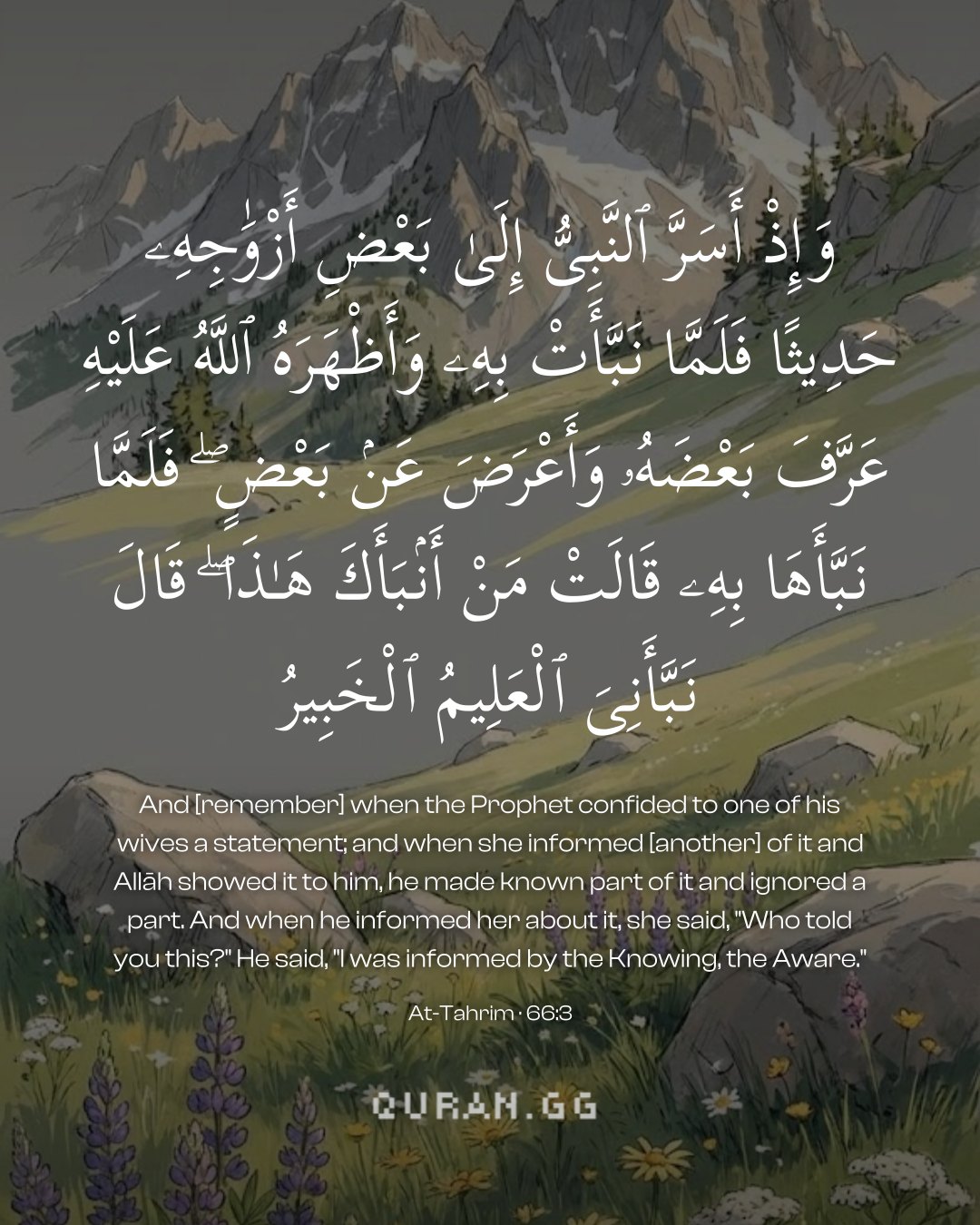
And [remember] when the Prophet confided to one of his wives a statement; and when she informed [another] of it and Allāh showed it to him, he made known part of it and ignored a part. And when he informed her about it, she said, "Who told you this?" He said, "I was informed by the Knowing, the Aware."
(In the Name of Allah, the Most Gracious, the Most Merciful.
Allah censures His Prophet for Prohibiting Himself from what He has allowed for Him In the Book
Al-Bukhari recorded that `Ubayd bin `Umayr said that he heard `A'ishah claiming that Allah's Messenger ﷺ used to stay for a period in the house of Zaynab bint Jahsh and drink honey in her house. (She said) "Hafsah and I decided that when the Prophet entered upon either of us, we would say, `I smell Maghafir on you. Have you eaten Maghafir' When he entered upon one of us, she said that to him. He replied (to her),
وَإِذْ أَسَرَّ النَّبِيُّ إِلَىٰ بَعْضِ أَزْوَاجِهِ حَدِيثًا (And [ remember ] when the Prophet ﷺ told one of his wives something in secret...66:3). The Holy Prophet ﷺ confided a certain secret in one of his wives. According to most versions of the authentic report, the 'secret' in this verse refers to the ban the Holy Prophet ﷺ imposed on himself about honey, but at the same time he did not want Sayyidah Zainab's ؓ feelings to be hurt and therefore he directed the wife to keep it secret from others, but the disclosing wife divulged the secret to another wife, as follows in the next verse. Although there are some other reports that explain the 'secret' in some other way, what has been mentioned above is in accordance with the most authentic narrations.
فَلَمَّا نَبَّأَتْ بِهِ وَأَظْهَرَهُ اللَّـهُ عَلَيْهِ عَرَّفَ بَعْضَهُ وَأَعْرَضَ عَن بَعْضٍ (So, when she disclosed it [ to another wife ], and Allah made it known to him, he told [ the disclosing wife ] part of it, and bypassed another part...66:3). In other words, when the disclosing wife divulged the secret to another wife, and Allah disclosed this fact to the Holy Prophet ﷺ ، he complained to the disclosing wife about her disclosure, but he did not convey to her the whole information. Instead, he communicated part of it to her and withheld part of it. This was because of the Holy Prophet's magnanimity and high morals. If he had disclosed the entire information he had received from Allah, it would have embarrassed her most profoundly. Who was the disclosing wife and who was the one to whom the secret was disclosed? The Qur'an is silent on their identity and does not name them. According to the best received narratives, it would appear that it was Sayyidah Hafsah ؓ whom the Holy Prophet ﷺ directed to keep the matter secret, and she divulged it to Sayyidah ` A'ishah ؓ as recorded in Bukhari on the authority of Sayyidna Ibn ` Abbas ؓ which will be narrated later.
Some narratives report that when Sayyidah Hafsah ؓ divulged the secret, the Holy Prophet ﷺ decided to divorce her, but Allah sent Jibra'l (علیہ السلام) to him, preventing him from divorcing her on the ground that she offered many prayers and kept fasts abundantly. Her name appears in the list of his wives in Paradise. [ Mazhari ]
Tazkirul Quran
Maulana Wahiduddin KhanOn ayahs 2–4
Due to some domestic problems created by his wives, the Prophet vowed that he would not take honey. But, a prophet’s actions become examples for his followers. Therefore, God commanded the Prophet to pay expiation, the penalty prescribed by the Islamic law, and free himself from the his vow not to take honey, so that in future, his followers should not take it as a symbol of piety and stop taking honey.
Uthmani text of the Madinah mushaf (King Fahd Complex). Translation: Saheeh International. Tafsir via Quran.com.