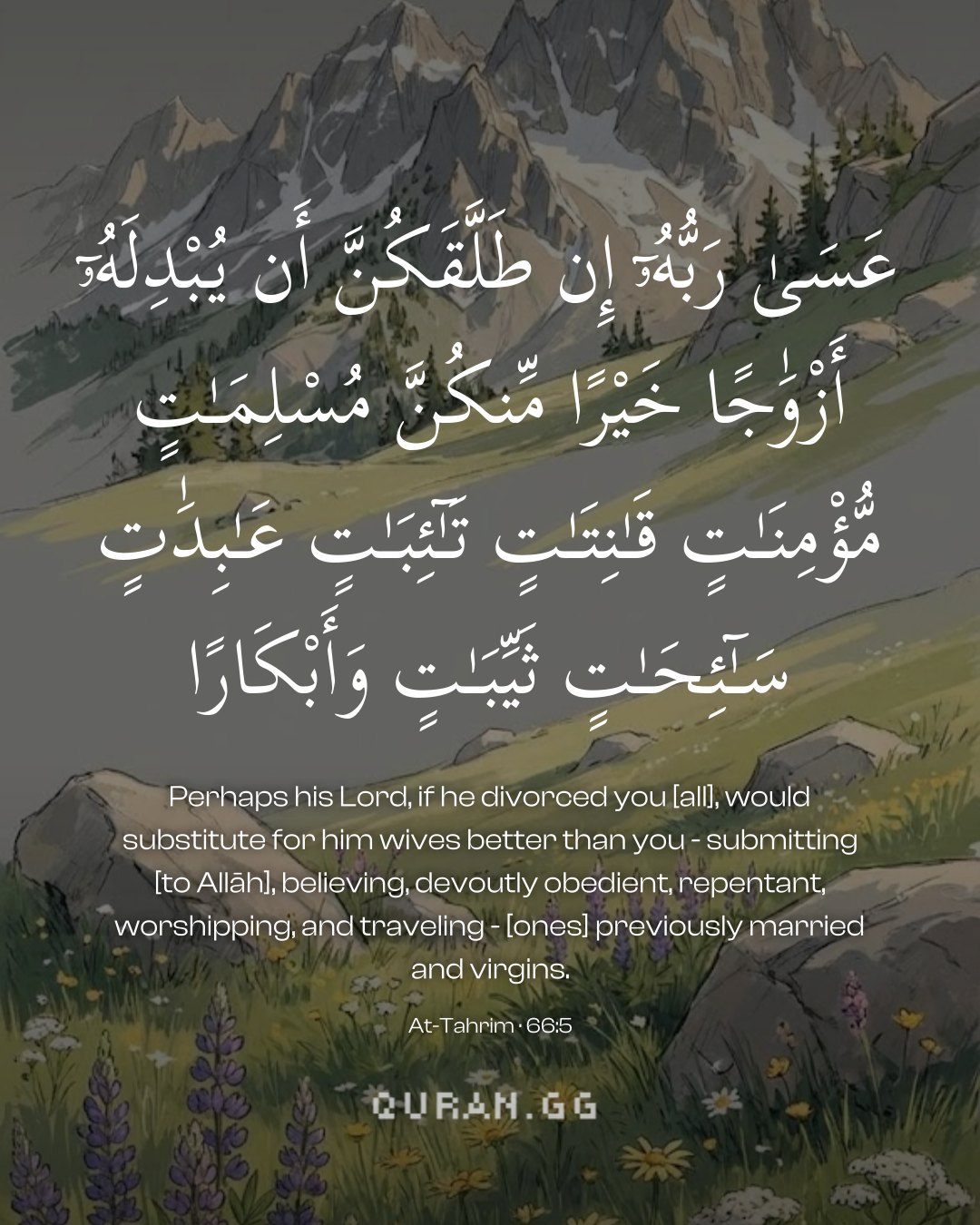
Perhaps his Lord, if he divorced you [all], would substitute for him wives better than you - submitting [to Allāh], believing, devoutly obedient, repentant, worshipping, and traveling - [ones] previously married and virgins.
(In the Name of Allah, the Most Gracious, the Most Merciful.
Allah censures His Prophet for Prohibiting Himself from what He has allowed for Him In the Book
Al-Bukhari recorded that `Ubayd bin `Umayr said that he heard `A'ishah claiming that Allah's Messenger ﷺ used to stay for a period in the house of Zaynab bint Jahsh and drink honey in her house. (She said) "Hafsah and I decided that when the Prophet entered upon either of us, we would say, `I smell Maghafir on you. Have you eaten Maghafir' When he entered upon one of us, she said that to him. He replied (to her),
عَسَىٰ رَبُّهُ إِن طَلَّقَكُنَّ أَن يُبْدِلَهُ أَزْوَاجًا خَيْرًا مِّنكُنَّ (It is hoped that, if he divorces you, Allah will give him in your place wives better than you, submissive to Allah, believing, devout, penitent, steadfast in worship, fasting, previously married and virgins....66:5). The verse refutes the possible thought of the wives that if they are divorced, the Holy Prophet ﷺ will probably not get women better than themselves. The verse under comment responds to their assessment of the situation. It purports to say that nothing is beyond Allah's power. If he divorces them, Allah will give him in exchange better wives than he has at the moment. This does not necessarily imply that there were better wives than the present holy wives at that time. Possibly such women were not available at that point of time, but, should the need have arisen, He could make other women better than they are. These verses specifically dealt with the holy wives of the Holy Prophet ﷺ ، their deeds, their moral reform, their discipline and training. Similar injunctions are given in the verses that follow for the general body of Muslims and believers.
Tazkirul Quran
Maulana Wahiduddin KhanOn ayahs 5–6
In the above-mentioned affair, some wives of the Prophet Muhammad had created complications in his house. By way of warning, his consorts have been addressed here in the manner of an ultimatum. This shows the importance of women in the affairs of life. The fact is that if a woman co-operates with her husband in the real sense, she becomes the husband’s ‘best half’, and if she does not prove to be a true comrade, she may ruin the life’s work of a purposeful man.
Uthmani text of the Madinah mushaf (King Fahd Complex). Translation: Saheeh International. Tafsir via Quran.com.