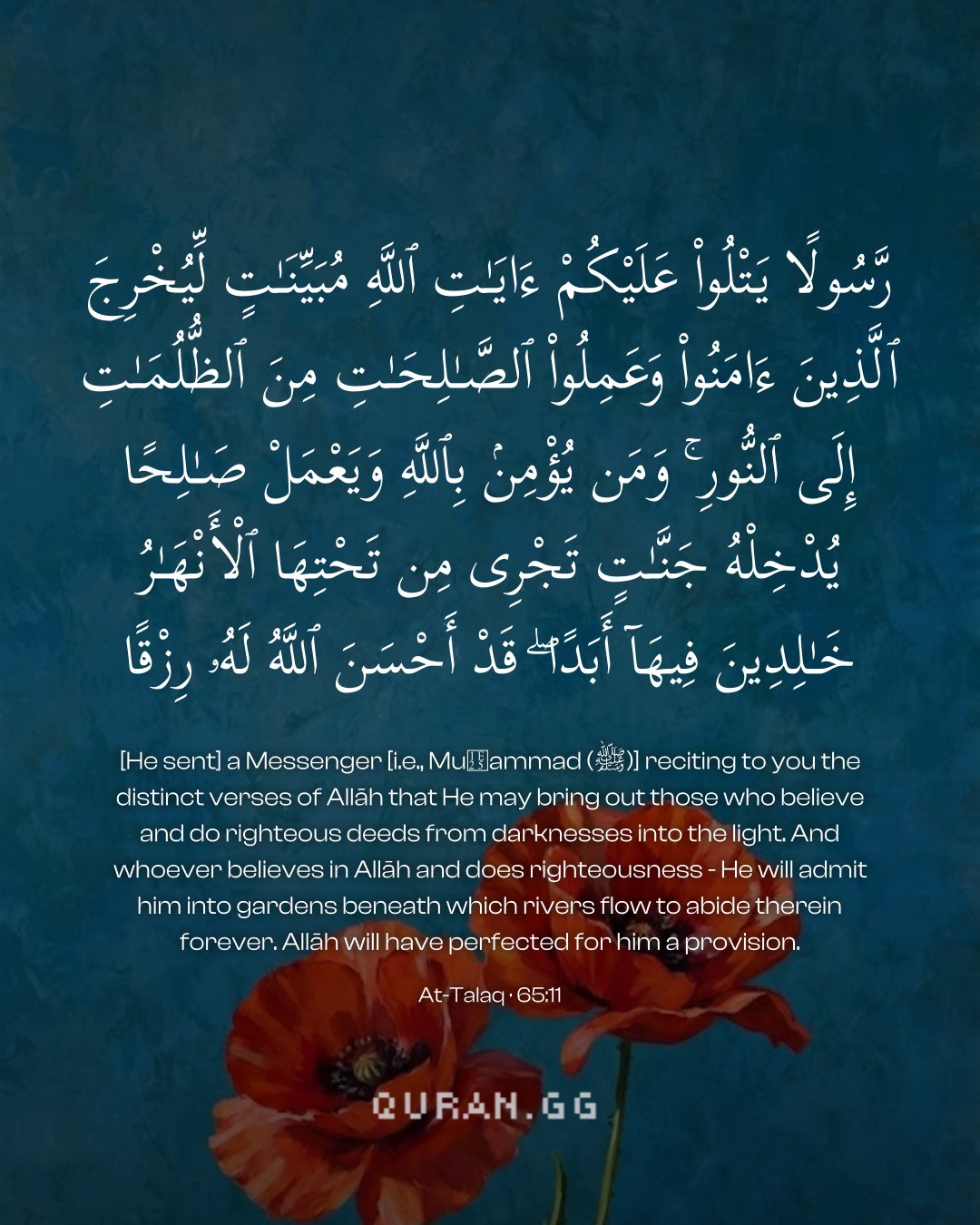
[He sent] a Messenger [i.e., Muḥammad (ﷺ)] reciting to you the distinct verses of Allāh that He may bring out those who believe and do righteous deeds from darknesses into the light. And whoever believes in Allāh and does righteousness - He will admit him into gardens beneath which rivers flow to abide therein forever. Allāh will have perfected for him a provision.
Allah the Exalted threatens those who defy His commands, deny His Messengers and contradict His legislation, by informing them of the end that earlier nations met who did the same,
(And many a town revolted against the command of its Lord and His Messengers;) meaning, they rebelled, rejected and arrogantly refused to obey Allah and they would not follow His Messengers,
قَدْ أَنزَلَ اللَّـهُ إِلَيْكُمْ ذِكْرًا رَّسُولًا (Allah has sent down to you a Reminder, a messenger...65:10-11). The verb arsala 'sent' needs to be understood preceding the object rasulan 'a messenger' which appears at the commencement of verse [ 11]. The simplest way in which these verses can be interpreted is to translate them thus: 'Allah has sent down to you a Reminder, (the Qur'an and He has also sent to you) a messenger...65:11) Other commentators have preferred other interpretations. For instance some say that the word dhikr ('Reminder' ) refers to the Holy Prophet ﷺ himself, and the word 'messenger' is an explanatory complement to the word 'dhikr', because abundance of his remembering Allah made him a personified Remembrance of Allah. [ Ruh ] 1
[ 1] This explanation is based on the premise that 'dhikr' in this verse means 'Allah's remembrance'. However, it also means 'reminder'. Taken in this sense, the word 'messenger' in the verse can be easily interpreted as an explanatory complement to the word 'dhikr', because the Holy Prophet is a 'Reminder' to the entire mankind. Our translation in the text is based on this connotation. (Muhammad Taqi Usmani)
Tazkirul Quran
Maulana Wahiduddin Khan
God sent His messenger ‘so that he might lead those, who have attained to faith and do good deeds, out of darkness into light.’ This statement at this juncture relates to family laws. In ancient times, superstition prevailed throughout the world. Different types of superstitious beliefs had caused the relations between man and woman to rest on an unnatural basis. The Quran banished these superstitions, and re-established the relations between men and women on a natural basis. Despite this, there are people who do not adopt the way of reform, and who can, therefore, expect nothing but loss on God’s earth.
Uthmani text of the Madinah mushaf (King Fahd Complex). Translation: Saheeh International. Tafsir via Quran.com.