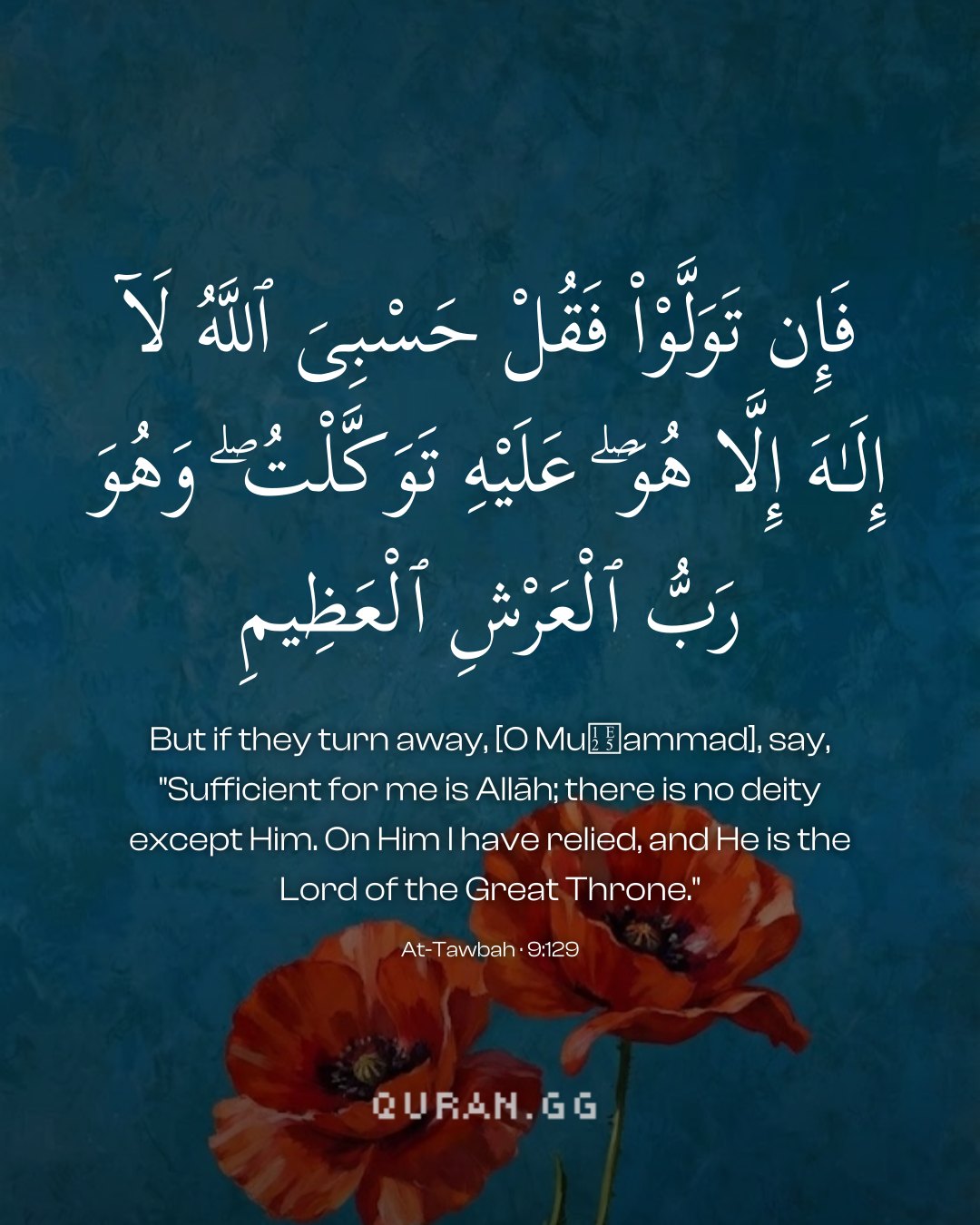
But if they turn away, [O Muḥammad], say, "Sufficient for me is Allāh; there is no deity except Him. On Him I have relied, and He is the Lord of the Great Throne."
(I was sent with the easy Hanifiyah monotheism way.) An authenic Hadith mentions,
«إِنَّ هَذَا الدِّينَ يُسْر»
(Verily, this religion is easy) and its Law is all easy, lenient and perfect. It is easy for those whom Allah the Exalted makes it easy.)
حَرِيصٌ عَلَيْكُمْ
(He is eager for you), that you gain guidance and acquire benefits in this life and the Hereafter. Imam Ahmad recorded that `Abdullah bin Mas`ud said that the Messenger of Allah ﷺ said,
The last two verses, according to Sayyidna ` Ubaiyy ibn Ka'b ؓ ، are the last verses of the Qur'an. After these no other verse was revealed and the Holy Prophet ﷺ left the mortal world. This is also the statement of Sayyidna Ibn ` Abbas ؓ . (Qurtubi)
Great merits of these two verses appear in Hadith. Sayyidna Abu-d-Darda' ؓ says, ` One who recites these verses three times, morning and evening, shall find that Allah Ta` ala makes things easy for him (Qurtubi) ' Allah knows best.
Tazkirul Quran
Maulana Wahiduddin Khan
The Quran tells us that God’s messenger is extremely kind and affectionate towards people. He is so perturbed by others’ suffering that it is as if he himself were affected by it. He is extremely anxious to give guidance to others. What moves him to convey the message of truth to the people is nothing but his great desire for their welfare—far from his having any personal ambition or there being any national problem. According to a tradition narrated by ‘Abdullah ibn Mas‘ud, the Prophet Muhammad said, ‘People are falling into the fire like flies and I am trying to keep them away from it by holding on to their waists.’ (Musnad Ahmad). In this depiction of the Prophet, we can see the mental and moral makeup of the eternal preacher of truth. He should have two prominent features. Firstly, his reliance should be solely on the one and only God. Secondly, he should have in his heart feelings only of love and well-wishing for the addressee. There might be many grievances against the addressee, there might be national or communal or material quarrels between the preacher (da‘i) and the addressee (mad‘u), yet, in spite of this, the preacher must ignore all points of conflict and must not allow any feelings to be aroused in him other than those of affection and kindness. The preacher should rise above the psychology of reaction. He should unilaterally become the well-wisher of his congregation, regardless of any objectionable behaviour on their part and call them to the Truth.
Uthmani text of the Madinah mushaf (King Fahd Complex). Translation: Saheeh International. Tafsir via Quran.com.