Ma'arif al-Qur'an
Mufti Muhammad Shafi
Verse 17 was describing the negative aspect as related to the Mushriks. It said that they did not deserve the honor of building and maintaining mosques. Verse 18 takes up the positive aspect relating to mosques by saying:
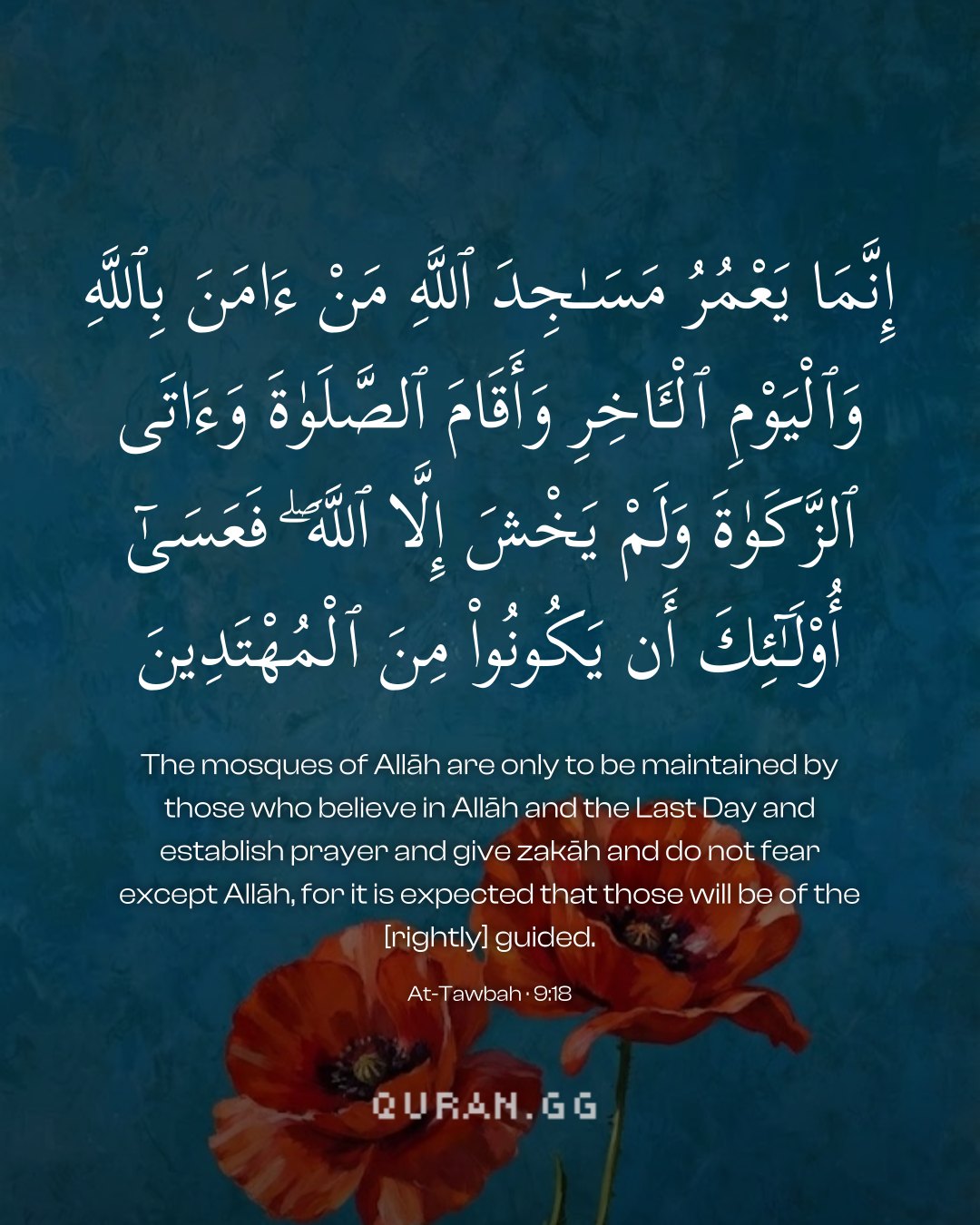
إِنَّمَا يَعْمُرُ مَسَاجِدَ اللَّـهِ مَنْ آمَنَ بِاللَّـهِ وَالْيَوْمِ الْآخِرِ وَأَقَامَ الصَّلَاةَ وَآتَى الزَّكَاةَ وَلَمْ يَخْشَ إِلَّا اللَّـهَ ۖ فَعَسَىٰ أُولَـٰئِكَ أَن يَكُونُوا مِنَ الْمُهْتَدِينَ ﴿18﴾
In fact, the mosques of Allah are built-up only by those who believe in Allah and in the Last Day and those who establish Salah and pay Zakah and who fear none but Allah. So, it is in all likelihood that they are to be among those on the right path.
It means the building of mosques in the real sense is a serene task. It can be done only by those who are bound by the commandments of Allah in their ` Aqidah (faith) and ` Amal (practice). They must believe in Allah and in the 'Akhirah, establish Salah, pay Zakah and fear none but Allah. At this place, only 'Iman (faith) in Allah and 'Akhirah (Last Day) have been mentioned. Faith in the Rasul (Messenger) of Allah was not mentioned expressly because there is no way one can have faith in Allah Ta` ala except that one puts his or her faith in His Rasul - and wholeheartedly accepts the commandments that come from Allah Ta` ala through him. Therefore, ` faith in the Rasul' is naturally included under ` faith in Allah.' This is why the Holy Prophet ﷺ once asked his noble Companions ؓ ، ` Do you know what 'Iman in Allah is?' The Companions said, ` Allah and His Rasul know best.' He said, ` Iman in Allah is that one bears witness to the fact that there is no one worthy of worship but Allah and that Muhammad is the Rasul of Allah.' This Hadith clearly states that having faith in the Rasul is included under having faith in Allah and is comprehensively united with it. (Mazhari with reference to al-Bukhari and Muslim)
As for the statement: ` fear none but Allah,' it means that, in matters of religion, one should not abandon the command of Allah out of some fear. Otherwise, fearing things that cause fear is quite natural. Beasts, snakes, thieves and robbers generate physical fear but that is not the kind of fear we are talking about here. When the magicians showed snakes made of ropes and staffs to Sayyidna Musa, he had a sense of fear within himself as mentioned in the Qur'an فَأَوْجَسَ فِي نَفْسِهِ خِيفَةً مُّوسَىٰ ﴿67﴾ - 20:67. Therefore, the normal fear caused by what causes pain or brings loss is neither contrary to the injunction of the Qur'an nor to the station of a prophet, wallyy or saint. However, one should not become so overcome by this fear as to start creating confusion about the injunctions of Allah Ta` ala or leaving them out altogether. This is not the style of a true believer and this is precisely what is meant at this place.
Some related issues
When it is said in the present verses that Mushriks and Kafirs cannot take up the task of ` maintaining' a masjid which was something only righteous Muslims could do, it refers to the trusteeship and administrative responsibility of the masjid. The outcome is that it is not permissible to appoint a Kafir the trustee and administrator of any Islamic Waqf (endowment). As for the construction of the different units of the structure such as walls and doors, it does not matter even if some non-Muslim is assigned to do the job. (Tafsir Maraghi) Similarly, when a non-Muslim makes a masjid as an act of thawab, or contributes funds for its building, then, it is permissible to accept it. However, the condition is that there should be no danger of a religious or worldly loss, or blame, or usurpation of the property later, or harping on the favor done. (Al-Du rr al Mukhtar, Shami and Maraghi)
It was hinted in verse 18 that building a masjid and making it throb with multitudes of Muslims making prayers, remembering Allah and reciting the Qur'an is a task that can only be accomplished by a righteous Muslim. It proves that anyone who keeps coming to the masjid either to supervise arrangements for the security, maintenance, upkeep and supplies for the masjid, or for the Dhikr of Allah, or to learn about his religion, or to recite or teach the Holy Qur'an is a perfect believer. These deeds are sufficient as witnesses to this honor.
The Holy Prophet ﷺ said: ` when you notice that a person is punctual with his presence in the masjid, bear witness to his ‘Iman - because, Allah Ta` ala has said: إِنَّمَا يَعْمُرُ مَسَاجِدَ اللَّـهِ مَنْ آمَنَ بِاللَّـهِ (In fact, the masjid of Allah are built-up only by those who believe in Allah... - 18). Imam Tirmidhi and Ibn Majah have reported this Hadith on the authority of Sayyidna Abu Said Al-Khudri ؓ .
It appears in Al-Bukhari and Muslim that the Holy Prophet ﷺ said: ` a person who presents himself in the masjid morning and evening, Allah Ta` ala sets aside a rank of Paradise for him.'
And Sayyidna Salman al-Farisi ؓ narrates that the Holy Prophet ﷺ said: ` a person who comes into the masjid is a visiting guest of Allah Ta` ala - and it is incumbent on the host that He honors the guest.' (Mazhari with reference to Tabarani, Ibn Jarir, al-Baihagi and others)
The commentator of the Qur'an, Qadi Thana'ullah of Panipat has said, ` the expression ` maintenance of the masjid' also requires that the masjid should be cleansed of things and practices for which it was not made. It includes activities like buying and selling, worldly conversation, search of lost property, asking people for material help, recitation of idle poetry, disputation, fighting, disturbing peace by noises and things like that. (Mazhari)
Uthmani text of the Madinah mushaf (King Fahd Complex). Translation: Saheeh International. Tafsir via Quran.com.