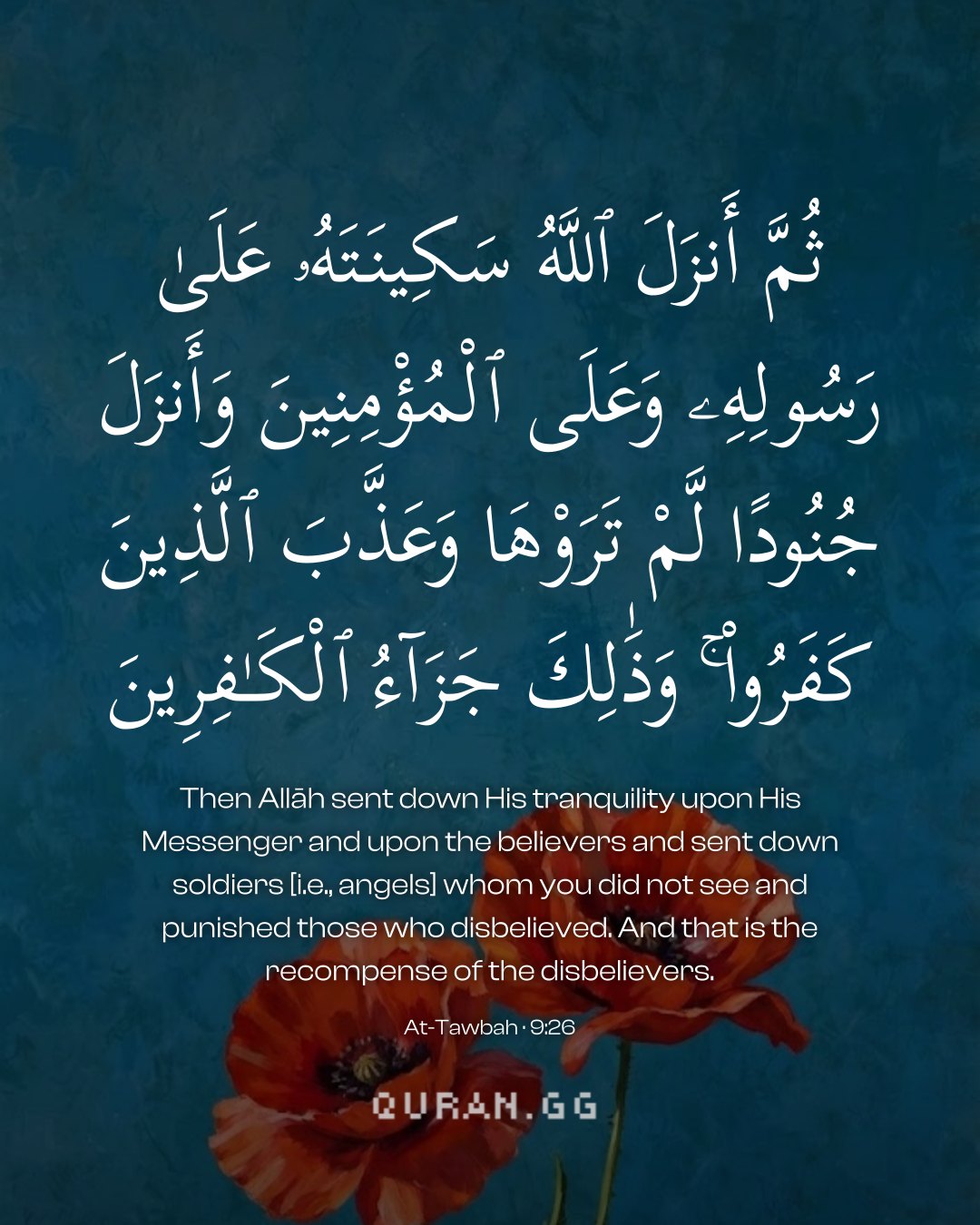
Then Allāh sent down His tranquility upon His Messenger and upon the believers and sent down soldiers [i.e., angels] whom you did not see and punished those who disbelieved. And that is the recompense of the disbelievers.
Ibn Jurayj reported from Mujahid that this was the first Ayah of Bara'ah in which Allah, the Exalted, reminds the believers how He favored and blessed them by giving them victory in many battles with His Messenger . Allah mentioned that victory comes from Him, by His aid and decree, not because of their numbers or adequate supplies, whether the triumphs are few or many. On the day of Hunayn, the Muslims were proud because of their large number, which did not avail them in the least; they retreated and fled from battle. Only a few of them remained with the Messenger of Allah ﷺ Allah then sent down His aid and support to His Messenger and the believers who remained with him, so that they were aware that victory is from Allah alone and through His aid, even if the victorious were few. Many a small group overcame a larger opposition by Allah's leave, and Allah is ever with those who are patient. We will explain this subject in detail below, Allah willing.
It will be useful to explain the statement: ثُمَّ أَنزَلَ اللَّـهُ سَكِينَتَهُ عَلَىٰ رَسُولِهِ وَعَلَى الْمُؤْمِنِين (Then Allah sent down His tranquility upon His Messenger and upon the believers) appearing in verse 26 a little further. It means that Allah Ta` ala sent down His tranquility upon the hearts of the noble Companions who had lost their foothold on the battlefield during the initial attack of the enemy at Hunain. This caused their feet to become firm again and those who had run away came back. As for the sending of tranquility upon the Holy Prophet ﷺ and the Companions ؓ who had stayed on the war front with firmness and determination, it means that they could see victory close at hand. And since the tranquility mentioned here was of two kinds - one for those who ran, and the other for those who stayed on with the Holy Prophet ﷺ with firmness and determination - it is to point out to this refinement that the expressions: عَلَىٰ رَسُولِهِ وَعَلَى الْمُؤْمِنِين (...upon His Messenger and upon the believers) have been placed separately and introduced one after the other with the repetition of the preposition علی ) ’ ala: upon).
After that, it was said: وَأَنزَلَ جُنُودًا لَّمْ تَرَوْهَا (... and sent down forces which you did not see). This means that the people at large did not see. That some reports mention the ` seeing' of these ` forces' should not be taken as contrary to this.
After that, in conclusion, it was said: وَعَذَّبَ الَّذِينَ كَفَرُوا ۚ وَذَٰلِكَ جَزَآءُ الْكَافِرِينَ. It means that Allah punished those who disbelieved - and those who disbelieved deserved that punishment. This punishment or recompense refers to their subjugation at the hands of Muslims which was some-thing witnessed openly. In sum, what was their worldly punishment, they received promptly. As for their fate in the Hereafter, it has been mentioned in verse 27:
Tazkirul Quran
Maulana Wahiduddin KhanOn ayahs 25–26
Reliance on oneself develops sort of a haughtiness in a man which results in carelessness of external facts. He falls short in carrying out disciplinary regulations. Due to overweening self-confidence, he starts acting in an unrealistic manner, the result of which is necessarily defeat in this world of cause and effect. As opposed to this, having confidence in God is reliance on the greatest power. This develops humility in a man; he becomes extremely realistic; and realism is the key to all success.
Uthmani text of the Madinah mushaf (King Fahd Complex). Translation: Saheeh International. Tafsir via Quran.com.