Tafsir Ibn Kathir (abridged)
Ismail ibn Kathir
ائْذَن لِّي
(Grant me leave), to stay behind,
وَلاَ تَفْتِنِّى
(and put me not into trial.), if I go with you and see the women of the Romans. Allah, the Exalted, replied,
أَلا فِى الْفِتْنَةِ سَقَطُواْ
(Surely, they have fallen into trial) because of the statement they uttered. Muhammad bin Ishaq reported from Az-Zuhri, Yazid bin Ruwman, `Abdullah bin Abi Bakr, `Asim bin Qatadah and several others that they said, "The Messenger of Allah ﷺ said to Al-Jadd bin Qays from Bani Salimah,
«هَلْ لَكَ يَا جَدُّ الْعَامَ فِي جَلَادِ بَنِي الْأَصْفَرِ؟»
(`Would you like to fight the yellow ones (Romans) this year) He said, `O Allah's Messenger! Give me permission (to remain behind) and do not cause Fitnah for me. By Allah! My people know that there is not a man who is more fond of women than I. I fear that if I see the women of the yellow ones, I would not be patient.' The Messenger of Allah ﷺ turned away from him and said,
«قَدْ أَذِنْتُ لَك»
(I give you permission.) In Al-Jadd's case, this Ayah was revealed,
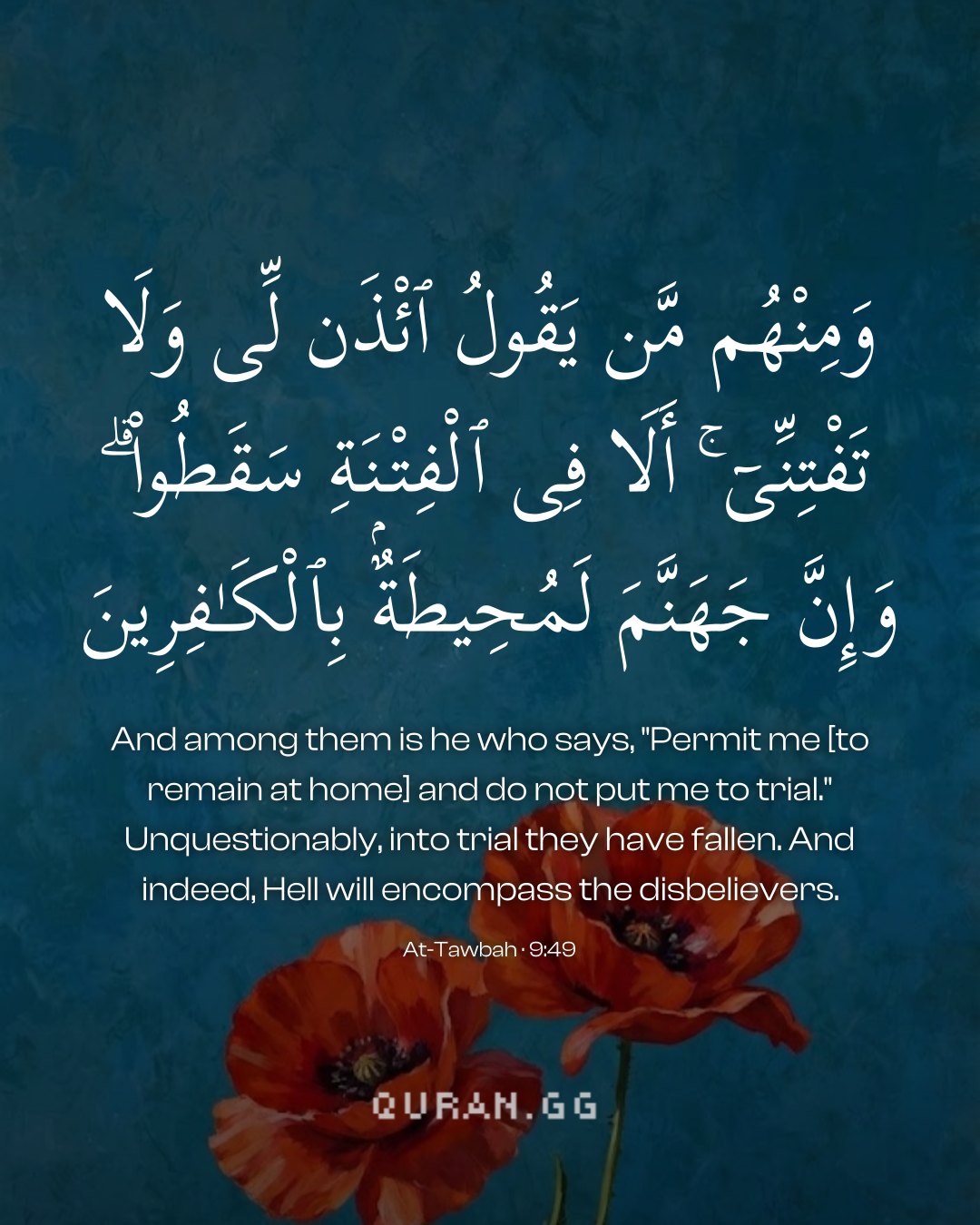
وَمِنْهُمْ مَّن يَقُولُ ائْذَن لِّي وَلاَ تَفْتِنِّى
(And among them is he who says: "Grant me leave and put me not into trial.") Therefore, Allah says that the Fitnah that he fell into because of not joining the Messenger of Allah ﷺ (in Jihad) and preferring his safety to the safety of the Messenger ﷺ is worse than the Fitnah that he falsely claimed to fear." It was reported from Ibn `Abbas, Mujahid and several others that this Ayah was revealed in the case of Al-Jadd bin Qays, who was among the chiefs of Bani Salimah. It is also recorded in the Sahih that the Messenger of Allah ﷺ asked,
«مَنْ سَيِّدُكُمْ يَا بَنِي سَلَمَةَ؟»
(Who is your chief, O Bani Salamah) They said, "Al-Jadd bin Qays, although we consider him a miser." The Messenger of Allah ﷺ said,
«وَأَيُّ دَاءٍ أَدْوَأُ مِنَ الْبُخْلِ وَلَكِنْ سَيِّدُكُمْ الْفَتَى الْجَعْدُ الْأَبْيَضُ بِشْرُ بْنُ الْبَرَاءِ بْنِ مَعْرُور»
(There is not a disease worse than stinginess! Therefore, your chief is the white young man with curly hair, Bishr bin Al-Bara' bin Ma'rur.) Allah said next,
وَإِنَّ جَهَنَّمَ لَمُحِيطَةٌ بِالْكَـفِرِينَ
(And verily, Hell is surrounding the disbelievers.) and they will never be able to avoid, avert, or escape from it.
Ma'arif al-Qur'an
Mufti Muhammad Shafi
In the seventh verse (49), after citing a particular excuse made by a noted hypocrite called Jadd ibn Qays, a comment has been made which shows how astray he had gone. The excuse for not going on Jihad he came up with was that he happened to be a young man. If he went out against the Roman Christians in their territory, there were chances that he might fall into the snare of their beautiful women! (` Do not expose me to an ordeal' ) The Qur'an responded by saying: أَلَا فِي الْفِتْنَةِ سَقَطُوا (Look! they have already fallen into an ordeal). It means that such people were not very smart. They were trying to hide behind the excuse of an imaginary ordeal, not realizing that they had already fallen into the sin of a certain ordeal, the ordeal of acting against the command of Allah and His Messenger, and of deserting the Jihad effort, right on the spot.
The last sentence of the verse: وَإِنَّ جَهَنَّمَ لَمُحِيطَةٌ بِالْكَافِرِينَ (and certainly the Jahannam has the disbelievers encircled) could have two meanings. It could either mean that the Hell would encircle them in the Hereafter. Or, it could mean that the very chain of causes, which are operating to take them to Hell, and which have them all encircled at that time, are what has been equated with Hell. Given this interpretation, it would suggest that they happen to be, even now, within the larger circle of nothing but Hell.
Adopting a religion may be done either with sincerity or with hypocrisy. Adopting religion sincerely means that a man makes religion the focus of his life, with a prime right over his life and property. Without sincerity, the adherent has a purely formal, external relation with religion, feeling no need to face all kinds of adversity for its sake. Admission of one’s mistakes amounts to acceptance of one’s being inferior to another: to do so is the most difficult thing for a man. That is why man always tries to somehow prove the correctness of his stand. Accordingly, those who accept Islam hypocritically are always in search of an opportunity to taunt sincere believers and to prove themselves as being in the right as compared to them. The hypocrites of Madinah were continuously engaged in such efforts. For example, when the Muslims were defeated in the battle of Uhud, the hypocrites who had remained behind in Madinah started circulating propaganda against the Prophet Muhammad to the effect that he had no experience of warfare or strategic affairs; that, spurred on by his own enthusiasm, he had taken the youngsters of the community to a dangerous place and had senselessly caused them to be killed. Among human beings there are very few people who are capable of deeply analysing problems and realising that the mere fact of a statement being cast in grammatically correct language does not in itself furnish proof of its being meaningfully correct. Many people are simple minded, and if something is presented to them in beautiful words, they are very soon affected by it. It is the presence of the hypocritical type of people in a Muslim group that is the cause of the weakening of that group. In their attempt to prove themselves right, such people frequently distort what they have to say so as give it a colour suited to their purpose. Influenced by such artifice, simple-minded people begin to be beset by doubts and uncertainty. In spite of the hypocrites’ efforts to oppose Islam, when the Muslims were victorious in the battle of Badr, ‘Abdullah ibn Ubayy and his companions are reported to have said, ‘This thing has got going now.’ The domination of Islam being obvious, they should have placed credence on the veracity of Islam, but even that fed their jealousy.
Continue reading the tafsir of ayahs 48–49 Uthmani text of the Madinah mushaf (King Fahd Complex). Translation: Saheeh International. Tafsir via Quran.com.