قُلْ
(Say), O Muhammad to them,
هَلْ تَرَبَّصُونَ بِنَآ
(Do you wait for us), anything,
إِلاَ إِحْدَى الْحُسْنَيَيْنِ
(except one of the two best things), martyrdom or victory over you, according to the meaning given by Ibn `Abbas, Mujahid, Qatadah, and others.
وَنَحْنُ نَتَرَبَّصُ بِكُمْ
(while we await for you), that this will touch you,
أَن يُصِيبَكُمُ اللَّهُ بِعَذَابٍ مِّنْ عِندِهِ أَوْ بِأَيْدِينَا
(either that Allah will afflict you with a punishment from Himself or at our hands), either capture or killing,
فَتَرَبَّصُواْ إِنَّا مَعَكُمْ مُّتَرَبِّصُونَ
(So wait, we too are waiting with you.) Allah said next,
Continue reading the tafsir of ayahs 52–54 Commentary
Mentioned in the previous verses were bad morals and bad deeds of the hypocrites. The same subject continues in the verses quoted above. As for the statement in verse 55 -- where it has been declared that the wealth and children of hypocrites should not be taken as a blessing for them as these are, in fact, a form of punishment from Allah -- it has a reason. Is it not that love for and engrossment in worldly life becomes a punishment right here in this world? One starts with desires to acquire worldly wealth, then goes through a series of hard work to establish the necessary channels, day in and day out, sacrificing sleep, comfort and family life. After that, if one succeeds, come the concerns of increasing and retaining it - a round the clock punishment indeed. A serious loss or sickness could become unwelcome cans of worries, and if one happens to get everything one wants, the vicious circle continues either through apprehensions of decreasing wealth or cravings of increasing it further. There is just no respite anytime.
Finally, these things go out of one's hands. This may happen at the time of death, or much earlier. Whenever it does, despair takes over. What is this, if not punishment? Man surrounds himself with articles of comfort and calls it comfort. Real comfort, the peace and comfort of the heart is something man has yet to find. But, in the meantime, man has to rely on material means and things for satisfaction, not realizing that these agents will keep snatching away his share of peace in this world and will also become the prelude to the punishment in the world to come.
Can Sadaqah be given to a disbeliever?
The last two verses show that the hypocrites used to receive a share from properties available as Sadaqat (plural of Sadaqah, meaning a donation through which one seeks reward with Allah Ta` ala, usually referred to as alms or charity). But, when they did not get these as they wished, they became angry and started accusing and cursing. If, at this place, Sadaqat are taken in their general sense - which includes all Sadaqat, necessary (wajib) and voluntary (nafl) - then, there is no problem, because non-Muslims can be given out of the voluntary Sadaqat. This is permissible on the basis of the consensus of Muslim Ummah and stands proved from Sunnah. However, even if Sadaqat at this place mean what is obligatory, like Zakah and ` Ushr, then, we should remember that the hypocrites were given a share from it on the basis that they claimed to be Muslims. Since they claimed to believe in all the necessary articles of faith and their kufr was hidden in their hearts, with no conclusive proof in their apparent claims they were treated as Muslims to the extent of this worldly life and Allah Ta` ala had, in His wisdom, given the orders that the hypocrites should be treated as Muslims. (Bayan a1-Qur'an)
Signs of Hypocrites and Warning for Muslims
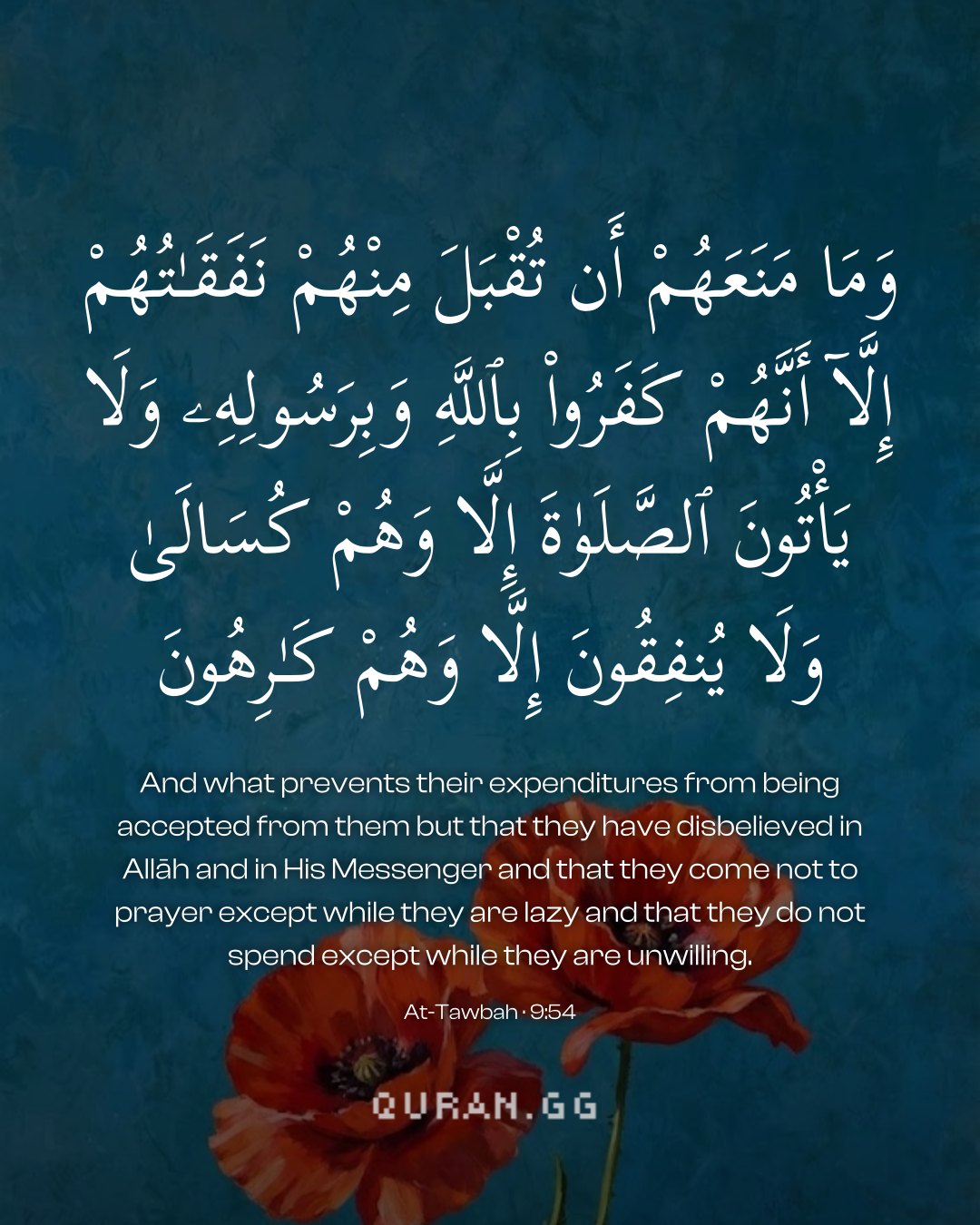
In verse 54, two signs of hypocrites have been given: (1) they come to the Sa ل ah lazily and listlessly, and (2) that they spend in the way of Allah unwillingly.
Muslims have been warned here that sloth in Salah and being sour at heart while spending in the way of Allah, that is, Zakah and Sadaqah, are signs of nifaq (hypocrisy). All Muslims should make conscious effort to stay safe from these signs.
In Madinah the majority of all the people who had embraced Islam, were sincere believers. However, there were a number of people who had embraced Islam to go with the tide of the times, but who lacked that spirit of surrender which is the characteristic of true faith in and true attachment to God. These are the people who are known as hypocrites. These hypocrites consisted mostly of the wealthy class. It was this wealth which was behind their hypocrisy. Those who do not have anything to lose are ready and willing to accept that Islam in which one has to lose one’s all. But those who have something to lose generally become anxious about their worldly considerations. They somehow carry out those commandments of Islam which do not involve any sacrifice, but they find themselves unable to go ahead and accept any requirements of Islam which might involve loss of life and property, or when the question of becoming a believer at the level of sacrifice arises. But lagging behind in accepting the Islam of sacrifice renders even their prayers and fasting valueless. The rite of prayer (‘ibadah)—the worship performed in mosques—is intimately related with worship outside the mosque. If the individual’s life outside the mosque is devoid of the real spirit of religion, his life inside the mosque will also be empty of the true religious spirit and, obviously, action without such spirit has no value before God. God accepts nothing but righteous action. All else is devoid of merit in His eyes.
Uthmani text of the Madinah mushaf (King Fahd Complex). Translation: Saheeh International. Tafsir via Quran.com.