Other Characteristics of Hypocrites
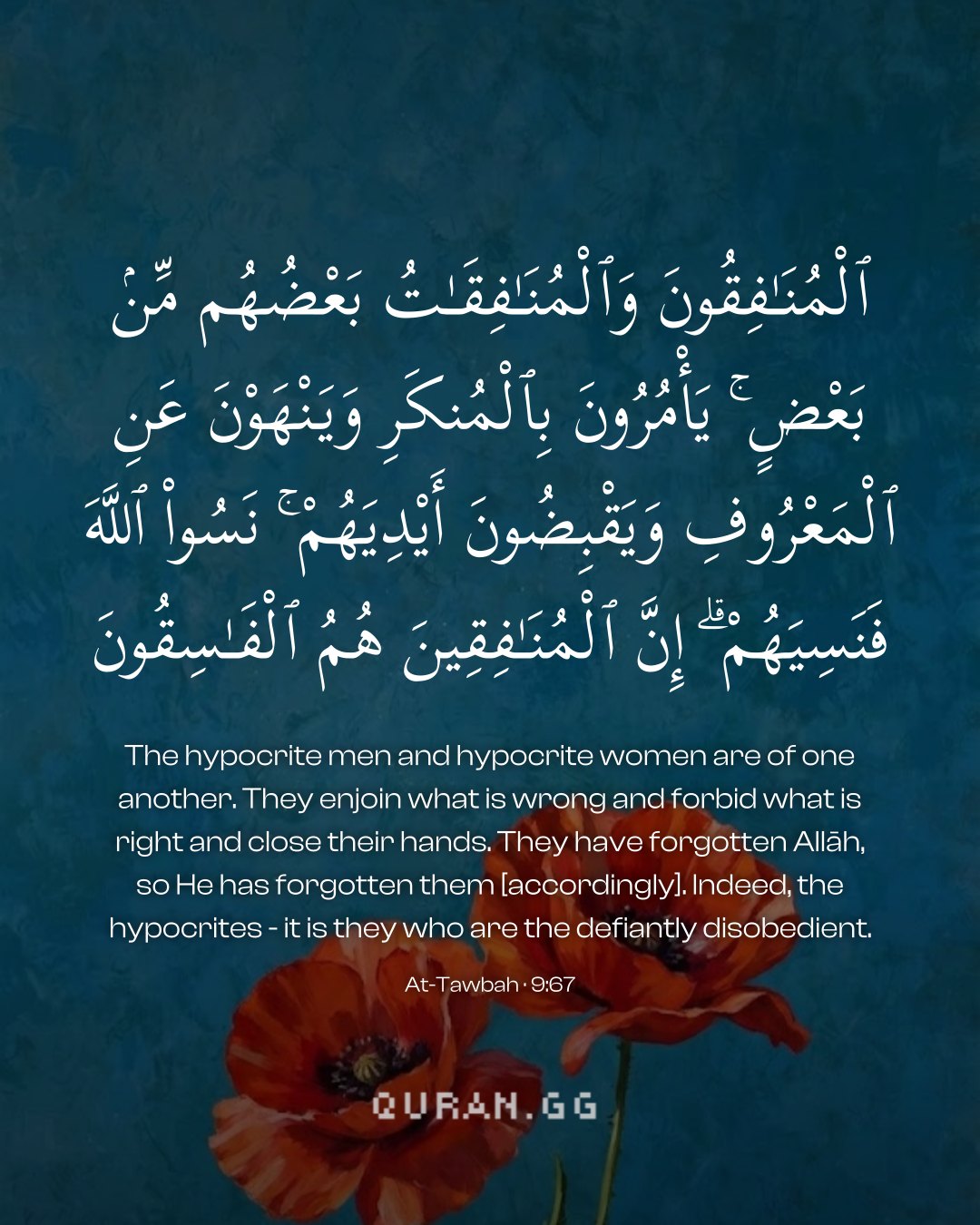
Allah admonishes the hypocrites who, unlike the believers, who enjoin righteousness and forbid evil,
يَأْمُرُونَ بِالْمُنكَرِ وَيَنْهَوْنَ عَنِ الْمَعْرُوفِ وَيَقْبِضُونَ أَيْدِيَهُمْ
(they enjoin evil, and forbid the good, and they close their hands), from spending in Allah's cause,
نَسُواْ اللَّهَ
(They have forgotten Allah), they have forgotten the remembrance of Allah,
فَنَسِيَهُمْ
(so He has forgotten them.), by treating them as if He has forgotten them. Allah also,
وَقِيلَ الْيَوْمَ نَنسَاكُمْ كَمَا نَسِيتُمْ لِقَآءَ يَوْمِكُمْ هَـذَا
(And it will be said: "This Day We will forget you as you forgot the meeting of this Day of yours) 45:34. Allah said,
إِنَّ الْمُنَـفِقِينَ هُمُ الْفَـسِقُونَ
(Verily, the hypocrites are the rebellious) the rebellious from the way of truth who embrace the wicked way,
وَعَدَ الله الْمُنَـفِقِينَ وَالْمُنَـفِقَاتِ وَالْكُفَّارَ نَارَ جَهَنَّمَ
(Allah has promised the hypocrites -- men and women -- and the disbelievers, the fire of Hell), on account of their evildoing mentioned here,
خَـلِدِينَ فِيهَآ
(therein shall they abide.), for eternity, they and the disbelievers,
هِىَ حَسْبُهُمْ
(It will suffice them.), as a torment,
وَلَعَنَهُمُ اللَّهُ
(Allah has cursed them), He expelled and banished them from His mercy,
وَلَهُمْ عَذَابٌ مُّقِيمٌ
(and for them is the lasting torment.)
Commentary
The first verse begins with a profile of the hypocrites. One of the expressions used there: يَقْبِضُونَ أَيْدِيَهُمْ (and they withhold their hands) has been explained in Tafsir al-Qurtubi as abandonment of Jihad and non-compliance of obligatory rights and duties. Then, the sentence that follows: نَسُوا اللَّـهَ فَنَسِيَهُمْ literally means ` they forgot Allah, so He forgot them.' But, Allah Ta` ala is free of forgetfulness. So, the sense at this place is: ` those people had abandoned the commandments of Allah, as if they had forgotten it, therefore, Allah too abandoned their prospects of better life in the Hereafter, to the extent that there remained just no trace of any good, or reward, in their name.'
At the time of the battle of Tabuk, those who had set out with the Prophet Muhammad were treated as staunch and courageous people, while those who remained behind at home were considered hypocrites and cowards. The hypocrites who stayed at home started ridiculing the Prophet and his companions in order to belittle the action taken by them. Some said, ‘In these reciters of the Quran, we see nothing except that they are the hungriest among us, the most extreme liars among us and the worst cowards among us.’ Some asked, ‘Do you think that fighting the Romans is like internal fighting among the Arabs? By God! Tomorrow all these people will be seen tied and bound.’ Others said, ‘This gentleman thinks that he will conquer and capture the palaces and castles of Rome. It’s a pity.’ (Tafsir ibn Kathir). When the Prophet Muhammad came to know about this, he called them and asked them about it. They said, ‘We were simply talking jocularly. In reply to this, the Quran has this to say: ‘Would you make a mockery of God and of His Revelations and His Messenger?’ The message of God is always conveyed through some human being. If this man is apparently ordinary in the eyes of the observers, they start to mock him. But this mockery is not against that man; it is against God Himself. Those who do this only prove that they are not serious about God’s religion. Such people are most guilty in the eyes of God. Their false justifications will never be successful in hiding the reality. Hypocrisy and apostasy (irtidad) after accepting Islam are two aspects of the same fact. If a man, after adopting Islam, openly becomes an infidel (disbeliever) then this is irtidad; and if in his mind and heart, he is far away from Islam but before other people shows himself as a Muslim, this is hypocrisy. The fate of such hypocrites before God is the same as of those who have committed irtidad. However, if they sincerely admit their wrongs and reform themselves before death, God may relent towards them.
Continue reading the tafsir of ayahs 66–67 Uthmani text of the Madinah mushaf (King Fahd Complex). Translation: Saheeh International. Tafsir via Quran.com.