Tafsir Ibn Kathir (abridged)
Ismail ibn Kathir
بِخَلَـقِهِمْ
(their portion), means, they mocked their religion, according to Al-Hasan Al-Basri. Allah's statement,
وَخُضْتُمْ كَالَّذِي خَاضُواْ
(and you indulged in play and pastime as they indulged in play and pastime), indulged in lies and falsehood,
أُوْلَـئِكَ حَبِطَتْ أَعْمَـلُهُمْ
(Such are they whose deeds are in vain), their deeds are annulled; they will not acquire any rewards for them because they are invalid,
فِي الدنْيَا وَالاٌّخِرَةِ وَأُوْلَـئِكَ هُمُ الْخَـسِرُونَ
(in this world and in the Hereafter. Such are they who are the losers.) because they will not acquire any rewards for their actions. Ibn `Abbas commented, "How similar is this night to the last night,
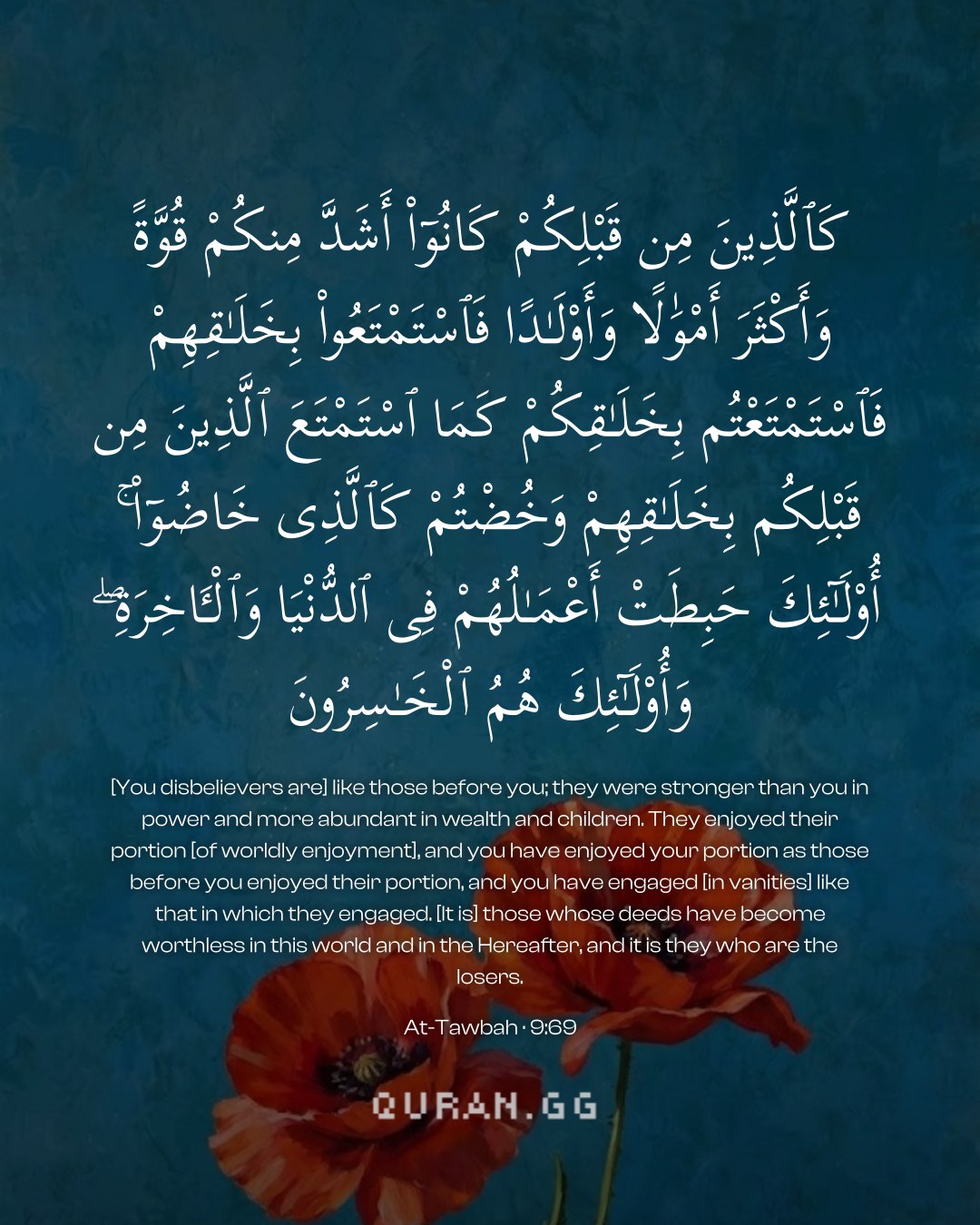
كَالَّذِينَ مِن قَبْلِكُمْ
(Like those before you...) These are the Children of Israel, with whom we were compared. The Prophet said,
«وَالَّذِي نَفْسِي بِيَدِهِ لَتَتَّبِعُنَّهُمْ حَتَّى لَوْ دَخَلَ الرَّجُلُ مِنْهُمْ جُحْرَ ضَبَ لَدَخَلْتُمُوه»
(By He in Whose Hand is my life! You will imitate them, and even if a man of them entered the den of a lizard, you will enter it likewise!)" Abu Hurayrah narrated that the Messenger of Allah ﷺ said,
«وَالَّذِي نَفْسِي بِيَدِهِ لَتَتَّبِعُنَّ سَنَنَ الَّذِينَ مِنْ قَبْلِكُمْ شِبْرًا بِشِبْرٍ وَذِرَاعًا بِذِرَاعٍ، وَبَاعًا بِبَاعٍ حَتَّى لَوْ دَخَلُوا جُحْرَ ضَبَ لَدَخَلْتُمُوه»
قالوا: ومن هم يا رسول الله، أهل الكتاب؟ قال:
«فَمَنْ؟»
(By He in Whose Hand is my soul! You will follow the traditions of those who were before you a hand span for a hand-span and forearm's length for forearm's length, and an arm's length for an arm's length. And even if they enter the den of a lizard, you will also enter it.) They asked, "Who, O Allah's Messenger, the People of the Book" He said, (Who else)" This Hadith is similar to another Hadith collected in the Sahih.
Let us now consider the statement: كَالَّذِينَ مِن قَبْلِكُمْ (You are) like those before you' in verse 69. According to one exegetical explanation, this is addressed to hypocrites while according to the other explanation, the address is to Muslims. The addition of ` you are' in parenthesis points out in this direction. Thus, it means that ` you too are like people before you. They went for worldly enjoyments and forgot all about the life to come. The result was that they sank into all sorts of sins. So shall you be.
Explaining this verse, Sayyidna Abu Hurairah ؓ عنہ narrates a Hadith in which the Holy Prophet ﷺ . 1n al has been reported to have said that ` you too will take to the ways taken by communities before you. You will imitate them in toto as dittos and clones to the limit that should you see one of them entering into the hole of a lizard (iguana), you will follow him there too.' After having narrated this far, Sayyidna Abu Hurairah ؓ said that should anyone wish to as-certain the thematic authenticity of this Hadith, let him read this verse of the Qur'an: كَالَّذِينَ مِن قَبْلِكُمْ `(You are) like those before you - 69.'
On hearing this, Sayyidna ` Abdullah ibn ` Abbas ؓ said: مَا اَشبَہَ اللَّیلَۃ بِالبَارِحَۃِ that is, ` how similar is this night (in our time) to the last night (way back) - they are the people of Bani Isra'il and we have been likened to them.' (Qurtubi)
The aim of the Hadith is fairly evident. It warns that Muslims too will start following the ways of the Jews and Christians by latter times. This statement appears only after a punishment has been announced for the hypocrites. It serves as an indicator that good Muslims would not do that. Only those among them, who are weak in 'Iman may do so because they are still infected with the germs of hypocrisy. All good men and women of the Muslim community have been instructed in this verse that they should themselves abstain from such ways as well as help others do the same.
God has blessed previous communities with status and wealth. These things nourished their pride, haughtiness and insensitivity. Their successors did not take a lesson from the plight that befell them. They too chose for themselves a share in worldly effects as their predecessors had done before them. This has been the condition of the common man in every period. He does not give importance to the requirements of Truth. The requirements of his children and his property are everything for him. The condition of the hypocrite in point of fact is also the same. Outwardly, he appears to be like the true believers, but the level of his existence is the same as that of an ordinary worldly person. The result is that, leaving aside a certain amount of exhibitionism, in real life he is just like any other average human being. The hypocrite is emotionally more attached to worldly individuals than to religious people. His heart constricts if he has to spend anything for the Hereafter. But he does not hesitate to go ahead and spend on worldly affairs. He does not like the progress of truth, but if it is a question of the progress of untruth, he eagerly tolerates it. In spite of outward religiousness, he is forgetful of God and the Hereafter, as if God and the Hereafter have no value for him. Such people are never safe from God’s wrath simply on the basis of their outward show of Islam. They will be cursed in the world and punished in the Hereafter. They will be deprived of God’s grace in the world as well as in the Hereafter. Complete attachment to God is the only thing which gives value to a man’s deeds. A deed performed without this will be as valueless in the Hereafter as a body without a soul, which in spite of its resemblance to a human body is in reality without meaning.
Continue reading the tafsir of ayahs 68–69 Uthmani text of the Madinah mushaf (King Fahd Complex). Translation: Saheeh International. Tafsir via Quran.com.