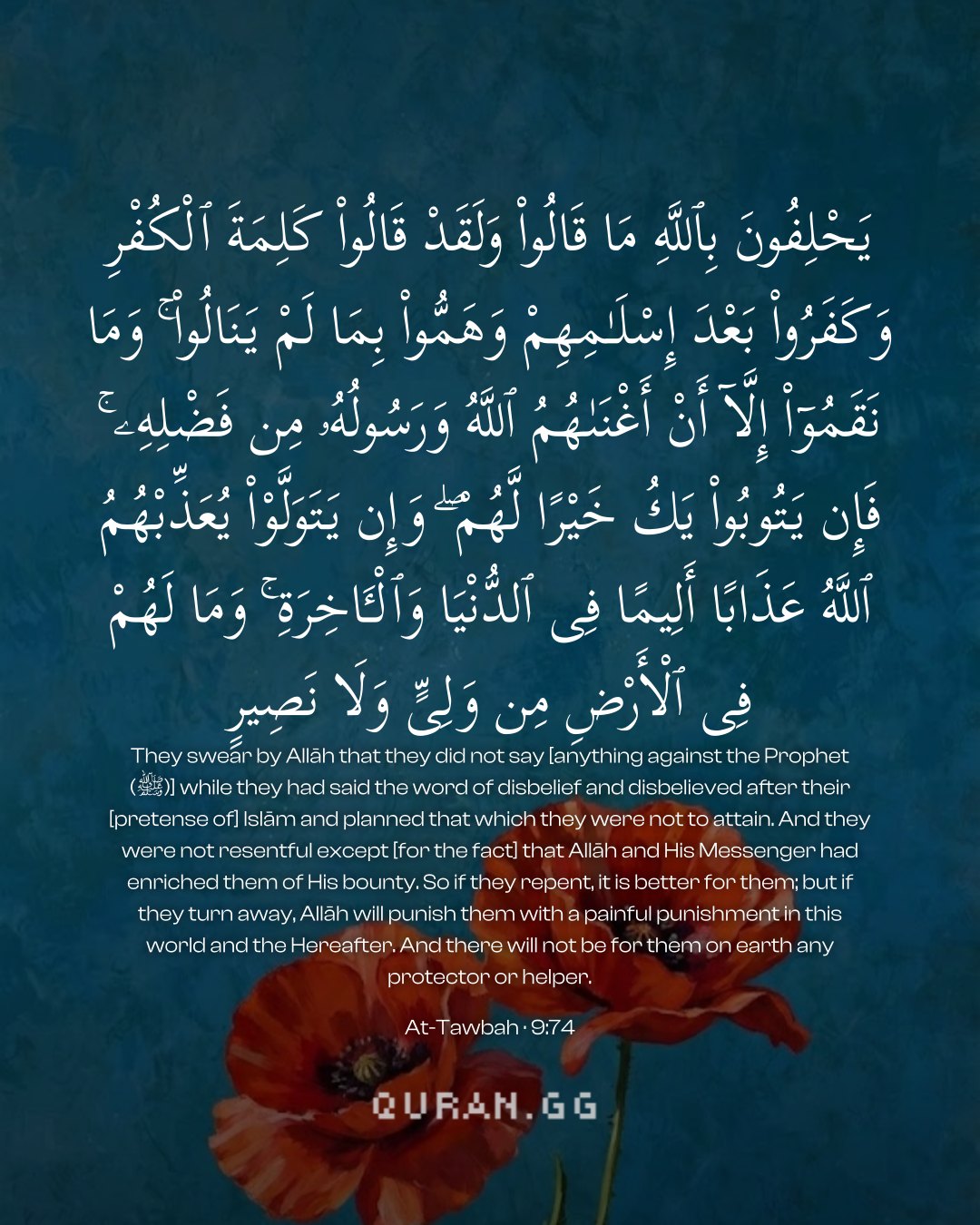
They swear by Allāh that they did not say [anything against the Prophet (ﷺ)] while they had said the word of disbelief and disbelieved after their [pretense of] Islām and planned that which they were not to attain. And they were not resentful except [for the fact] that Allāh and His Messenger had enriched them of His bounty. So if they repent, it is better for them; but if they turn away, Allāh will punish them with a painful punishment in this world and the Hereafter. And there will not be for them on earth any protector or helper.
The Order for Jihad against the Disbelievers and Hypocrites
Allah commanded His Messenger to strive hard against the disbelievers and the hypocrites and to be harsh against them. Allah also commanded him to be merciful with the believers who followed him, informing him that the destination of the disbelievers and hypocrites is the Fire in the Hereafter. Ibn Mas`ud commented on Allah's statement,
جَـهِدِ الْكُفَّـرَ وَالْمُنَـفِقِينَ
(Strive hard against the disbelievers and the hypocrites) "With the hand, or at least have a stern face with them." Ibn `Abbas said, "Allah commanded the Prophet to fight the disbelievers with the sword, to strive against the hypocrites with the tongue and annulled lenient treatment of them." Ad-Dahhak commented, "Perform Jihad against the disbelievers with the sword and be harsh with the hypocrites with words, and this is the Jihad performed against them." Similar was said by Muqatil and Ar-Rabi`. Al-Hasan and Qatadah said, "Striving against them includes establishing the (Islamic Penal) Law of equality against them." In combining these statements, we could say that Allah causes punishment of the disbelievers and hypocrites with all of these methods in various conditions and situations, and Allah knows best.
In the first verse: يَحْلِفُونَ بِاللَّـهِ (They swear by Allah -74), the text reverts to the hypocrites who keep uttering words of infidelity in their gatherings but, should Muslims come to know about that, they would promptly declare on oath that they had nothing to do with it. Giving the background in which this verse was revealed, Al-Baghawi reports that the Holy Prophet ﷺ gave an address on the occasion of the battle of Tabuk. He talked about the sorry state of affairs the hypocrites were in and warned them of their sad end. Also present there was Jullas, a hypocrite. When he returned to his people, he said ` if whatever Muhammad says is true, then, we are worse than donkeys.' By chance, a Sahabi whose name was ` Amir ibn Qays heard the comment. He told him that ` there is no doubt about what the Holy Prophet ﷺ has said for it is true and you are really worse than donkeys.'
When the Holy Prophet ﷺ returned to Madinah back from his trip to Tabuk, ` Amir ibn Qays told him about this event. But, Jullas flatly disowned what he had said. On top of that, he charged ` Amir ibn Qays of having accused him falsely. The Holy Prophet ﷺ ordered both of them to stand close to the Mimbar of the Nabiyy (the stepped platform used to deliver khutbah in the masjid originally occupied by the Holy Prophet ﷺ and traditionally regarded as a symbol of his message) and take an oath. Jullas was quick to take a false oath to the effect that he never said that and that ` Amir was lying. When it was ` Amir's turn, he took his oath. Then, he raised his hands of prayer before Allah saying, ` 0 Allah, let Your Messenger know about the reality of this matter through a revelation to him.' The Holy Prophet ﷺ said 'Amin (amen) following his prayer and so did all Muslims present there. These people had yet to move from there when came Angel Jibra'il (علیہ السلام) with the revelation which included this verse.
When Jullas heard this verse, he stood up immediately and started saying, ` ya rasulallah, now I confess that I was the one in the wrong and that which was said by ` Amir was the truth. But, this very verse has also given me the right of making Taubah (repentance). Hence, I seek forgiveness from Allah and repent for what I did earlier.' The Holy Prophet ﷺ accepted his Taubah after which he stayed firm in it and things turned towards the better in his life. (Mazhari)
Some commentators have referred to similar events as the back-ground of the revelation of this verse - especially as this verse includes the sentence: وَهَمُّوا بِمَا لَمْ يَنَالُوا (and had intended what they could not achieve -74). This sentence seems to suggest that the verse is connected with some event when the hypocrites had hatched some conspiracy against the Holy Prophet ﷺ and his Muslim followers in which they could not succeed. For example, there is a fairly well known incident that came to pass during the return from this very battle of Tabuk. Twelve men from among the hypocrites sat in ambush behind a mountain pass with the intention of taking the Holy Prophet ﷺ by surprise and kill him. Angel Jibra'il (علیہ السلام) informed him of their intention. He took a different route and their conspiracy went to dust.
For that matter, several other events of this nature are also on record. But, there is no element of contradiction or improbability in the likelihood that all those events are being referred to through this verse.
Tazkirul Quran
Maulana Wahiduddin KhanOn ayahs 74–76
According to a tradition, during the period of the Prophet Muhammad, there were about eighty hypocrites in Madinah. This indicates that the jihad ordered here against hypocrites did not mean waging (qital) war on them. Had it been so, the Prophet would have had them eliminated. According to a hadith narrated by Ibn ‘Abbas, here jihad meant striving by word of mouth. Hence, according to the majority of Muslims, jihad with the sword against hypocrites is not in accordance with the Shariah. Hypocrisy is the adoption of Islam in such a way that it is subservient to personal interests and worldly considerations. When hypocrites see that true believers have adopted Islam in a manner devoid of self-interest and worldly consideration and invite others also to accept the true Islam, they feel that this Islam amounts to degrading their form of Islam. Therefore, they begin to hate such preachers (da‘is). They become the enemies of the inviters to that very Islam in the name of which they have flourishing business. This enmity of hypocrites expresses itself by way of conspiracy and ridicule. If they observe that somebody has ill feelings towards the believers, the hypocrites encourage and incite these feelings with a view to making sure that fighting breaks out against the believers. They make fun of sincere people of faith. They utter words which belittle their sacrifices. They trivialize and distort their doings in order to spoil their image among the people. During the Tabuk journey, it once happened that the Prophet Muhammad’s camel strayed from a camp site and a search was started by some of the Muslims. When the hypocrites came to know of this, they mockingly said, ‘This gentleman tells about happenings in the skies, but he is not aware of the whereabouts of his camel.’ The hypocritical Muslims become the accomplices and instruments of Satan in order to defeat the believers. But, God is ever the supporter of true believers, and He saves them in spite of all the conspiracies of hypocrites. The fate of the hypocrites is that, their transgressions having been established beyond doubt, they become liable for punishment in this world as well as in the Hereafter. a Tha‘laba ibn Hathib Ansari requested the Prophet Muhammad to pray to God to bless him with wealth. The Prophet said that to be grateful to God for less wealth is better than acquiring a lot of wealth and then being unable to be grateful to Him. But Tha‘laba repeated his request several times. So, the Prophet prayed, ‘O God, bless Tha‘laba with wealth.’ Thereafter, Tha‘laba reared a goat. The breed of goats increased to such an extent that the land of Madinah could not provide enough fodder for his goats. Tha‘laba then shifted to a valley outside Madinah. Now Tha‘laba started becoming remiss in his Islamic observances. First of all he missed the congregational prayers. Then he missed the Friday prayers. A stage came when an official on behalf of the Prophet Muhammad approached Tha‘laba to collect alms (zakat) and he refused, saying, ‘This is nothing but a capital tax (jizyah); this is in no way different from the tax levied on those who deny the truth.’
Uthmani text of the Madinah mushaf (King Fahd Complex). Translation: Saheeh International. Tafsir via Quran.com.