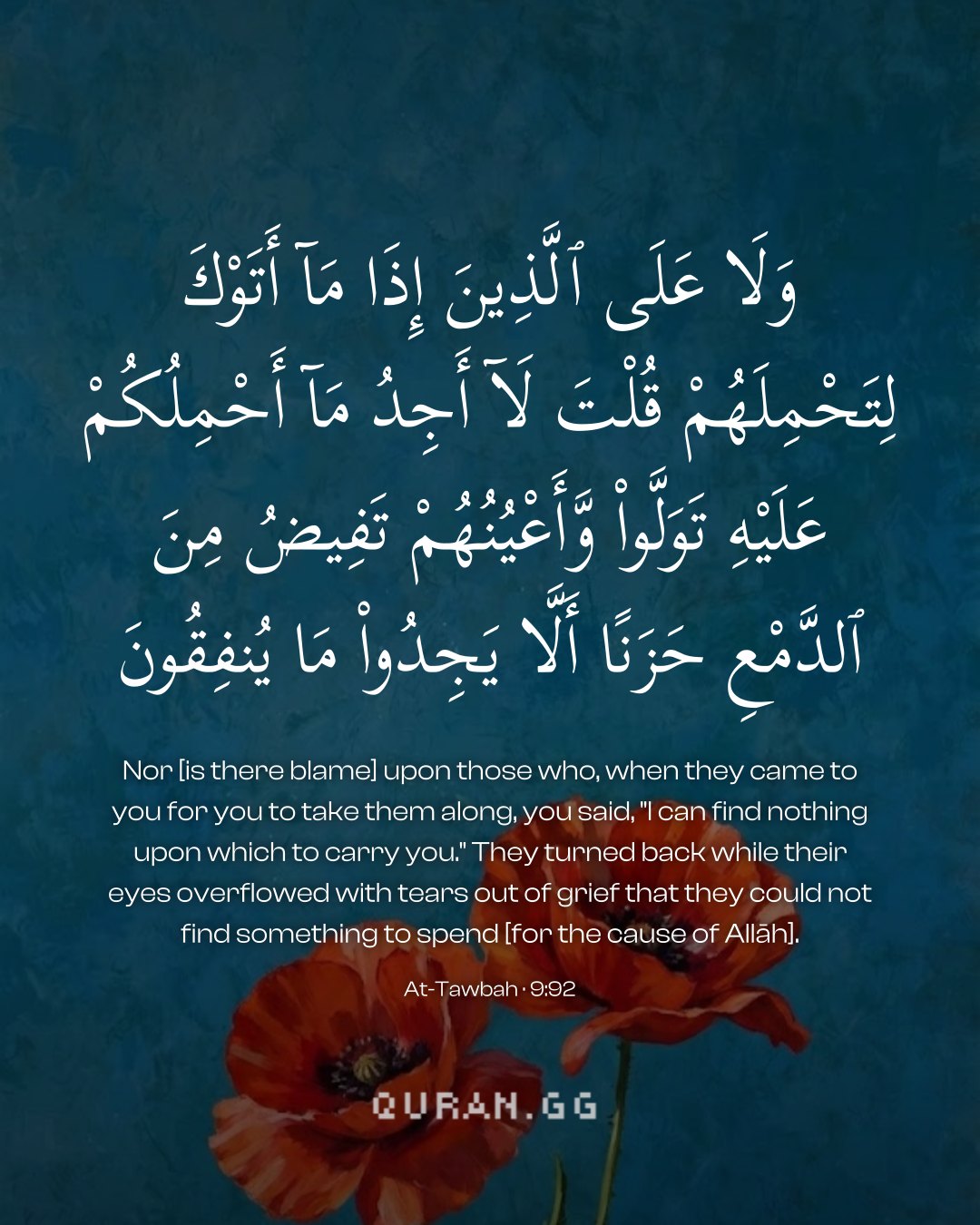
Nor [is there blame] upon those who, when they came to you for you to take them along, you said, "I can find nothing upon which to carry you." They turned back while their eyes overflowed with tears out of grief that they could not find something to spend [for the cause of Allāh].
Allah mentions here the valid excuses that permit one to stay away from fighting. He first mentions the excuses that remain with a person, the weakness in the body that disallows one from Jihad, such as blindness, limping, and so forth. He then mentions the excuses that are not permanent, such as an illness that would prevent one from fighting in the cause of Allah, or poverty that prevents preparing for Jihad. There is no sin in these cases if they remain behind, providing that when they remain behind, they do not spread malice or try to discourage Muslims from fighting, but all the while observing good behavior in this state, just as Allah said,
Previous verses mentioned people who were not really excusable from participation in Jihad but sat it out because of laziness. Then, there were hypocrites who had taken permission from the Holy Prophet ﷺ under false pretexts because of their disbelief and hypocrisy. And then there were the arrogant ones who did not bother about excuses and permissions and just sat back. They were told there that they were not excusable and that there was a painful punishment waiting for those of them who practiced disbelief and hypocrisy.
The present verses mention sincere Muslims who were deprived of participation in Jihad because they were genuinely incapable of doing so. Some of them were blind, or sick, or handicapped. Their excuse was all too evident. Then, there were some of those who were ready to take part in Jihad, in fact, were ` dying' to go into the Jihad, but they could not make the trip because they did not have an animal to ride on. The journey was long and the weather was very hot. They told the Holy Prophet ﷺ how eager they were to participate in the Jihad but how unfortunate that they had nothing to ride on. They requested him to see if they could have some mounts.
When the struggle to obey the call of religion demands that people forfeit their lives and property, and if at that time they lag behind in spite of having the ability to make such a sacrifice, this is the worst type of crime. This proves people’s insensitivity to the call of religion. Such behaviour on the part of a Muslim amounts to his being a traitor to God and His Prophet. Such people do not deserve any share in God’s graces. If they were unwilling to spare anything from whatever they had for the sake of God, then how do they expect that God will give them whatever He has? Nobody can receive anything unless he or she pays the price for it. However, God forgives handicapped persons and invalids. One who is ill, who has nothing to contribute to the mission or who does not possess the resources required for the journey will be forgiven by God. Moreover, it is quite possible that in spite of not doing anything, they may be given credit for everything, as has been recorded in a tradition (hadith) of the Prophet Muhammad: while returning from the battle of Tabuk, he said to his companions, ‘There are certain people in Madinah, about whom you may say that they have not trodden any path or that they have not traversed any valley but who were nevertheless shoulder to shoulder alongwith you.’
Uthmani text of the Madinah mushaf (King Fahd Complex). Translation: Saheeh International. Tafsir via Quran.com.