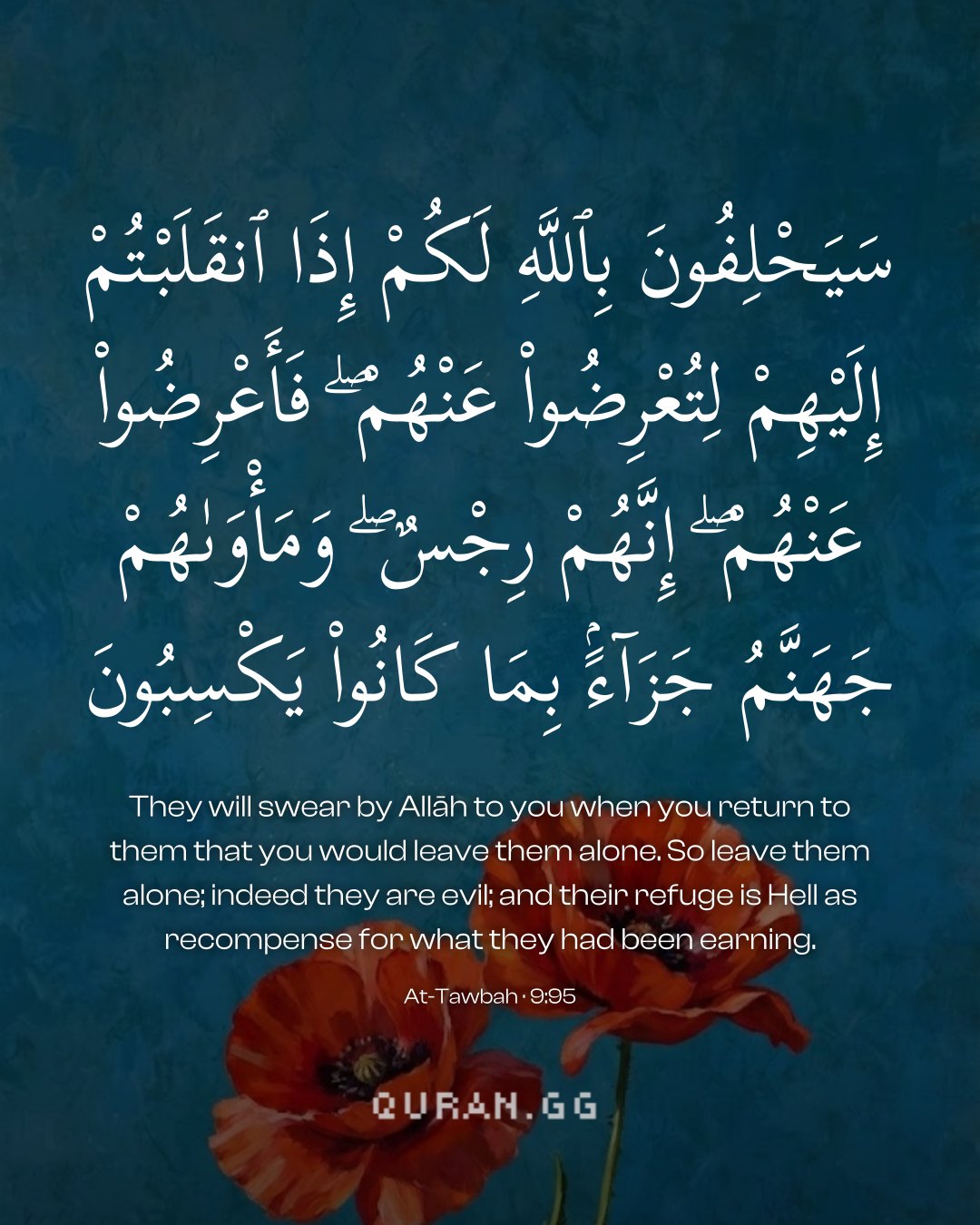
They will swear by Allāh to you when you return to them that you would leave them alone. So leave them alone; indeed they are evil; and their refuge is Hell as recompense for what they had been earning.
2. The second instruction to the Holy Prophet ﷺ appears in the second verse (95) where it has been said that these people will come to him after his return to Madinah, impress him with their feigned oaths and try to satisfy him. What they would wish to achieve from this initiative is: لِتُعْرِضُوا عَنْهُمْ (so that you may ignore their misdeed), that is, ignore their absence from Jihad and spare the reproach due on it.' Thereupon, it was said that he might as well grant their wish. The text says: فَأَعْرِضُوا عَنْهُمْ :` you ignore them.' Thus, the instruction carries the sense: ` neither reproach and admonish, nor deal with pleasantly' - because, reproach usually brings no good. When they have no faith in their heart - and they do not want to have it either - what would come out of reproach? So, why waste good time!
Tazkirul Quran
Maulana Wahiduddin KhanOn ayahs 94–95
Now, who are those fortunate people whose inaction is regarded as action and who are therefore rewarded for it? They are those who, while not physically participating because of some incapacity, give proof of three things—heartfelt solidarity with the participants (nush); doing at least by word of mouth whatever is possible for them to do (ihsan); and, sorrowfulness about their shortcomings that is so intense that it gushes out in the form of tears (huzn). If an individual relegates something to an unimportant category in his life and does so again and again, it can happen that the very consciousness of its importance vanishes from his heart. The demands of that task keep coming before him, but there being no urge left in his heart to accomplish it, he fails to come to grips with it. This growing insensitivity is termed in the Quran ‘the sealing of hearts’. ‘God has already informed us about you.’ This statement makes it clear that the hypocrites referred to here are those present at the time of revelation of the Quran, that is, the Prophet’s contemporaries. According to Tabaqat ibn Sa‘d, there were eighty individuals about whose hypocritical character God had informed the Prophet through His revelation. However, in spite of this knowledge, the behaviour which the companions of the Prophet were allowed to adopt towards them was to overlook and ignore them. The issue of meting out punishment to them was kept by God in His own Hands. However, the only severity shown to the hypocrites of Madinah was that the excuses they offered were not accepted. So much so that when Tha‘laba ibn Hatib Ansari, a hyprocite, offered zakat, it was not accepted from him. ‘Abdullah ibn Ubayy’s son wanted to take drastic action against his father for his hypocritical actions, but the Prophet restrained him, saying, ‘Leave him. By God, as long as he is amongst us, we will treat him properly.’ (Tabaqat ibn Sa‘d).