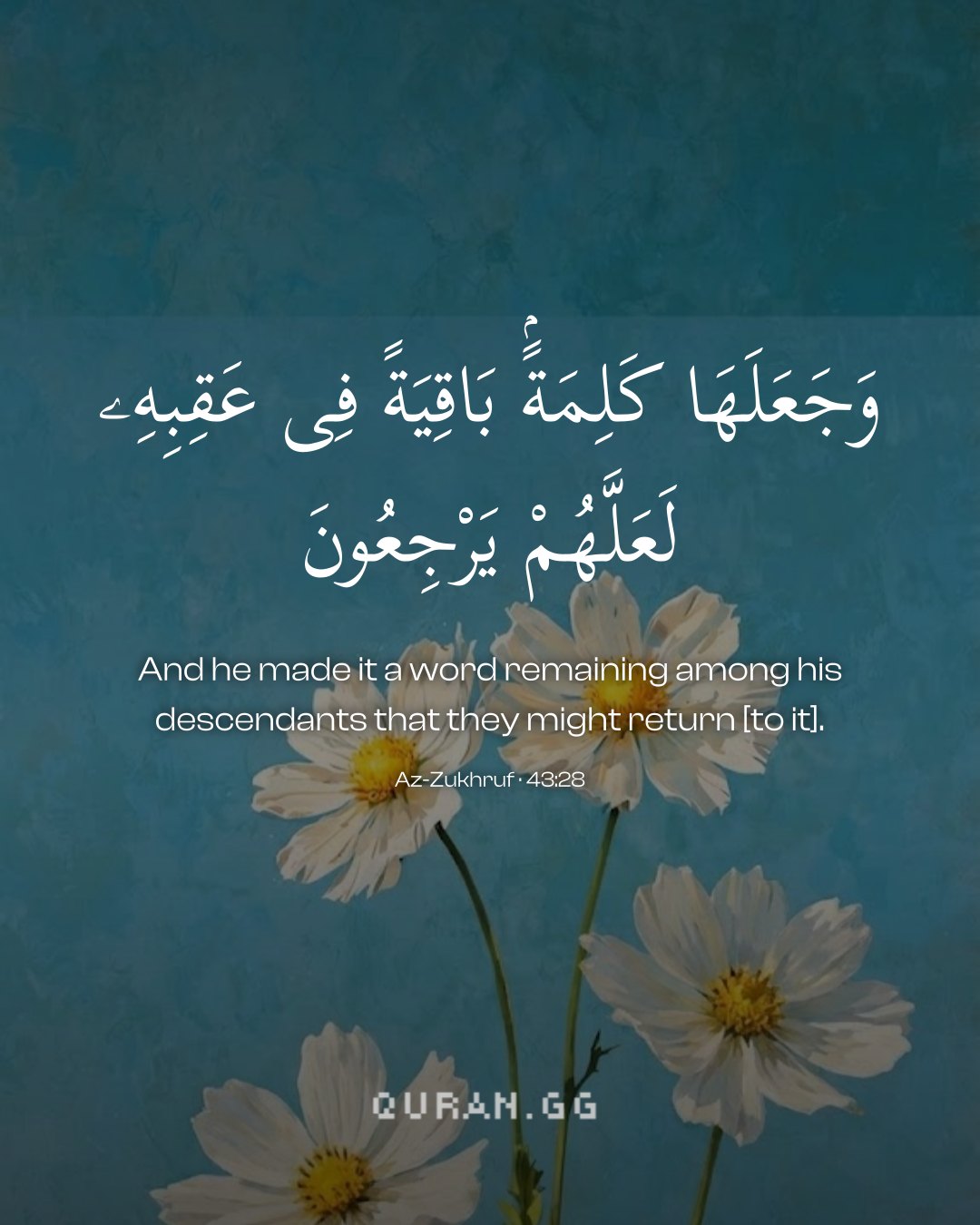
Allah tells us about His servant, Messenger and close Friend, the leader of the monotheists and the father of all subsequent Prophets, from whom Quraysh were descended and claimed to have taken their religion. He disowned his father's and his people's worship of idols and said:
("Verily, I am innocent of what you worship, except Him Who created me; and verily, He will guide me." And he made it a Word lasting among his offspring,) The Word means the worship of Allah Alone with no partner or associate, and the denunciation of all gods apart from Him, i.e., La ilaha illallah. He left this word as an example to be followed by those of his progeny who were guided by Allah.
وَجَعَلَهَا كَلِمَةً بَاقِيَةً فِي عَقِبِهِ (And he made it a word lasting among his posterity.) It means that Ibrahim t did not keep the belief in 'tauhid' restricted to himself, rather he emphasized upon his posterity also to remain firm on this faith, as a result of which a large number of his posterity adhered to tauhid. In Makkah and its surroundings, there were many blessed souls, even till the advent of the Holy Prophet ﷺ ، who had remained steadfast in the original 'din' of Sayyidna Ibrahim (علیہ السلام) .
We learn from this verse that it is one of the obligatory duties of a Muslim to try his best to put his or her children on the path of the correct religion and to make them practice it throughout their lives. The Holy Qur'an tells us that Sayyidna Yaqub (علیہ السلام) also had directed his sons, shortly before his death, to remain firm on the correct faith. As such, it is necessary, as a consistent practice of the prophets, to employ one's best possible efforts to reform the morals and deeds of his or her children. So to say, there are many ways to reform one's offspring which should be used according to the situation, but Shaikh Abdul Wahhab Sha` rani (رح) has said in his book Lata'if-ul-Minan wal-Akhlaq that the most effective way for the betterment of one's offspring in matters pertaining to 'din' is that the parents should pray to Allah regularly to make them true practicing Muslims . Alas! The negligence of parents from this easy way is becoming very common these days, and the parents themselves are witnessing the ill effects of this negligence.
Tazkirul Quran
Maulana Wahiduddin KhanOn ayahs 25–29
A man may do whatever he wants in this world, because he has ample opportunities to do so. For this reason, people harbour the misunderstanding that whatever they do must be right. They argue that, had they been wrong, they would not have achieved success by adopting the course that they did. Arguments of this kind are generally advanced by those who belong to the well-to-do class. But this is a serious misunderstanding. In this world, indulgence in any kind of behaviour may make headway because of the freedom given to human beings during their period of trial. But in the world of the Hereafter, the testing period will be over and, therefore, this opportunity will no longer exist for anybody there. In every age, the religion of the prophets was opposed and most of all by ancestral religion. Ancestors assume the status of the ‘great’ ones in the estimation of nations. As compared to them, the prophet of their own days appears lowly in stature. It therefore becomes impossible for them to renounce the religion of their great men in favour of that of a lesser mortal. But it is on account of their denial of these ‘small’ men that these nations have had to face horrendous punishments.
Uthmani text of the Madinah mushaf (King Fahd Complex). Translation: Saheeh International. Tafsir via Quran.com.