Tafsir Ibn Kathir (abridged)
Fir`awn's Address to His People and how Allah punished Him
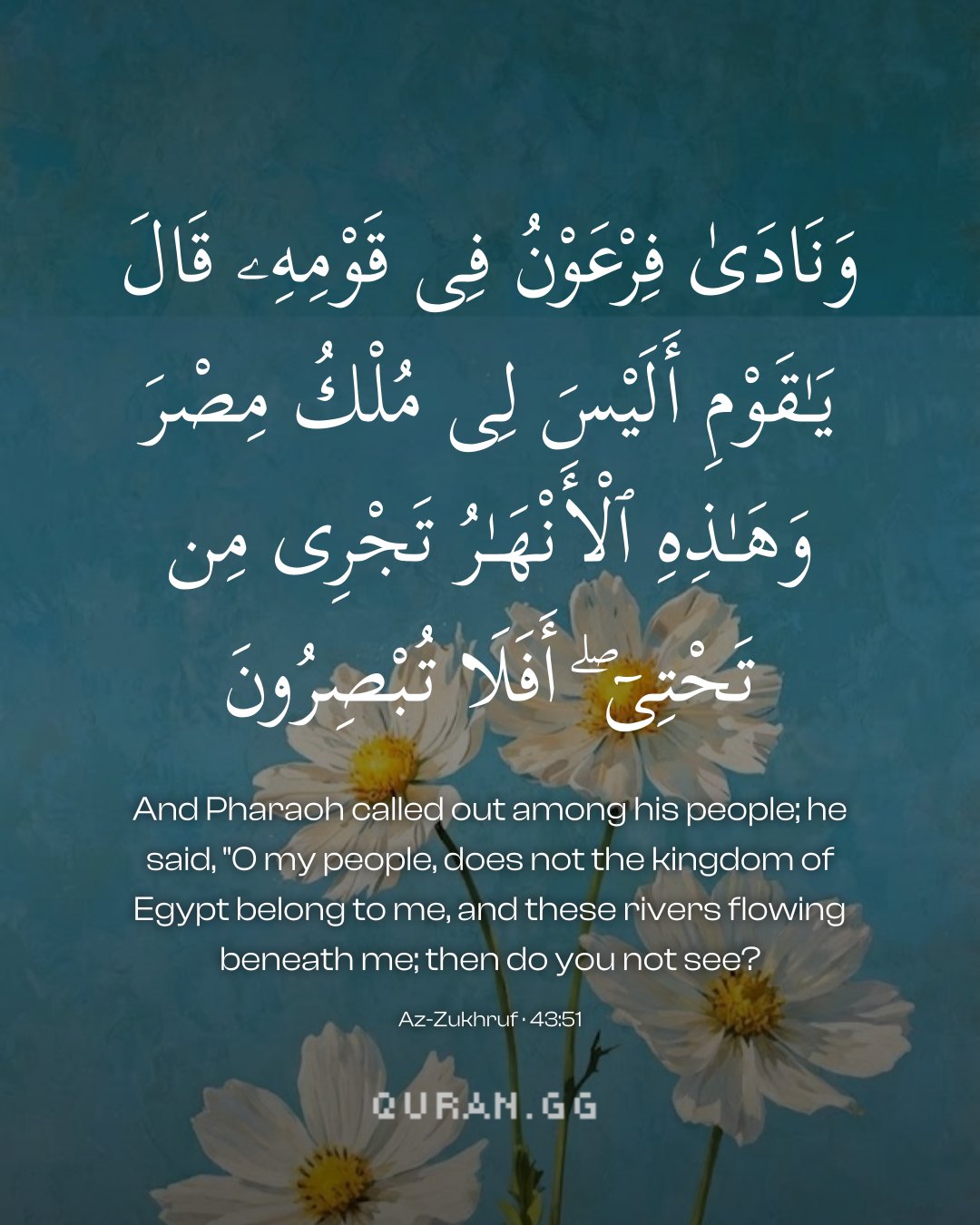
Allah tells us how Fir`awn stubbornly persisted in his rebellion and disbelief. He assembled his people and addressed them in a vainglorious fashion, boasting of his dominion over Egypt.
أَلَيْسَ لِى مُلْكُ مِصْرَ وَهَـذِهِ الاٌّنْهَـرُ تَجْرِى مِن تَحْتِى
(Is not mine the dominion of Egypt, and these rivers flowing underneath me) Qatadah said, "They had gardens and rivers of flowing water."
أَفلاَ تُبْصِرُونَ
(See you not then) means, `do you not see my position of might and power' -- implying that Musa and his followers were poor and weak. This is like the Ayah:
فَحَشَرَ فَنَادَى - فَقَالَ أَنَاْ رَبُّكُمُ الاٌّعْلَى - فَأَخَذَهُ اللَّهُ نَكَالَ الاٌّخِرَةِ وَالاٍّوْلَى
(Then he gathered (his people) and cried aloud, saying: "I am your lord, most high." So Allah seized him with punishment for his last and first transgression.) (79:23-25)
أَمْ أَنَآ خَيْرٌ مِّنْ هَـذَا الَّذِى هُوَ مَهِينٌ
(Am I not better than this one who is despicable) As-Suddi said, "He was saying, `indeed I am better than this one, who is despicable'." Some of the grammarians of Basrah said that Fir`awn -- may the curse of Allah be upon him -- was saying that he was better than Musa, peace be upon him. But this is an obvious lie, may continued curses be upon him until the Day of Resurrection. By describing Musa as despicable he meant -- as Sufyan said -- insignificant. Qatadah and As-Suddi said, "He meant, weak." Ibn Jarir said, "He meant, he had no power, authority or wealth."
وَلاَ يَكَادُ يُبِينُ
(and can scarcely express himself clearly) means, he cannot speak clearly, he stammers and cannot speak well. Fir`awn's description of Musa as "despicable" is a lie; rather it is he who was despicable and insignificant, lacking in physical, moral and religious terms, and it is Musa who was noble, truthful, righteous and upright.
وَلاَ يَكَادُ يُبِينُ
(and can scarcely express himself clearly). This was also a lie. Although something happened to Musa's tongue when he was a child, when it was burnt by a coal. He asked Allah to loosen the knot from his tongue (i.e., to correct his speech defect) so that they could understand what he said, and Allah had answered his prayer and said:
قَدْ أُوتِيتَ سُؤْلَكَ يمُوسَى
(You are granted your request, O Musa) (20:36). It may be the case that some problem remained which he had not asked to be relieved of, as Al-Hasan Al-Basri suggested, and that he had asked only to be relieved of that which stood in the way of his conveying the Message. A person cannot be blamed for physical matters over which he has no control. Even though Fir`awn had the intelligence to understand that, he wanted to confuse and mislead his people, who were ignorant and stupid. So he said:
فَلَوْلاَ أُلْقِىَ عَلَيْهِ أَسْوِرَةٌ مِّن ذَهَبٍ
(Why then are not golden bracelets bestowed on him...) meaning, adornments which are placed on the arms. This was the view of Ibn `Abbas, may Allah be pleased with him, Qatadah and others.
أَوْ جَآءَ مَعَهُ الْمَلَـئِكَةُ مُقْتَرِنِينَ
(or angels sent along with him) meaning, to serve him and to testify that he is telling the truth. He looked only at outward appearances and did not understand the true inner matters that are clearer than what he focused on, if only he had understood that. Allah says:
فَاسْتَخَفَّ قَوْمَهُ فَأَطَاعُوهُ
(Thus he fooled his people, and they obeyed him.) meaning, he confused them and invited them to misguidance, and they responded to him.
إِنَّهُمْ كَانُواْ قَوْماً فَـسِقِينَ
(Verily, they were ever a people who were rebellious.) Then Allah says:
فَلَمَّآ ءَاسَفُونَا انتَقَمْنَا مِنْهُمْ فَأَغْرَقْنَـهُمْ أَجْمَعِينَ
(So when they angered Us, We punished them, and drowned them all.) `Ali bin Abi Talhah reported that Ibn `Abbas, may Allah be pleased with him, said it means: "When they angered Us means, they provoked Our wrath." Ad-Dahhak said, it means "They made Us angry." This was also the view of Ibn `Abbas, Mujahid, `Ikrimah, Sa`id bin Jubayr, Muhammad bin Ka`b Al-Qurazi, Qatadah, As-Suddi and other scholars of Tafsir. Ibn Abi Hatim recorded that `Uqbah bin `Amir, may Allah be pleased with him, said that the Messenger of Allah ﷺ said:
«إِذَا رَأَيْتَ اللهَ تَبَارَكَ وَتَعَالَى يُعْطِي الْعَبْدَ مَا يَشَاءُ، وَهُوَ مُقِيمٌ عَلى مَعَاصِيهِ، فَإِنَّمَا ذَلِكَ اسْتِدْرَاجٌ مِنْهُ لَه»
(When you see that Allah gives a person what he wants even though he is persisting in sin, that means that Allah is enticing him into destruction.) Then he recited:
فَلَمَّآ ءَاسَفُونَا انتَقَمْنَا مِنْهُمْ فَأَغْرَقْنَـهُمْ أَجْمَعِينَ
(So when they angered Us, We punished them, and drowned them all.) It was reported that Tariq bin Shihab said, "I was with `Abdullah, may Allah be pleased with him, and the issue of sudden death was mentioned. He said, `It is a relief for the believer and a source of regret for the disbeliever.' Then he recited the Ayah:
فَلَمَّآ ءَاسَفُونَا انتَقَمْنَا مِنْهُمْ فَأَغْرَقْنَـهُمْ أَجْمَعِينَ
(So when they angered Us, We punished them, and drowned them all). " `Umar bin `Abdul-`Aziz, may Allah be pleased with him, said, "I found that punishment comes with negligence, meaning the Ayah:
فَلَمَّآ ءَاسَفُونَا انتَقَمْنَا مِنْهُمْ فَأَغْرَقْنَـهُمْ أَجْمَعِينَ
(So when they angered Us, We punished them, and drowned them all)."
فَجَعَلْنَـهُمْ سَلَفاً وَمَثَلاً لِّلاٌّخِرِينَ
(And We made them a precedent, and an example to later generations.) Abu Mijlaz said, "Precedent for others who do the same as they did." He and Mujahid said, "An example, i.e., a lesson to those who come after them." Allah is the One Who guides to the straight path, and unto Him is the final return.