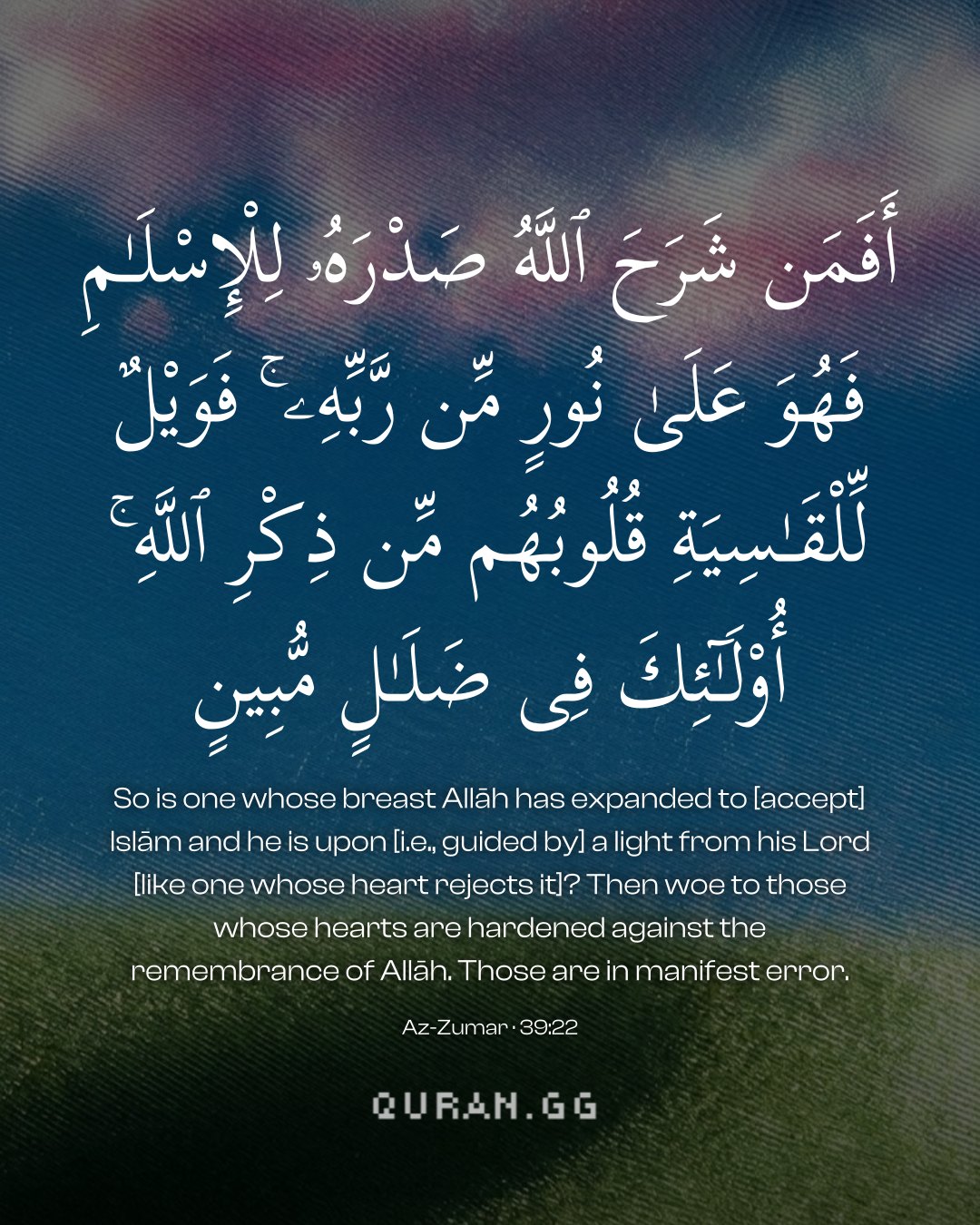
So is one whose breast Allāh has expanded to [accept] Islām and he is upon [i.e., guided by] a light from his Lord [like one whose heart rejects it]? Then woe to those whose hearts are hardened against the remembrance of Allāh. Those are in manifest error.
Allah tells us that water originates in the sky. This is like the Ayah:
وَأَنزَلْنَا مِنَ السَّمَآءِ مَآءً طَهُوراً
(and We send down pure water from the sky) (25:48). So, Allah sends down water from the sky, and it settles in the earth, then He causes it to flow wherever He wills, and He causes springs, great and small, to flow as needed. Allah says:
فَسَلَكَهُ يَنَابِيعَ فِى الاٌّرْضِ
(and causes it to penetrate the earth, as water springs,) Sa`id bin Jubayr and `Amir Ash-Sha`bi said that all the water on earth has its origins in the sky. Sa`id bin Jubayr said, its origins lie in the snow, meaning that snow piles up in the mountains, then settles at the bottom (of the mountains) and springs flow from the bottom of them.
In the first sentence of verse 22, it was said: أَفَمَن شَرَحَ اللَّـهُ صَدْرَهُ لِلْإِسْلَامِ فَهُوَ عَلَىٰ نُورٍ مِّن رَّبِّهِ (So I ask about a person whose heart Allah has opened up for Islam, and consequently he proceeds in a light from his Lord.). The word: شَرَحَ (sharh) literally means to open, enlarge or extend. The expression: شرح الصدر (sharh-us-sadr) means the capacity or capability of the heart (to receive and accommodate input). The sense is that one's heart is capable of learning lessons and receiving benefits by deliberating into Divine signs of creation in the heavens and the earth, particularly so by deliberating in his own creation. Similar is the case with other signs of Allah revealed in the form of scriptures and injunctions. One's heart also has to have the ability to deliberate in them and be benefited by them. In contrast, there is a heart that is straightened or hardened. The statement in a verse of the Qur'an: يَجْعَلْ صَدْرَهُ ضَيِّقًا حَرَجًا He makes his heart narrow, much too narrow - Al-An am, 6:125) and the one in the next verse at this place: لِّلْقَاسِيَةِ قُلُوبُهُم "woe to those whose hearts are too hard to remember Allah - 39:22" has appeared in contrast to this very 'sharh-us-sadr' (a heart opened to acceptance of truth and at ease with it).
According to a narration from Sayyidna ` Abdullah Ibn Masud ؓ ، when the Holy Prophet ﷺ recited this verse: أَفَمَن شَرَحَ اللَّـهُ صَدْرَهُ (Is it not that, a person for whom Allah opens up his heart...), we asked him about the meaning of 'sharh-us-sadr'. He said, "when the light of 'iman (faith) enters the human heart, it enhances its capacity (which makes the comprehension and implementation of Divine commandments easy on the person concerned)." We submitted, 'ya rasulallah, what is the sign of it (that is, of 'sharh-us-sadr' )?' Then, he said:
الانابۃ الی دار الخلود والتجافی عن دارالغرور و اتأھب لموت قبل نزولہ ۔ رواہ الحاکم رفی المستدرک ولبیھقی فی شعب الایمان ۔ (روح المعانی)
"Longing passionately for the eternal home, and seeking refuge from the deceptive abode, and preparing for death before its arrival." - Reported by al-Hakim in al-Mustadrak and al-Baihaqi in Shu` ab-u1-'iman (Ruh-ul-Ma’ ani).
The verse under study has been initiated as headed by an interrogative particle: اَفمَن (afaman). The sense it carries can be explained by saying: 'Can a person whose heart has been opened up for Islam - and he is on the light coming from his Lord, that is, does everything under it - and another person with a hardened heart be equal?' The contrasting part relating to the hardened heart has been mentioned in the next verse with a warning of woeful punishment attached to it.
In this verse (22), it was said: فَوَيْلٌ لِّلْقَاسِيَةِ قُلُوبُهُم (woe to those whose hearts are too hard to remember Allah). The word: الْقَاسِيَةِ (al-qasiyah) is a derivation from: قَسَاوَت (qasawah) which means to be hard-hearted, having no mercy for anyone, and also the one who remains totally unaffected by the need to remember Allah and follow His injunctions.
Tazkirul Quran
Maulana Wahiduddin Khan
The wonderful system of rains on the earth, the resulting growth of greenery and the subsequent preparations for harvesting, have countless meaningful lessons in them. But, these lessons are available only to those who devote themselves to deep thought. On the one hand, God has created the external world in a way that everything in it has become a sign of great realities, and, on the other, He has endowed man with the ability to read these signs and understand them. Those who keep their natural capabilities alive and, by utilising them, give deep consideration to the things of the world, will have their minds filled with the deep realisation (ma‘rifah) of God. Whereas those who do not keep these capabilities alive, will be unable to learn anything, even though surrounded by countless lessons. They will not be able to see, even after seeing, and will not be able to hear, even after hearing.
Uthmani text of the Madinah mushaf (King Fahd Complex). Translation: Saheeh International. Tafsir via Quran.com.