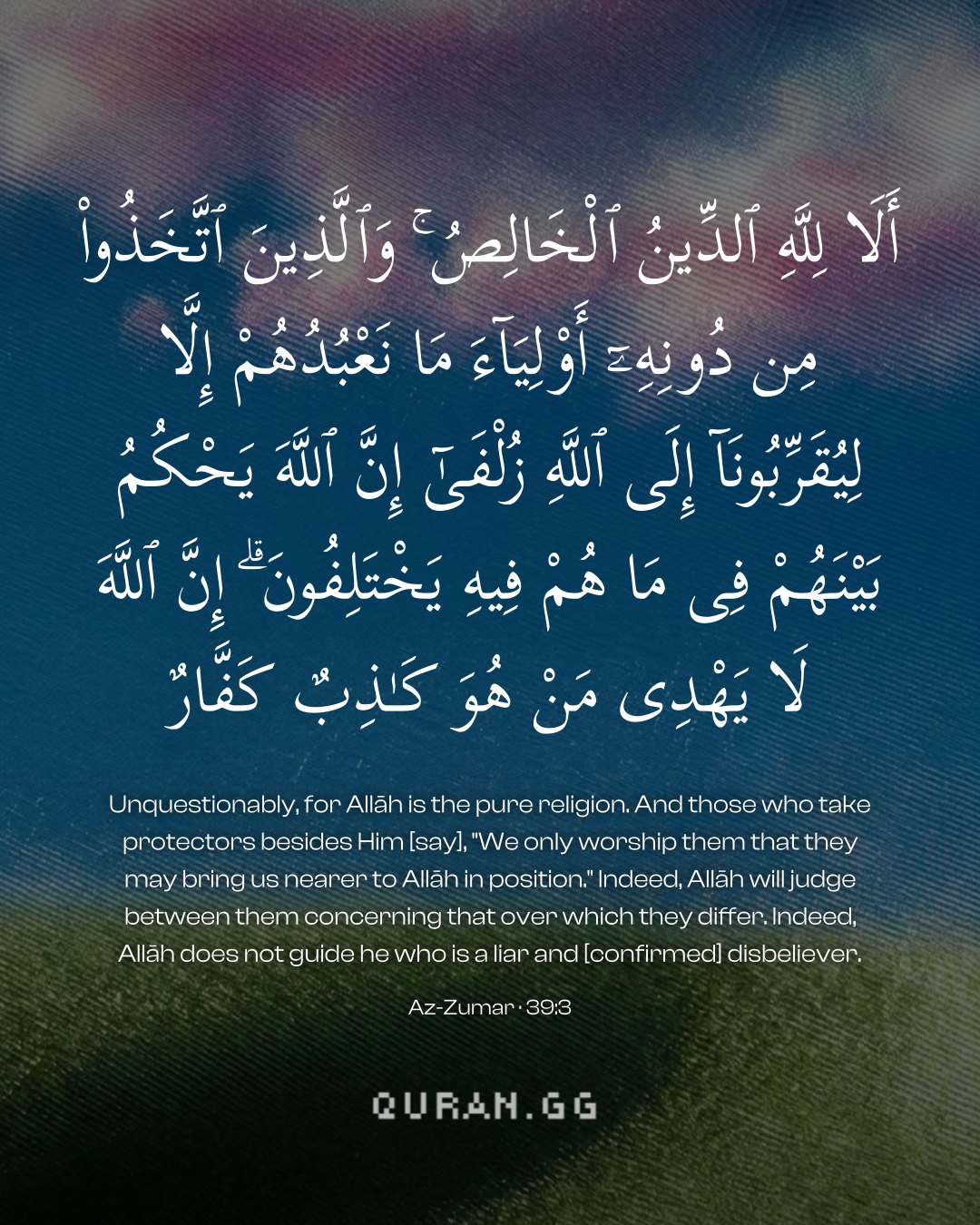
Unquestionably, for Allāh is the pure religion. And those who take protectors besides Him [say], "We only worship them that they may bring us nearer to Allāh in position." Indeed, Allāh will judge between them concerning that over which they differ. Indeed, Allāh does not guide he who is a liar and [confirmed] disbeliever.
An-Nasa'i recorded that `A'ishah, may Allah be pleased with her, said, "The Messenger of Allah ﷺ used to fast until we would say, `He does not want to break fast,' and he would not fast until we would say, `He does not want to fast.' And he used to recite Bani Isra'il Al-Isra' and Az-Zumar every night."
بِسْمِ اللَّهِ الرَّحْمَـنِ الرَّحِيمِ
In the Name of Allah, the Most Gracious, the Most Merciful.
The Order for Tawhid and the Refutation of Shirk
Allah tells us that the revelation of this Book, which is the magnificent Qur'an, is from Him, and is truth in which there is no doubt whatsoever. This is like the Ayat:
The next sentence in verse 3 says: وَالَّذِينَ اتَّخَذُوا مِن دُونِهِ أَوْلِيَاءَ مَا نَعْبُدُهُمْ إِلَّا لِيُقَرِّبُونَا (As for those who have taken to guardians other than Him [ saying ], "We worship them for no other reason than that they would bring us near to Allah closely." - 39:3). This is a description of the creed of the Mushriks of Arabia. Even the common people among them during that period of time more or less had the same belief that Allah Ta’ ala is the creator, owner and master in all matters. But when the Shaitan (Shaitan) instigated them, they started making idols in the image of angels, as they imagined they would be. They knew it well that these idols made by them had no consciousness, reason or power, yet they believed that by showing their reverence for these idols, those angels (in whose images these idols are designed) will be pleased with them, and the angels have nearness to Allah. They compared Allah's nearness with that of the worldly kings where a courtier who is pleased with someone could put in a good word for him with the king and have him included among his inner circle. So, they surmised that the angels too could recommend anyone they chose very much like the royal courtiers of their world. But, all these ideas they nursed were totally false, in fact, they were nothing but satanic deception. First of all, who can say whether or not these idols happen to be on the real form of the angels and, even if they were, one cannot expect angels close to Allah showing their pleasure over being worshipped by somebody on the earth. In fact, they temperamentally hate everything that Allah Ta’ ala does not like. In addition to that, angels cannot intercede on behalf of anyone before Allah on their own, unless they are allowed to make their intercession about a particular person. The verse of the Qur'an: وَكَم مِّن مَّلَكٍ فِي السَّمَاوَاتِ لَا تُغْنِي شَفَاعَتُهُمْ شَيْئًا إِلَّا مِن بَعْدِ أَن يَأْذَنَ اللَّـهُ لِمَن يَشَاءُ وَيَرْضَىٰ (And how many angels there are in the heavens whose intercession cannot benefit (anyone) at all, but after Allah allows (it) for whomsoever He wills and pleases - An-Najm, 53:26) means exactly this.
Even the polytheists of that period were better than the disbelievers of today
Modern day materialistic disbelievers already deny the very existence of Allah Ta’ ala and would not demur when making audacious remarks against Him. Kufr or disbelief is now an imported stuff. Take the kufr that is imported from Europe. It may come in different colors and shades, like capitalism and communism. Yet, there is a common denominator. God forbid, they hold, nothing like God exists. We are masters of our destiny. There is no one to question us as to what we are doing. Terrible ingratitude indeed! As a consequence, peace has disappeared from the whole world. Ever-new gadgets of comfort proliferate, but real comfort remains missing. Advancements in health care have never been at a level they are today, but there is a matching abundance of diseases hitherto unheard of. Security arrangements, police, guards, surveillance abound, but the graph of crime keeps rising. This craze for new instrumentation and gadgetry and this relentless pursuit of pleasure and comfort through state-of-the-art objects one is being pushed to live with are things, if someone cares to think about it, that have assumed the proportions of a curse for innocent human beings so fondly created by their Maker. As for the punishment of kufr in the Hereafter, it is, as due for all disbelievers, an everlasting stay in the Jahannam. But, one should not forget that this blind ingratitude could not go unaccounted for. The ungrateful person has to undergo some punishment for it within this world for the reason that the ungrateful person used the blessings of Allah even to ride the skies, yet failed to thank Him for it. How apt is the Persian quip: 'In the middle of the house, I forgot the master of the house!'
Tazkirul Quran
Maulana Wahiduddin KhanOn ayahs 3–4
The Quran is a divine statement of facts. Its sagacious style of expression and the exceptional nature of its discourses allude to it being the Book of God. No man is capable of presenting such a sublime work. ‘So worship God with your total devotion,’ means to worship only God, praying to Him, revering Him and devoting oneself entirely to Him. (Safwat at-Tafasir, vol. III, p. 69 ). The instinct for worship and devotion is inherent in human nature, so he must consider a being as great and have feelings of awe for that being. Anyone for whom a man develops such feelings is considered most holy by him and man’s entire existence submits before him. He expresses superlative respect and veneration for him and, his soul derives pleasure from remembering him. That being becomes the greatest support in man’s life. This is true devotion and such worship is the exclusive, rightful due of the one and only God. But what man does is that while accepting the one God, he accords divinity to beings other than God and starts worshipping them. This is the real error into which man falls because just as the godhead or divinity is indivisible, worship cannot be divided either.
Uthmani text of the Madinah mushaf (King Fahd Complex). Translation: Saheeh International. Tafsir via Quran.com.