(Is not Allah Sufficient for His servant) Some of them read it "His servants." It means that Allah is Sufficient for the one who worships Him and relies upon Him.
وَيُخَوِّفُونَكَ بِالَّذِينَ مِن دُونِهِ
(Yet they try to frighten you with those besides Him!) means, the idolators tried to scare the Messenger of Allah ﷺ with their idols and gods which they called upon besides Allah out of ignorance and misguidance. Allah says:
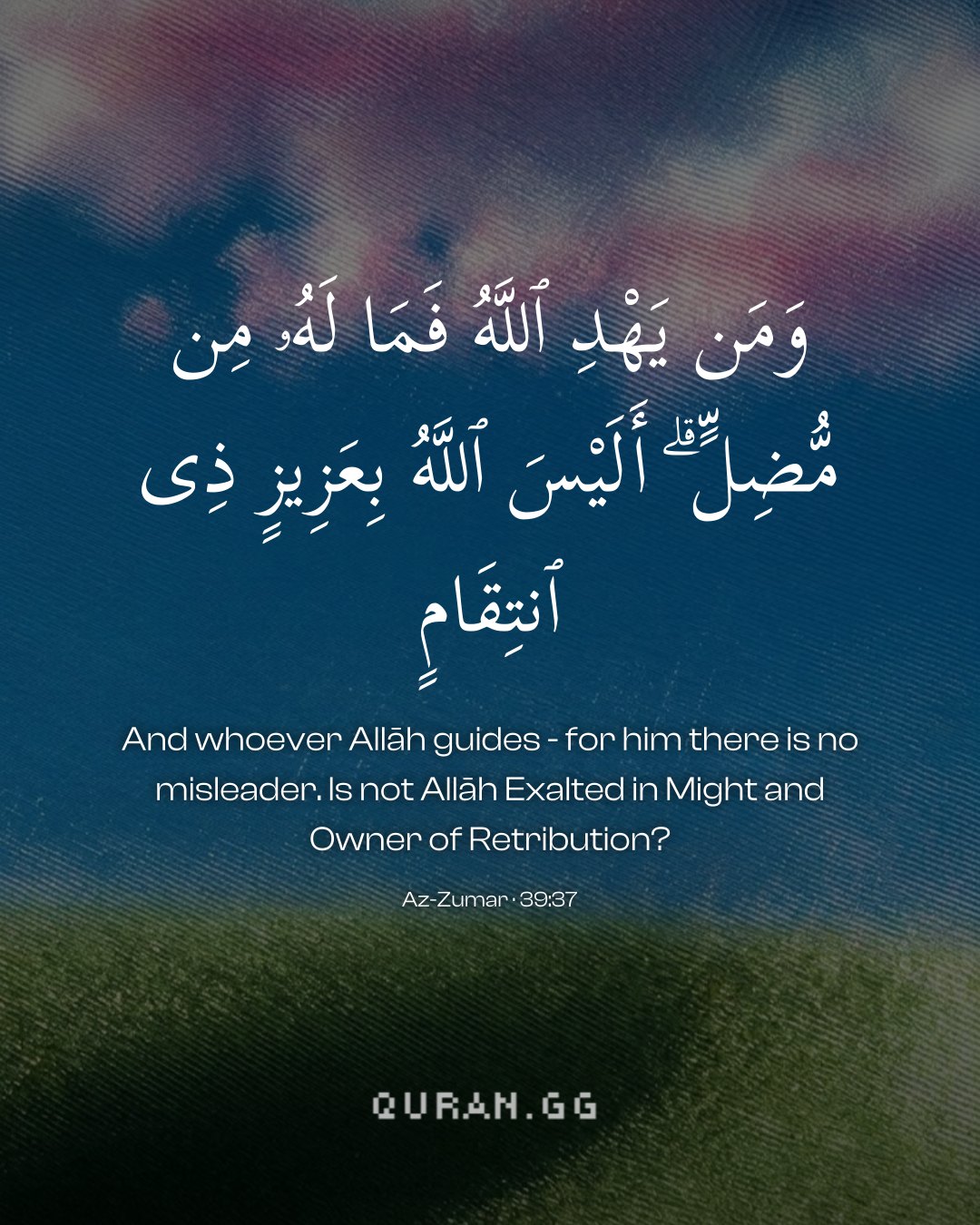
(And whom Allah sends astray, for him there will be no guide. And whomsoever Allah guides, for him there will be no misleader. Is not Allah Almighty, Possessor of Retribution) meaning, whoever relies on Him and turns to Him, will never be forsaken, for He is the Almighty Who cannot be overwhelmed by another, and there is none more severe than Him in exacting retribution on those who disbelieve in Him, associate others in worship with Him and resist His Messenger .
In the first verse (36), it was said: أَلَيْسَ اللَّـهُ بِكَافٍ عَبْدَهُ (Is Allah not sufficient for (the protection of) His slave?). This verse was revealed in the background of an event. The disbelievers had threatened the Holy Prophet ﷺ and his noble Sahabah by saying that, should they act irreverently against their idols, they would never escape the curse of these idols, something very lethal to face. In reply, they were told: Is Allah not sufficient for His slave?
Therefore, some commentators have taken: عَبْدَه (abdahu: His slave) here to mean a particular slave of Allah, that is, the Holy Prophet ﷺ . Maulana Ashraf ` Ali Thanavi (رح) ، a summary of whose Tafsir appears in the original edition of Ma’ ariful-Qur'an, has also opted for this very Tafsir. Then there are other commentators who have taken abd or slave in its general sense. Another qira'ah (rendition) of this verse as: عِبَادہ (` ibadihi: His slaves) supports this position. And as for the subject itself, it is, after all, general in the sense that Allah Ta’ ala is sufficient for everyone among His slaves.
The Prophet Muhammad preached the Unity of God. But he did not stop at only the positive declaration of ‘God is one’. At the same time he used to negate those non-godly beings whom the people themselves had given the status of deities. This second part of his mission had become unbearable to the people. Those non-godly beings were, in fact, their national heroes. For centuries exaggerated tales of their miraculous deeds had held the people in thrall. The greatness of these beings had captured people’s minds to such an extent that when the Prophet Muhammad contradicted the idea of their holiness, they could not understand how they could be other than holy. They asked the Prophet Muhammad to desist from speaking against their gods, otherwise they warned that he would be destroyed. The preacher of Truth was ordered not to pay heed to remarks of this kind, and to continue to perform the dual task of advocating the Unity of God and rejection of polytheism—all this while relying up on God and praying for the Truth to become clear and manifest.
Uthmani text of the Madinah mushaf (King Fahd Complex). Translation: Saheeh International. Tafsir via Quran.com.