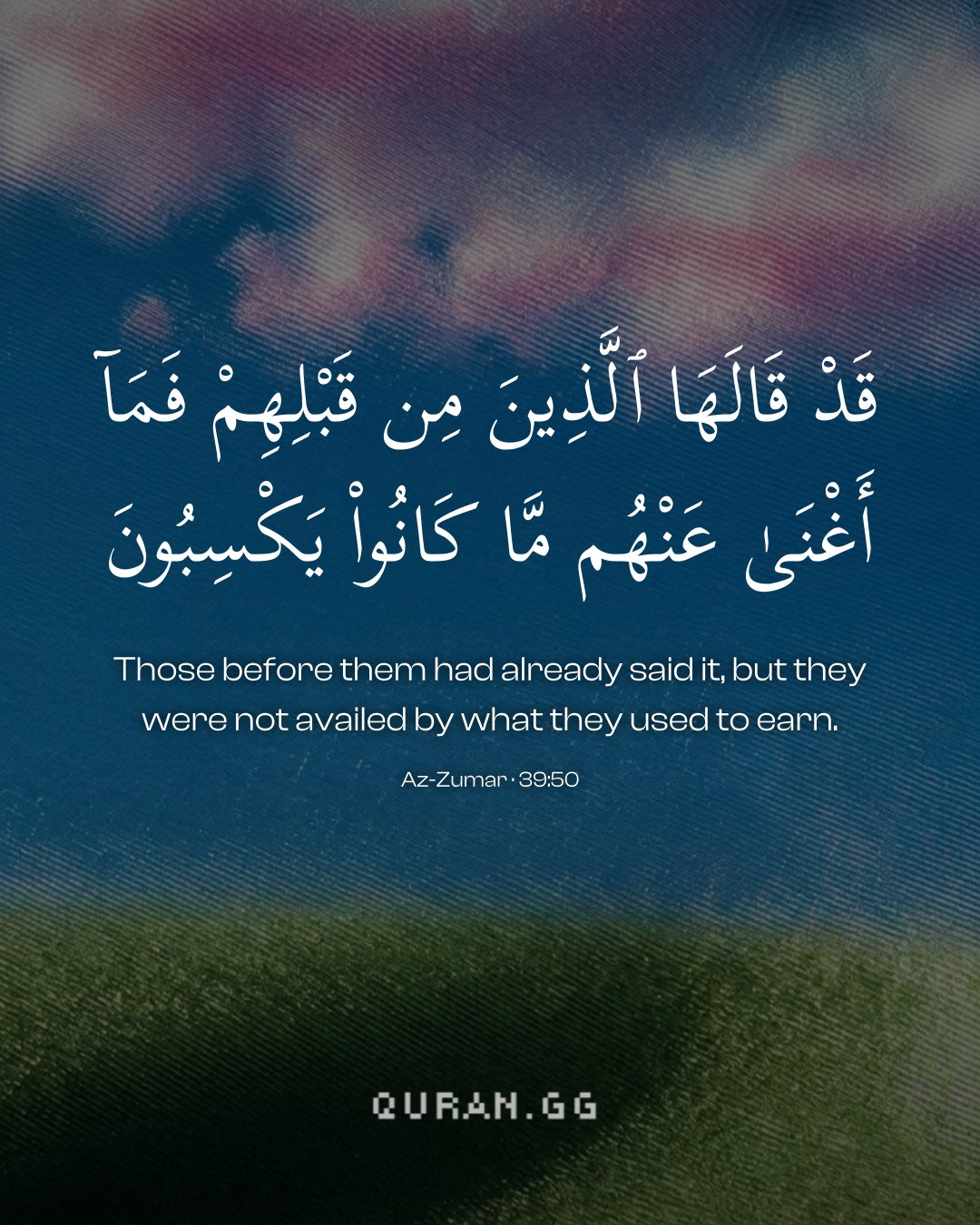
How Man changes when He is blessed after suffering Harm
Allah tells us how man, when he is suffering from harm, prays to Allah, turning to Him in repentance and calling upon Him, but when He makes things easy for him, he transgresses and commits sins.
إِنَّمَآ أُوتِيتُهُ عَلَى عِلْمٍ
(Only because of knowledge I obtained it.) means, `because Allah knows that I deserve it; if it were not for the fact that Allah regards me as special, He would not have given me this.' Qatadah said, "Because I know that I deserve it." Allah says:
بَلْ هِىَ فِتْنَةٌ
(Nay, it is only a trial,) meaning, `the matter is not as he claims; on the contrary, We have blessed him with this as a test to see whether he will be obedient or disobedient -- although We have prior knowledge of that.' In fact, it is a trial.
In verse 47, it was said: وَبَدَا لَهُم مِّنَ اللَّـهِ مَا لَمْ يَكُونُوا يَحْتَسِبُونَ (And there will appear to them from Allah what they have never imagined.) The famous tabi` i, Sufyan Thawri recited this verse and said, 'Ruined are those who did good deeds only to pretend their piety before people. (He repeated this sentence twice) This verse is about them. They did good deeds in their mortal life to impress people, who took them to be good people. Even they themselves used to deceive themselves by thinking that these deeds will become a source of salvation for them in the Hereafter. But, as these were never performed with unalloyed sincerity ('ikhlas), they deserve no reward in the sight of Allah. So, once they are in the life after death, the punishment would come upon them suddenly against their expectation.' (Qurtubi)
An important instruction concerning 'mushajarat' (disagreements among Sahabah)
Someone asked Rabi' Ibn-u1_-Khaitham about the shahadah (martyrdom) of Sayyidna Husain ؓ . He sighed and recited the verse (46): قُلِ اللَّـهُمَّ فَاطِرَ السَّمَاوَاتِ وَالْأَرْضِ عَالِمَ الْغَيْبِ وَالشَّهَادَةِ أَنتَ تَحْكُمُ بَيْنَ عِبَادِكَ ( O Allah, Creator of the heavens and the earth, Knower of the unseen and the seen, You will judge between Your servants...) and said, 'whenever you have a doubt in your heart about the mutual difference of the noble Sahabah, do recite this verse.' Tafsir Ruh-ul-Ma’ ani reports this statement and then says: This teaches us the best etiquette in regard to this issue, and is something one should always bear in mind.
Tazkirul Quran
Maulana Wahiduddin KhanOn ayahs 48–51
Those believed by polytheists to be potential intermediaries between them and God were not simply stone statues. They were actually the statues of great men who lived among them. These supposed intermediaries were in reality their national heroes to whom they owed allegiance and who, they believed, would be adequate mediators before God. Those who entertain such beliefs about beings other than God, gradually reach the point where their loyalty is dedicated solely to these beings. They are pleased to hear the praises of these beings; the proclamation of the Majesty of the One and only God does not nourish their souls. With such people, howsoever one advocates the cause of the pure Unity of God, they do not accept it. Their eyes will open only when, on the Day of Judgement, the Majesty of God reveals itself. Today, man is not even ready to offer words of acceptance, but at that time (on the Day of Judgment), he will wish to offer whatever he has as compensation in order to save himself. But, on that Day, nothing will be of avail to him except the merit of his own deeds.
Uthmani text of the Madinah mushaf (King Fahd Complex). Translation: Saheeh International. Tafsir via Quran.com.