This Ayah is a call to all sinners, be they disbelievers or others, to repent and turn to Allah. This Ayah tells us that Allah, may He be blessed and exalted, will forgive all the sins of those who repent to Him and turn back to Him, no matter what or how many his sins are, even if they are like the foam of the sea. This cannot be interpreted as meaning that sins will be forgiven without repentance, because Shirk can only be forgiven for the one who repents from it. Al-Bukhari recorded that Ibn `Abbas, may Allah be pleased with him, said that some of the people of Shirk killed many people and committed Zina (illegal sexual acts) to a great extent; they came to Muhammad ﷺ and said, "What you are saying and calling us to is good; if only you could tell us that there is an expiation for what we have done." Then the following Ayat were revealed:
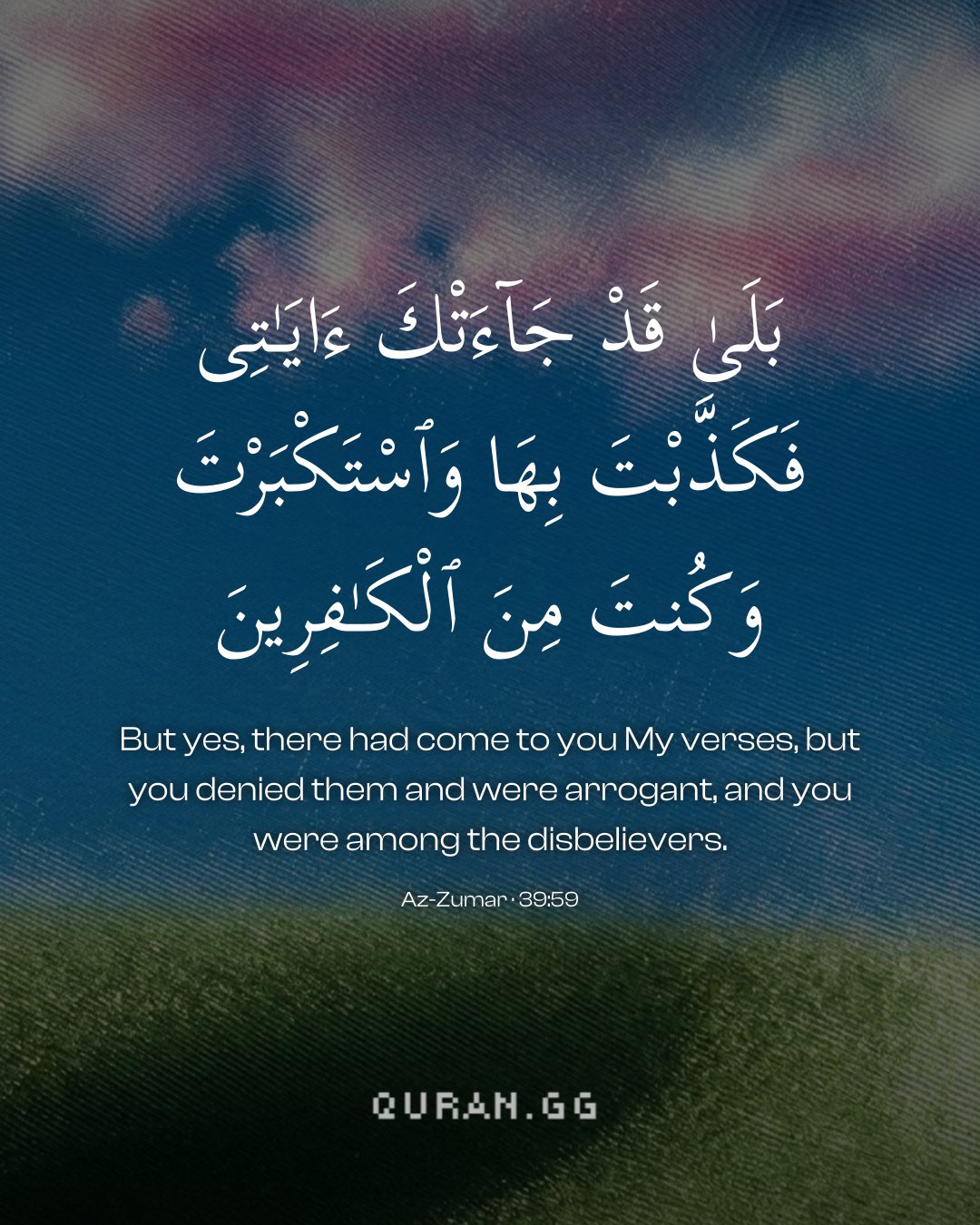
In verse 59, it was said: بَلَىٰ قَدْ جَاءَتْكَ آيَاتِي فَكَذَّبْتَ بِهَا (Why not? My verses had reached you, but you called them untrue, and waxed proud, and became of those who disbelieved...). In this verse, what the disbelievers said in: (If Allah were to show me the way, I would have surely been among those who fear Allah",- 39:57) has been answered. The outcome of this verse is that Allah had already given the necessary guidance, fully and conclusively. He had sent His books, verses and signs. Therefore, their claim that Allah gave them no guidance was absurd. Of course, once He had given the guidance, Allah never forced anyone to be good and obedient. In fact, every servant of His was given the choice to take to either the way of the truth or the way of the false. This was a test for the maker of the choice. On this depended his or her success or failure. Whoever took to the way of error by one's own free will, choice and volition, he or she is, himself or herself, responsible for it.
Tazkirul Quran
Maulana Wahiduddin KhanOn ayahs 54–60
When those who possess sensitive hearts are blessed with a deep realisation of God (ma‘rifah), they start becoming worried as to what would happen about their past sins. Similarly, even after adopting a God-fearing way of life, a man is likely to display shortcomings from time to time, and his sensitive nature makes him worry again on this account. These feelings in some people can become so intense as to cause a deep sense of frustration. For such people, God has declared in His Book that they should firmly believe that their God is Forgiving and Merciful. He does not look at a man’s past but at his present. He does not look to his outward form but at his inner soul. He treats a man with broad-mindedness and not with petty-mindedness. That is why, when a man turns towards Him, He once again takes him into the fold of His Mercy, howsoever big a blunder the man might have committed.
Uthmani text of the Madinah mushaf (King Fahd Complex). Translation: Saheeh International. Tafsir via Quran.com.