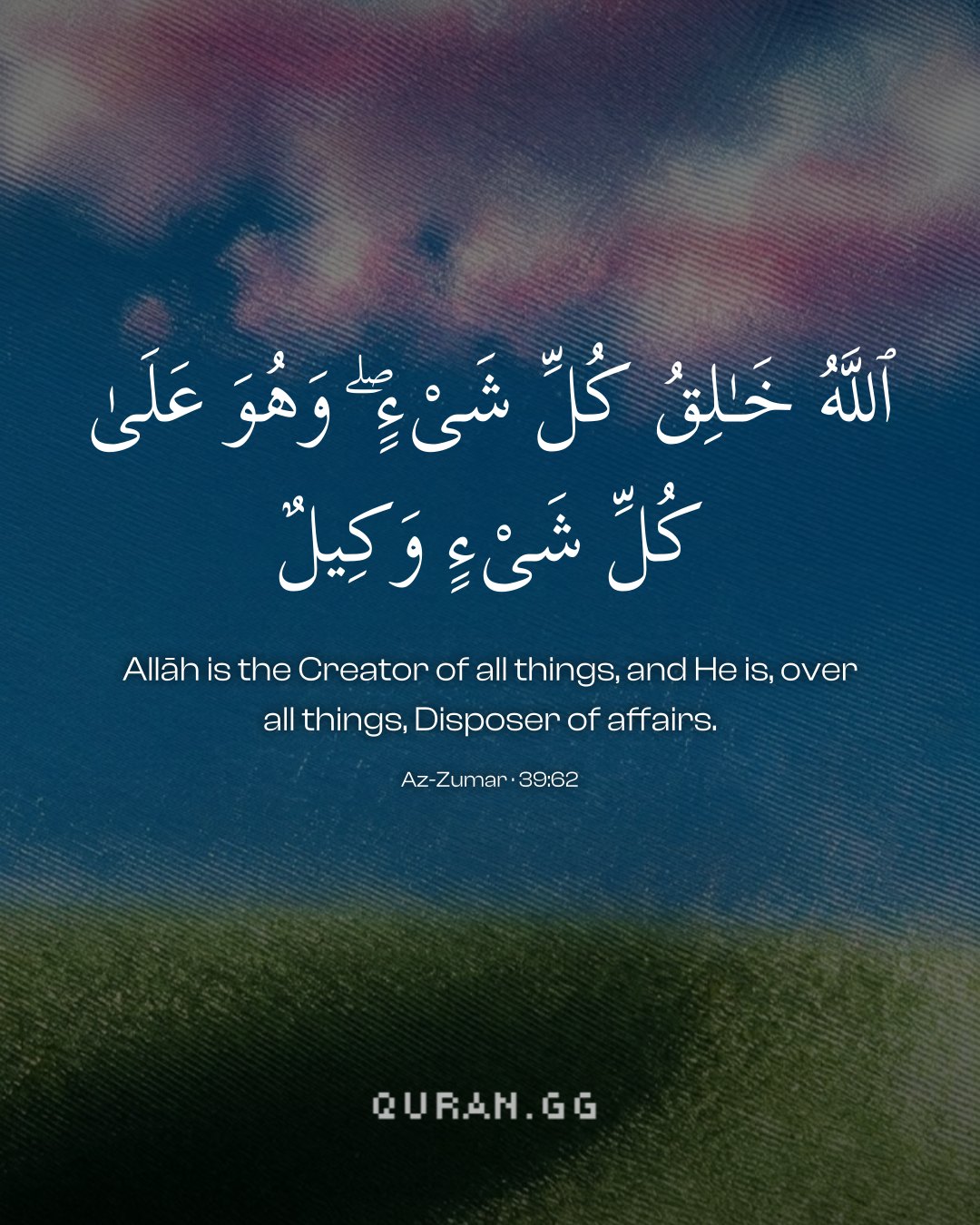
Allah is the Creator and Controller, and associating others in worship with Him cancels out Good ...
Allah tells us that He is the Creator, Lord, Sovereign and Controller of all things; everything is subject to His dominion, power and guardianship.
لَّهُ مَقَالِيدُ السَّمَـوَتِ وَالاٌّرْضِ
(To Him belong the Maqalid of the heavens and the earth.) Mujahid said, "Maqalid means `keys' in Persian." This was also the view of Qatadah, Ibn Zayd and Sufyan bin `Uyaynah. As-Suddi said:
لَّهُ مَقَالِيدُ السَّمَـوَتِ وَالاٌّرْضِ
(To Him belong the Maqalid of the heavens and the earth.) "The treasures of the heavens and the earth." Both opinions mean that the control of all things is in the Hand of Allah, may He be blessed and exalted, for His is the dominion and to Him is the praise, and He is able to do all things. He says:
وَالَّذِينَ كَفَرُواْ بِـَايَـتِ اللَّهِ
(And those who disbelieve in the Ayat of Allah,) meaning, His proof and evidence,
أُولَـئِكَ هُمُ الْخَـسِرُونَ
(such are they who will be the losers.)
قُلْ أَفَغَيْرَ اللَّهِ تَأْمُرُونِّى أَعْبُدُ أَيُّهَا الْجَـهِلُونَ
(Say: "Do you order me to worship other than Allah O you fools!") The reason for the revelation of this Ayah was narrated by Ibn Abi Hatim and others from Ibn `Abbas, may Allah be pleased with him, that the idolators in their ignorance called the Messenger of Allah ﷺ to worship their gods, then they would worship his God with him. Then these words were revealed:
قُلْ أَفَغَيْرَ اللَّهِ تَأْمُرُونِّى أَعْبُدُ أَيُّهَا الْجَـهِلُونَ - وَلَقَدْ أُوْحِىَ إِلَيْكَ وَإِلَى الَّذِينَ مِن قَبْلِكَ لَئِنْ أَشْرَكْتَ لَيَحْبَطَنَّ عَمَلُكَ وَلَتَكُونَنَّ مِنَ الْخَـسِرِينَ
(Say: "Do you order me to worship other than Allah O you fools!" And indeed it has been revealed to you, as it was to those before you: "If you join others in worship with Allah, surely your deeds will be in vain, and you will certainly be among the losers.") This is like the Ayah:
وَلَوْ أَشْرَكُواْ لَحَبِطَ عَنْهُمْ مَّا كَانُواْ يَعْمَلُونَ
(But if they had joined in worship others with Allah, all that they used to do would have been of no benefit to them.) (6:88).
بَلِ اللَّهَ فَاعْبُدْ وَكُن مِّنَ الشَّـكِرِينَ
(Nay! But worship Allah, and be among the grateful.) means, `you and those who follow you and believe in you should make your worship sincerely for Allah Alone, with no partner or associate.'
In verse 59, it was said: بَلَىٰ قَدْ جَاءَتْكَ آيَاتِي فَكَذَّبْتَ بِهَا (Why not? My verses had reached you, but you called them untrue, and waxed proud, and became of those who disbelieved...). In this verse, what the disbelievers said in: (If Allah were to show me the way, I would have surely been among those who fear Allah",- 39:57) has been answered. The outcome of this verse is that Allah had already given the necessary guidance, fully and conclusively. He had sent His books, verses and signs. Therefore, their claim that Allah gave them no guidance was absurd. Of course, once He had given the guidance, Allah never forced anyone to be good and obedient. In fact, every servant of His was given the choice to take to either the way of the truth or the way of the false. This was a test for the maker of the choice. On this depended his or her success or failure. Whoever took to the way of error by one's own free will, choice and volition, he or she is, himself or herself, responsible for it.
The discourse of God maintains in all its parts a consistent level of perfection, so that in the Quran, one cannot say that some verses are better than others. Nor can it be said about the Quran in comparison with other divine books that one book is better to the exclusion of all others. The fact is that in the present world of trial, man has freedom of action. He has the option of accepting divine words in their proper sense or of taking them wrongly. He may pay full attention to the real purpose of a talk, or he may try to ferret out insignificant points from it and interpret them wrongly. Ridiculing the Divine words is the result of such misconstruction. Man takes a verse and derives a wrong meaning from it, and then on the basis of that self-devised meaning, starts to make a mockery of it. Man has kept himself hidden from reality, from what he really is. On account of false pride, he simply does not accept the Truth, but then talks glibly to give the impression that he is rejecting the Truth on the basis of principles. But, on the Day of Judgement, his face will reflect his inner condition. At that time his face will reveal that his rejection of the Truth was, in fact, the result of his false interpretation of divine words. Otherwise, the Truth was, in itself, very obvious and clear. At that time he will be full of regret, but regretting then will be of no avail.
Uthmani text of the Madinah mushaf (King Fahd Complex). Translation: Saheeh International. Tafsir via Quran.com.