Evidence of Life after Death
Often Allah refers to the Resurrection by using the analogy of the earth coming back to life after it has died, as in the beginning of Surat Al-Hajj, where He urges His servants to draw the lesson of the former from the latter. For the earth is dead and lifeless, with nothing growing in it, then He sends to it clouds which bring water, which He sends down upon it,
اهْتَزَّتْ وَرَبَتْ وَأَنبَتَتْ مِن كُلِّ زَوْجٍ بَهِيجٍ
(it is stirred (to life), and it swells and puts forth every lovely kind (of growth)) (22:5). So too, when Allah wishes to resurrect the bodies, He will send rain from beneath the Throne which will cover the whole earth, and the bodies will grow in their graves like seeds grow in the earth. It says in the Sahih:
Continue reading the tafsir of ayahs 9–11Ma'arif al-Qur'an
Mufti Muhammad Shafi
Commentary
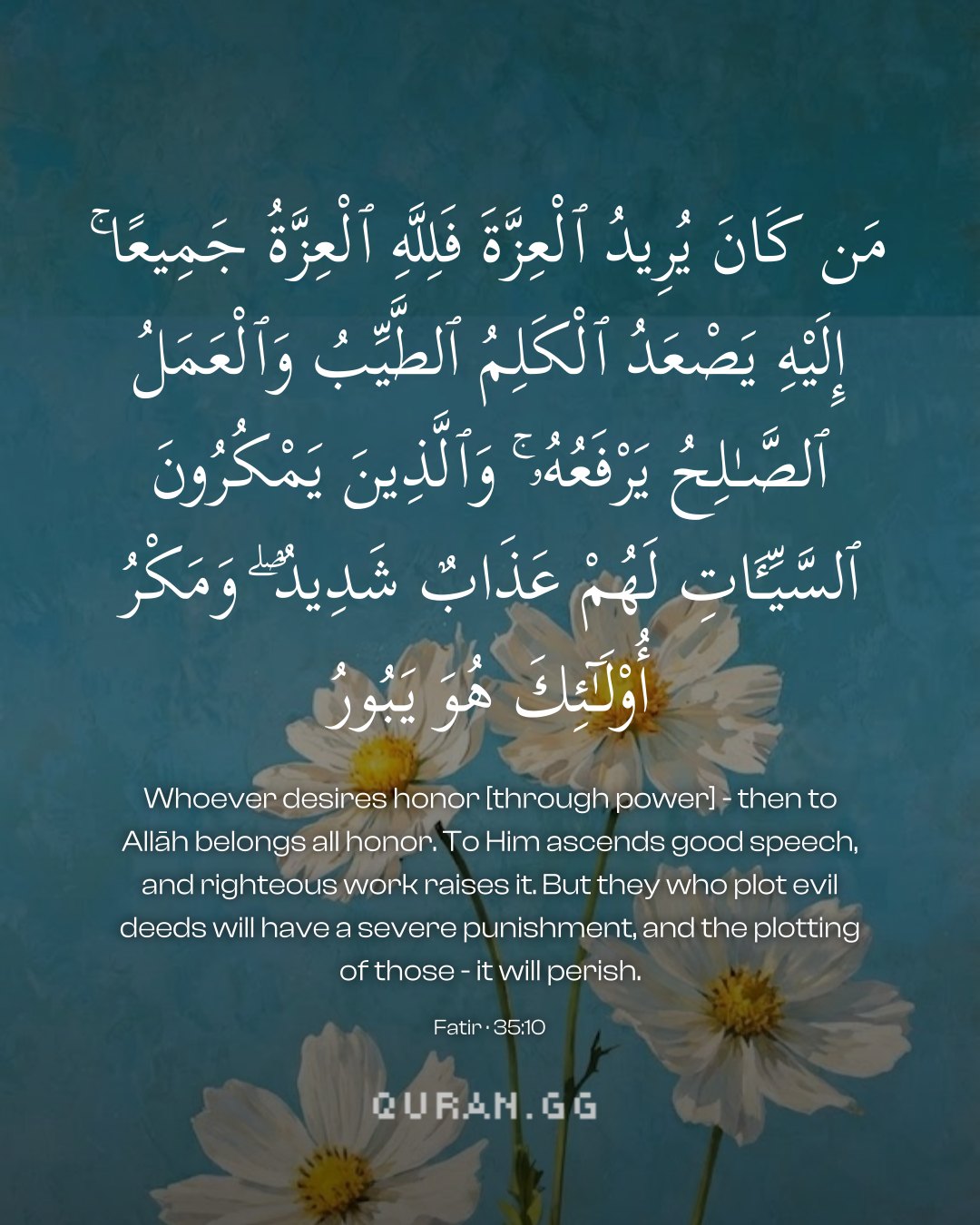
In verse 10, it was said: إِلَيْهِ يَصْعَدُ الْكَلِمُ الطَّيِّبُ وَالْعَمَلُ الصَّالِحُ يَرْفَعُهُ (Towards Him, ascends the pure word, and the righteous deed uplifts it). Immediately earlier to this, it was declared that the person seeking honor and power should understand that these matters are not controlled by anyone other than Allah. As for those who have taken certain things as objects of worship or have taken some people as friends in the hope of being honored by them, they cannot give honor to anyone. Given in the present verse, there is a method of acquiring the gifts of grace and honor from Allah Ta’ ala. It has two parts: (1) Good word (that is, the kalimah of tauhid: la ilaha il-lal-lah) and the knowledge of the being and attributes of Allah. (2) Good deed, that is, to believe by heart and then act in accordance with its dictates under the Shari` ah. Shah ` Abdul Qadir (رح) has said in Mudih-ul-Qur'an that this prescription of becoming a recipient of honor is perfectly true and tested, however, the condition is that one remains constant in remembering Allah and doing good deeds. When this constancy reaches an appointed limit, Allah Ta’ ala blesses the doer of these with an everlasting and unparalleled honor both in this world and in the world to come.
These two parts have been expressed in the cited verse by saying that good word ascends towards Allah and reaches Him while good deed uplifts it and makes it reach Him. In the grammatical arrangement of: الْعَمَلُ الصَّالِحُ يَرْفَعُهُ the good deed uplifts it) there are certain probabilities. The meanings of the sentence change in terms of each such probability. Authorities in Tafsir have explained it in line with the respective probabilities that they have deemed to be appropriate by them. According to the first probability, the subjective pronoun in: يَرْفَعُهُ (uplifts) should be taken as reverting to: ... (the good deed) and the objective pronoun (it) to: ... (good word) meaning: 'good words ascend to Allah, but the thing through which they are made to ascend are good deeds (as in the khulasa-e-Tafsir of Maulana Ashraf Ali Thanavi (رح)). The majority of Tafsir authorities - Sayyidna Ibn ` Abbas, Ibn Jubayr, Hasan al-Basri, Mujahid, Dahhak, Shahr Ibn Hawshab and others - have opted for this very approach. And the sense of ascending to and being helped to ascend is being accepted in the sight of Allah, therefore, the gist of the sentence would be that good word, be it the kalimah of tauhid or others words of the remembrance and glorification of Allah, nothing of it gets to be acceptable with Allah without good deed. Here, the confirmation by heart is an integral part of good deed the most important part of which is the belief by heart in His Oneness. This belief by heart is a necessary condition for the acceptance of deeds in the absolute sense. Without it, neither the Kalimah: لا إله إلا اللہ (la ilaha il-lal-lah) nor any other Dhikr of Allah is acceptable.
Then, there are the other parts of good deed, such as, prayers and fasting and abstinence from forbidden and reprehensible things. Though, the acceptability of the 'good word’, that is, the kalimah of tauhid does not depend on such good deeds, yet these deeds too are conditions to a perfect acceptability of the 'good words'. If a person simply does not have faith, and its confirmation, in his heart, then, no matter how many times he repeats the words of the cardinal statement of one's Islam (Kalimah Tauhid: la ilaha il-lal-lah) and remains engaged with dhikr and Tasbih of Allah, he will not deserve the least of acceptability in the sight of Allah. In contrast, there is the case of the other person who does have faith and its confirmation, but fails to do other good deeds or falls short in them, then, his saying of the kalimah of tauhid and the doing of the dhikr of Allah will, though, not go to waste totally, however, its benefit will be restricted to delivering him from the everlasting punishment. The consequence will be that he will go through a certain punishment for some time that will be in proportion to his abandonment of duty and the shortcoming.
In a Hadith, the Holy Prophet ﷺ has said, 'Allah Ta’ ala does not accept any word without deed, and any word and deed without the intention, and any word, deed and intention without compatibility with sunnah (as said and done by him).' (Qurtubi)
This tells us that correspondence with sunnah is the condition of perfect acceptability. Even if the word, the deed and the intention, all these, are also correct but the mode and method of conduct is not in accordance with sunnah, then, one cannot become a recipient of perfect acceptability with Allah.
Some commentators suggest another syntactical arrangement in respect of this sentence. According to them, the subjective pronoun in: يَرْفَعُهُ (uplifts) reverts to: ضَمِر فَاعِل good word) and the objective pronoun (i.e.'it' ) to: کلم طیّب ( good deed). Thus, the meaning of the sentence become totally different from that of the earlier, that is, 'good word' which is the dhikr of Allah, makes 'good deed' ascend and makes it rise higher up, that is, makes it worthy of being accepted. The outcome would then be that a person who does good deeds, and along with it, also does his dhikr of Allah abundantly, then, this dhikr of Allah embellishes his deed and makes it acceptable.
Tazkirul Quran
Maulana Wahiduddin Khan
The present world gives us an introduction to the Hereafter. Rain, a common phenomenon, indicates that a force is at work which is beyond our ken. Rain results from the action of universal forces. The sun, the air, the sea, gravitational force and many other factors combine with each other in perfect co-ordination to produce the rain which makes dry land come alive. This process of rain-making proves that the Organizer of the universe has full powers over it. He brings about an event according to His plan. Re-vitalizing a barren piece of land and resurrecting a dead man are both feats of the same calibre. If the possibility of the first event is proved, then by analogy, the possibility of the second event automatically stands proved. The present world is a testing ground. Therefore, here even an undeserving person may temporarily receive honour, but in the Hereafter all the honours will fall to the lot of those who are really deserving of them. The criteria for judging worthiness will be righteous words (al-kalim at-tayyib) and pious deeds (al-‘amal as-salih), that is, man’s expression—in thought, word and deed—of his discovery of God and the devotion of all his strength to the service of the Almighty. Those who build their lives in piety are bound to secure God’s help.
Uthmani text of the Madinah mushaf (King Fahd Complex). Translation: Saheeh International. Tafsir via Quran.com.