Tafsir Ibn Kathir (abridged)
The Perfect Power of Allah
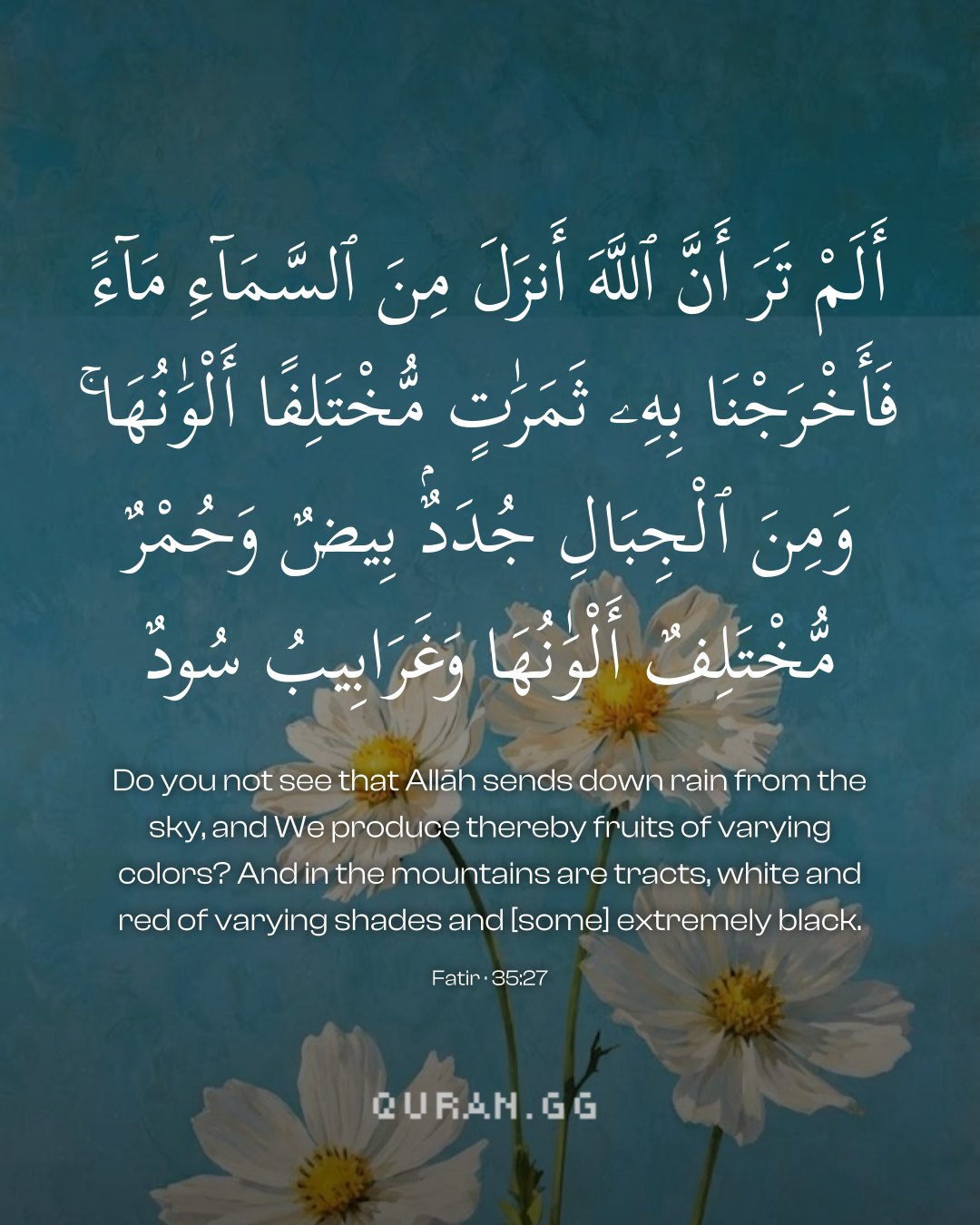
Allah tells us of His complete and perfect power of creation. He tells us how He makes different kinds of things from one thing, which is the water that He sends down from the heaven. From water He brings forth fruits of various colors, yellow, red, green, white and other colors, as we can see in the immense variety of their colors, tastes and scents. This is like another Ayah where Allah says:
وَفِى الاٌّرْضِ قِطَعٌ مُّتَجَـوِرَتٌ وَجَنَّـتٌ مِّنْ أَعْنَـبٍ وَزَرْعٌ وَنَخِيلٌ صِنْوَنٌ وَغَيْرُ صِنْوَنٍ يُسْقَى بِمَآءٍ وَحِدٍ وَنُفَضِّلُ بَعْضَهَا عَلَى بَعْضٍ فِى الاٍّكُلِ إِنَّ فِى ذلِكَ لآيَـتٍ لِّقَوْمٍ يَعْقِلُونَ
(And in the earth are neighbouring tracts, and gardens of vines, and green crops, and date palms, growing into two or three from a single stem root, or otherwise, watered with the same water; yet some of them We make more excellent than others to eat. Verily, in these things there are Ayat for the people who understand.) (13:4)
وَمِنَ الْجِبَالِ جُدَدٌ بِيضٌ وَحُمْرٌ مُّخْتَلِفٌ أَلْوَنُهَا
(and among the mountains are Judad, white and red, of varying colors) means, He created the mountains like this, with different colors, as we also see that there are indeed white and red mountains, and in some of them there are streaks which are also of varying colors. Ibn `Abbas said Al-Judad means pathways. This was also the view of Abu Malik, Al-Hasan, Qatadah and As-Suddi. And there are some mountains which are very black. `Ikrimah said, "Al-Gharabib means mountains which are high and black. This was also the view of Abu Malik, `Ata' Al-Khurasani and Qatadah. Ibn Jarir said, "When the Arabs describe something as being very black, they say Ghirbib.
وَمِنَ النَّاسِ وَالدَّوَآبِّ وَالاٌّنْعَـمِ مُخْتَلِفٌ أَلْوَنُهُ كَذَلِكَ
(And likewise, men and moving creatures and cattle are of various colors.) means, the same is true of living creatures too, humans and animals, all creatures which walk on their feet, and cattle. Here something general is followed by something specific. These are all different too, for among mankind there are Berbers, Ethiopians and some non-Arabs who are very black, and Slavs and Romans who are very white, and the Arabs who are in between, and the Indians. Allah says in another Ayah:
وَاخْتِلَـفُ أَلْسِنَتِكُمْ وَأَلْوَنِكُمْ إِنَّ فِى ذلِكَ لأَيَـتٍ لِّلْعَـلَمِينَ
(and the difference of your languages and colors. Verily, in that are indeed signs for men of sound knowledge) (30:22). Similarly, animals and cattle vary in their colors, even within one species, and a single animal may have patches of different colors. Blessed be Allah, the Best of creators. Allah then says:
إِنَّمَا يَخْشَى اللَّهَ مِنْ عِبَادِهِ الْعُلَمَاءُ
(It is only those who have knowledge among His servants that fear Allah.) meaning, only those who have knowledge truly fear Him as He should be feared, because the more they know about the Almighty, All-Powerful, All-Knowing Who has the most perfect attributes and is described with the most beautiful Names, the more they will fear Him. `Ali bin Abi Talhah reported that Ibn `Abbas commented on the Ayah:
إِنَّمَا يَخْشَى اللَّهَ مِنْ عِبَادِهِ الْعُلَمَاءُ
(It is only those who have knowledge among His servants that fear Allah.) those who know that Allah is able to do all things. Ibn `Abbas said, "The one among His servants who knows about Ar-Rahman, is the one who does not associate anything in worship with Him; the one who accepts as lawful that which He has permitted and accepts as unlawful that which He has prohibited. He obeys His commands and is certain that he will meet Him and be brought to account for his deeds. Sa`id bin Jubayr said, "Fear is what stands between you and disobeying Allah, may He be glorified." Al-Hasan Al-Basri said, "The knowledgeable person is the one who fears Ar-Rahman with regard to the Unseen, who likes that which Allah wants him to like, and who shuns that which angers Allah." Then Al-Hasan recited:
إِنَّمَا يَخْشَى اللَّهَ مِنْ عِبَادِهِ الْعُلَمَاءُ إِنَّ اللَّهَ عَزِيزٌ غَفُورٌ
(It is only those among His servants who have knowledge that fear Allah. Verily, Allah is Almighty, Oft-Forgiving.) Sufyan Ath-Thawri narrated from Abu Hayyan At-Taymi from a man who said, "It used to be said that the knowledgeable are of three types: (first) one who knows Allah and the command of Allah, (second) one who knows Allah but does not know the command of Allah, and (third) one who knows the command of Allah but does not know Allah. The one who knows Allah and the command of Allah is the one who fears Allah and knows the limits (Hudud) and the obligatory duties (Fara'id). The one who knows Allah but does not know the command of Allah is the one who fears Allah but does not know the limits (Hudud) and the obligatory duties (Fara'id). The one who knows the command of Allah but does not know Allah is the one who knows the limits (Hudud) and the obligatory duties (Fara'id) but does not fear Allah."