The Muslims will be the Ones Who gain in the Hereafter
Here Allah tells us that His believing servants, who recite and believe in His Book, and do the deeds prescribed in it such as establishing regular prayer at the prescribed times, night and day, spending (in charity) out of that which Allah has provided for them secretly and openly,
يَرْجُونَ تِجَـرَةً لَّن تَبُورَ
(they hope for a (sure) trade-gain that will never perish.) means, they hope for a reward from Allah which will inevitably be theirs. Allah says:
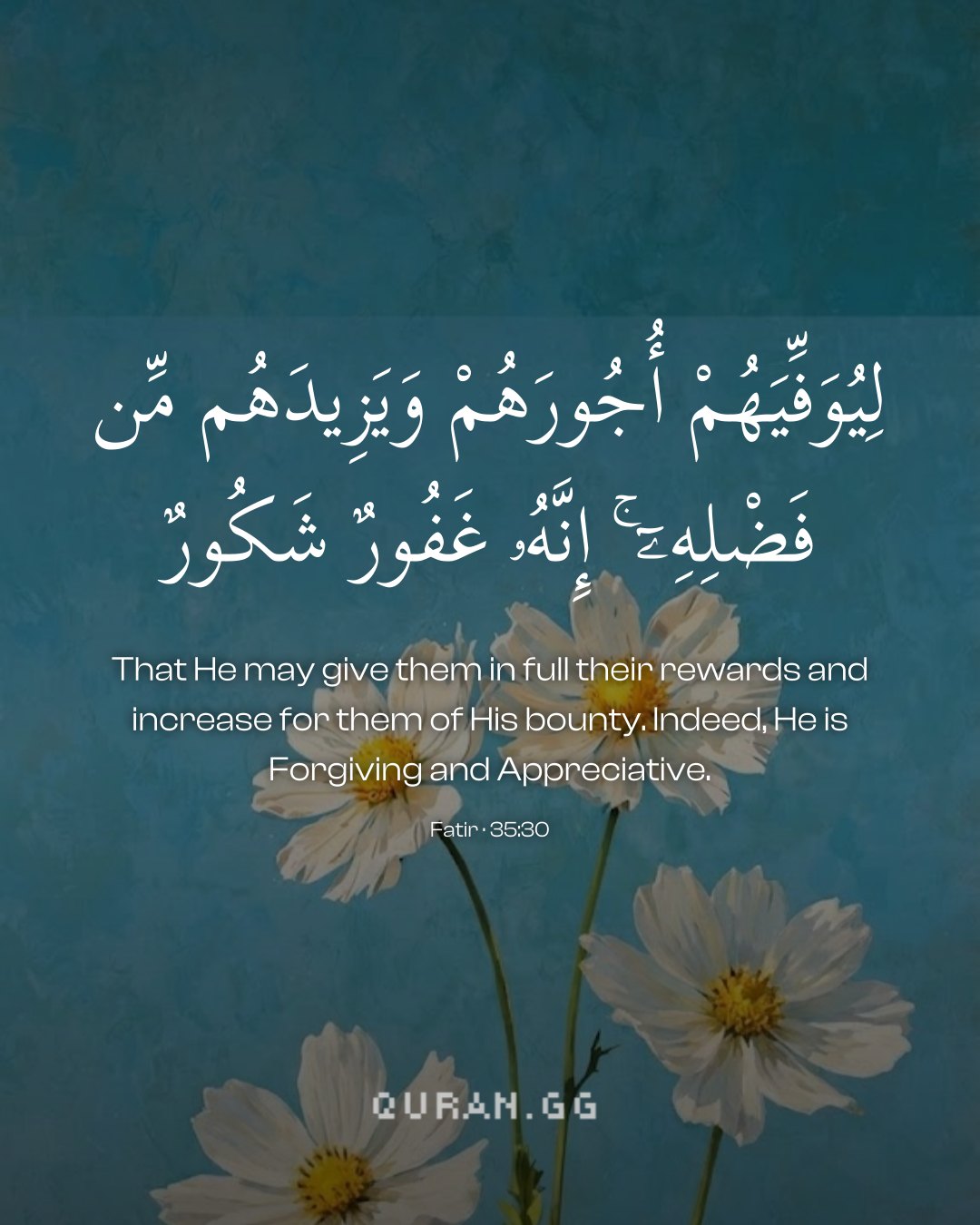
لِيُوَفِّيَهُمْ أُجُورَهُمْ وَيَزِيدَهُم مِّن فَضْلِهِ
(That He may pay them their wages in full, and give them (even) more, out of His grace.) meaning, that He may give them a reward for what they have done, and multiply it by adding more, such as has never occurred to them.
إِنَّهُ غَفُورٌ
(Verily, He is Oft-Forgiving,) means, He forgives their sins,
شَكُورٍ
(Most Ready to appreciate.) means, He appreciates even a little of their good deeds.
Commentary
Mentioned earlier, in verse 28, there was a quality of true ` Ulama' who acknowledge Allah. This quality related to the heart. It was to have Allah's awe in the heart. In the first of the present verses (29), some those qualities of the same blessed people, the awliya' or men of Allah, are mentioned that find expression through outward parts of the body. Out of these, the first quality is the tilawah (recitation) of the Qur'an. This denotes the people who recite the Book of Allah constantly. The use of the aorist tense (mudari) in: یَتلُونَ (yatluna: they recite) releases a hint in this direction. Then, there are other elders who have taken: یَتلُونَ (yatluna) at this place in its literal sense, that is, they follow the Qur'an in deed. But, the first Tafsir is weightier, even though, it also stands determined from the context that recitation can be trustworthy only when it brings forth actions in accordance with the Qur'an. But, the word: تِلَاوَت (tilawah or recitation) used here appears in its recognized sense. Similarly, Mutarrif Ibn ` Abdullah Ibn Shikhkhir (رح) said: ھَذِہٖ آیَۃُ القُرَّاِء (This verse is for al-qurra' ), the phoneticians of the Qur'an, who make the recitation of the Qur'an their special activity of life.
Continue reading the tafsir of ayahs 29–31 The man of knowledge is one who experiences a deep realization of God (ma‘rifah) and one who attains this state, makes the Book of God, a guide in his thinking processes; he becomes a pious subject of God. Moreover, he becomes so kind to his fellow human beings that he sets apart a share from his hard-earned income for them. He gathers the courage to devote himself body and soul to God’s tasks and is content with the knowledge that he will be rewarded in the Hereafter. One of the proofs of the Quran being true is that it tallies exactly with forecasts made in the previous divine scriptures. If a man is serious and sincere, this very fact will be enough to make him have faith in Quran.
Uthmani text of the Madinah mushaf (King Fahd Complex). Translation: Saheeh International. Tafsir via Quran.com.