Surah Fussilat Ayah 37 (41:37) — Meaning & Tafsir | Quran.GG

Surah Fussilat, Ayah 37

41:37 · Meaning and tafsir

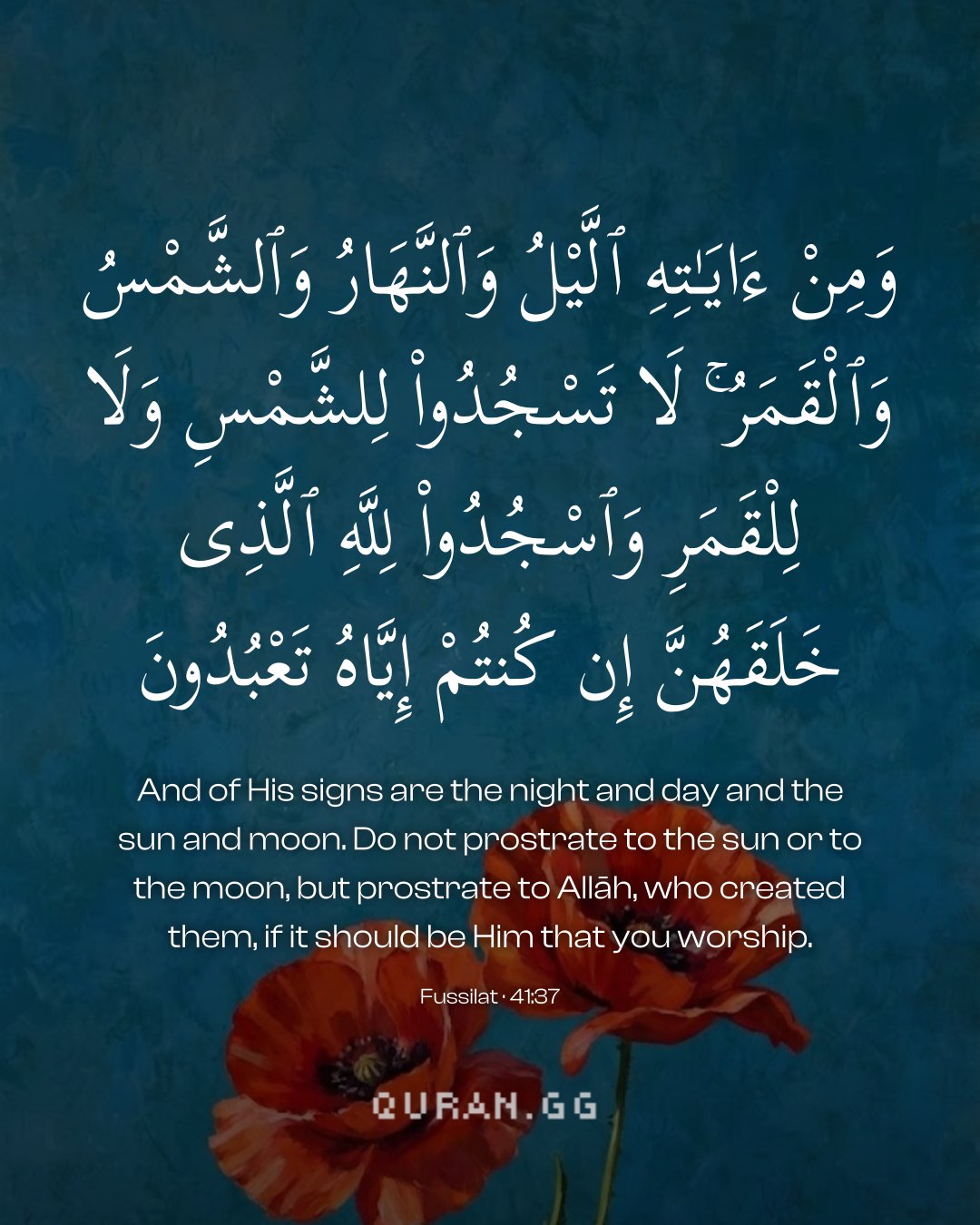
وَمِنْ ءَايَـٰتِهِ ٱلَّيْلُ وَٱلنَّهَارُ وَٱلشَّمْسُ وَٱلْقَمَرُ ۚ لَا تَسْجُدُوا۟ لِلشَّمْسِ وَلَا لِلْقَمَرِ وَٱسْجُدُوا۟ لِلَّهِ ٱلَّذِى خَلَقَهُنَّ إِن كُنتُمْ إِيَّاهُ تَعْبُدُونَ ٣٧

And of His signs are the night and day and the sun and moon. Do not prostrate to the sun or to the moon, but prostrate to Allāh, who created them, if it should be Him that you worship.

Surah Fussilat 41:37 in Arabic with its translation: “And of His signs are the night and day and the sun and moon. Do not prostrate to the sun or to the moon, but…”

Make something with this ayah

Turn it into a video for Stories, Reels or TikTok, recited by the reciter you pick, or an image on a background you choose. Free, in your browser.

Download this image

Tafsir Ibn Kathir (abridged)

From among the Signs of Allah

Here Allah reminds His Creation of His power, and that He is the One Who has no equal, and He is Able to do all things. Allah's saying;

وَمِنْ ءَايَـتِهِ الَّيْلُ وَالنَّهَارُ وَالشَّمْسُ وَالْقَمَرُ

(And from among His signs are the night and the day, and the sun and the moon.) means, He created the night with its darkness and the day with its light, and they alternate without ceasing. And He created the sun with its shining light, and the moon with its reflected light. and He allotted their stages and gave them separate orbits in the heavens, so that by the variations in their movements man may know the stages of night and day, of weeks, months and years, and time periods related to people's rights, acts of worship and various transactions. Moreover, because the sun and moon are the most beautiful of the heavenly bodies that can be seen in both the upper and lower realms, Allah points out that they are created entities which are in a state of enthrallment to Him, subject to His dominion and control. So He says:

لاَ تَسْجُدُواْ لِلشَّمْسِ وَلاَ لِلْقَمَرِ وَاسْجُدُواْ لِلَّهِ الَّذِى خَلَقَهُنَّ إِن كُنتُمْ إِيَّاهُ تَعْبُدُونَ

(Do not prostrate yourselves to the sun nor to the moon, but prostrate yourselves to Allah Who created them, if you (really) worship Him.) meaning, `do not associate anything in worship with Him, for your worship of Him will be of no benefit to you if you worship others alongside Him, because He does not forgive the association of others in worship with Him.' He says:

فَإِنِ اسْتَكْبَرُواْ

(But if they are too proud, ) i.e., to worship Him Alone, and they insist on associating others with Him,

فَالَّذِينَ عِندَ رَبِّكَ

(then there are those who are with your Lord) i.e., the angels,

يُسَبِّحُونَ لَهُ بِاللَّيْلِ وَالنَّهَارِ وَهُمْ لاَ يَسْـَمُونَ

(glorify Him night and day, and never are they tired.) This is like the Ayah:

فَإِن يَكْفُرْ بِهَا هَـؤُلاءِ فَقَدْ وَكَّلْنَا بِهَا قَوْماً لَّيْسُواْ بِهَا بِكَـفِرِينَ

(But if these disbelieve therein, then, indeed We have entrusted it to a people who are not disbelievers therein.) (6:89).

وَمِنْ ءَايَـتِهِ

(And among His signs) means, signs of His ability to bring the dead back to life.

أَنَّكَ تَرَى الاٌّرْضَ خَـشِعَةً

(that you see the earth barren,) means, lifeless, with nothing growing in it; it is dead.

فَإِذَآ أَنزَلْنَا عَلَيْهَا الْمَآءَ اهْتَزَّتْ وَرَبَتْ

(but when We send down water (rain) to it, it is stirred to life and growth.) means, it brings forth all kinds of crops and fruits.

إِنَّ الَّذِى أَحْيَـهَا لَمُحْىِ الْمَوْتَى إِنَّهُ عَلَى كُلِّ شَىْءٍ قَدِيرٌ

(Verily, He Who gives it life, surely is able to give life to the dead. Indeed He is Able to do all things.)

Ma'arif al-Qur'an

It is Not permissible to prostrate before anyone except Allah Almighty

لَا تَسْجُدُوا لِلشَّمْسِ وَلَا لِلْقَمَرِ‌ وَاسْجُدُوا لِلَّـهِ الَّذِي خَلَقَهُنَّ (Do not make sajdah [ prostration ] to the sun, or to the moon. And make sajdah to Allah who has created them - 37). It is learnt from this verse that prostration is the right of the Creator of the Universe only. The consensus of the Ummah is that to prostrate before any star, human being, etc. is haram (forbidden), whether it is for worship, or just as a gesture of respect and reverence. The only difference is that if someone prostrates before anyone other than Allah with intention to worship him, he becomes an infidel and the one who prostrates simply as a mark of respect and reverence is not called an infidel, but he is guilty of committing a serious haram act and is a sinner.

Prostration of worship for any being other than Allah has never been lawful for any Ummah in any Shari` ah of any prophet, because it becomes a practice of shirk (polytheism) and shirk has never been allowed in any code of shari'ah revealed to any prophet. However, prostration in respect and reverence of anyone (with no intention to worshipping him) had been allowed in the codes of shari'ah revealed to some prophets. All the angels were ordered to prostrate before Sayyidna 'Adam (علیہ السلام) before he came into this world. It is stated in the Qur'an that the father and brothers of Sayyidna Yusuf (علیہ السلام) prostrated before him. But the jurisprudents of this Ummah are unanimous on the point that such a prostration was permissible in the earlier codes only, and it stands abrogated in Islam. Prostration for any being other than Allah has been declared absolutely haram (forbidden). Full details of this issue are given in the author's booklet ( المقالۃ المرضیۃ فی حکم سجدۃ التحیۃ) Al-maqalat-ulmardiyyah, fi Hukmi sajdat-it-tahiyyah' in Arabic, and its Urdu translation has also been published.

Tazkirul Quran

The call of the Quran is to invite people to God. Bringing man closer to his Lord and Sustainer; making him spend his whole life in remembrance of God; developing a feeling in man that he should make the one and only God the centre of his attention—these are the real aims of the Quranic call and undoubtedly there is no call better than this. But, only that person becomes the preacher of God who is so sincere in his call that he, first of all, accepts whatever he wants others to accept. Whatever he exhorts others to do, he should have himself started doing from the outset. The greatest weapon of a preacher of Truth is his ability to treat people well. Even if people are not good to him, he should be good to them. He should adopt the policy of avoidance in the face of provocation or irritating behaviour and exercise patience under trying circumstances. Almighty God has made it possible for unilateral good behaviour to be immensely persuasive. The preacher of God is aware of this God-given asset, and uses it to the utmost extent, even although it may involve crushing his own feelings and killing the urge to retaliate. Whenever a caller to Truth has the feeling within him that it is necessary for him to retaliate against a particular instance of oppression in order to prevent the enemy from becoming so bold as to commit even greater excesses, he should immediately understand that this is a satanic inducement. It is the duty of every believer and preacher of Truth to seek the protection of God from such feelings instead of acting upon them.

Uthmani text of the Madinah mushaf (King Fahd Complex). Translation: Saheeh International. Tafsir via Quran.com.