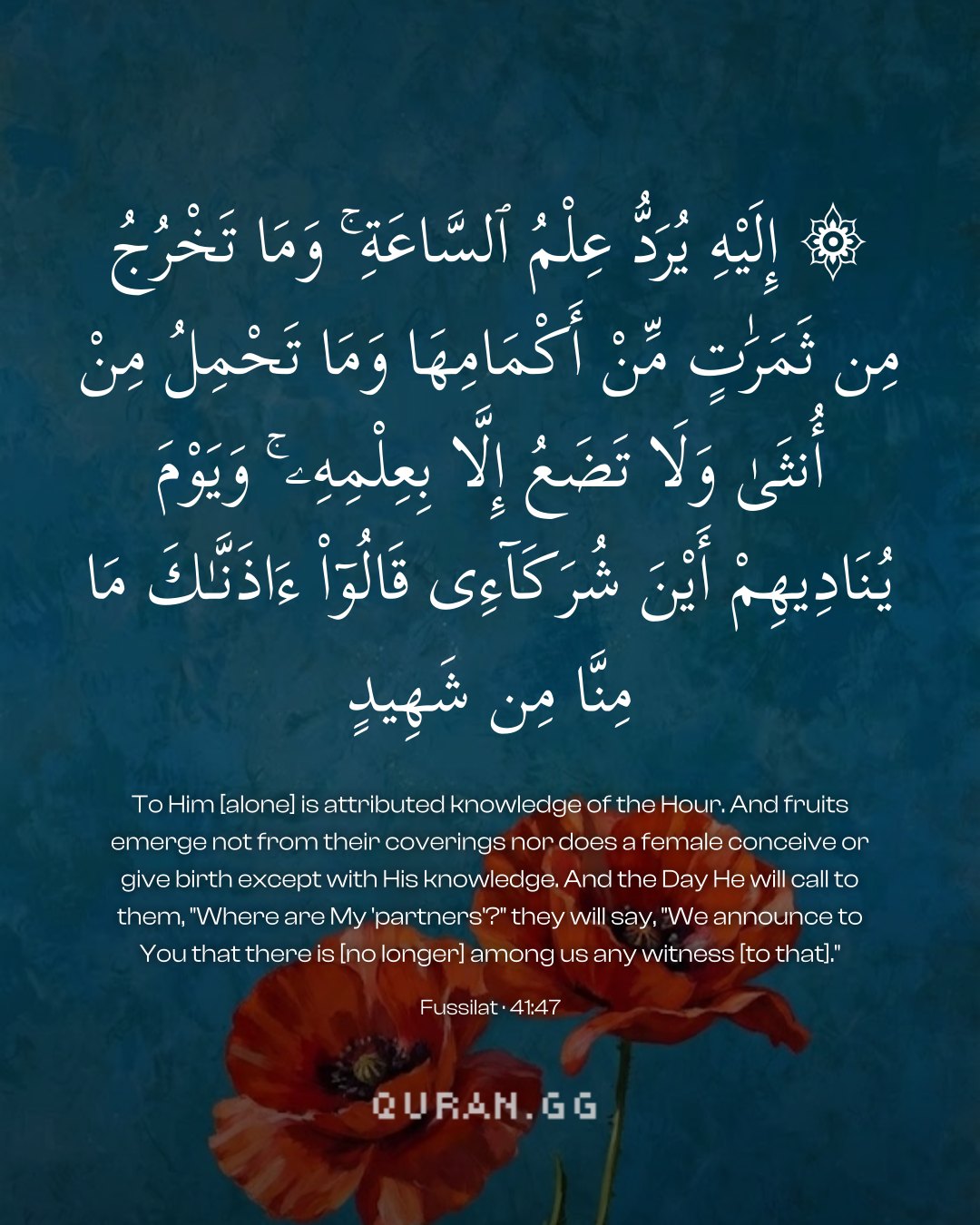
To Him [alone] is attributed knowledge of the Hour. And fruits emerge not from their coverings nor does a female conceive or give birth except with His knowledge. And the Day He will call to them, "Where are My 'partners'?" they will say, "We announce to You that there is [no longer] among us any witness [to that]."
(Whosoever does righteous good deed, it is for himself;) means, the benefit of which will come to him.
وَمَنْ أَسَآءَ فَعَلَيْهَا
(and whosoever does evil, it is against himself.) means, the consequences of that will come back on him.
وَمَا رَبُّكَ بِظَلَّـمٍ لِّلْعَبِيدِ
(And your Lord is not at all unjust to (His) servants) means, He only punishes people for their sins, and He does not punish anyone except after establishing proof against him and sending a Messenger to him.
Knowledge of the Hour is with Allah Alone
Then Allah says:
إِلَيْهِ يُرَدُّ عِلْمُ السَّاعَةِ
(To Him is referred the knowledge of the Hour.) meaning, no one knows about that apart from Him. Muhammad ﷺ , the leader of mankind, said to Jibril, who is one of the leading angels, when he asked him about the Hour:
أَأَعْجَمِيٌّ وَعَرَبِيٌّ (Is it a non- Arabic [ book ] and an Arab [ messenger ]? - 44) The original word used for non-Arabic in the text is a'jamiyy (with hamza before the letter 'ain) which is an Arabic term for ` ineloquent speech', while ` ajam' (without hamzah in its beginning) means any nation other than Arabs. Therefore ` ajamiyy is a person who is non-Arab, even though he may speak eloquently, and a'jamiyy is a person who cannot speak eloquently (Qurtubi). The use of the word أَعْجَمِيٌّ ajamiyy in this verse means that if We had revealed the Qur'an in any language other than Arabic, then the Quraysh who are the first addressees of the Qur'an would have complained that they did not understand this Book and would have said wonderingly that the prophet is an ` Arab, but the book is ajamiyy which is ineloquent.
When the Truth was revealed through previous prophets, some people accepted it while others did not. The same thing happened when the last of the prophets was raised. Why does man give the Truth such indifferent treatment? The reason for this is the existence of the present conditions for man’s trial. In the present world of trial, whenever Truth appears, a veil is attached to it which screens it from human vision. This veil, which was required to be torn asunder, is then turned into a source of doubt. But this doubt cannot be an excuse for anybody on the Day of Judgement, because it proves that man was not serious about the issue of Truth. Man is perfectly serious in the matter of his worldly interests and therefore he tears down all the veils and discovers the reality. Similarly, if he were to become serious about his ‘other-worldly’ interests, he would pull down all the veils of doubt and see reality as it actually is.
Uthmani text of the Madinah mushaf (King Fahd Complex). Translation: Saheeh International. Tafsir via Quran.com.