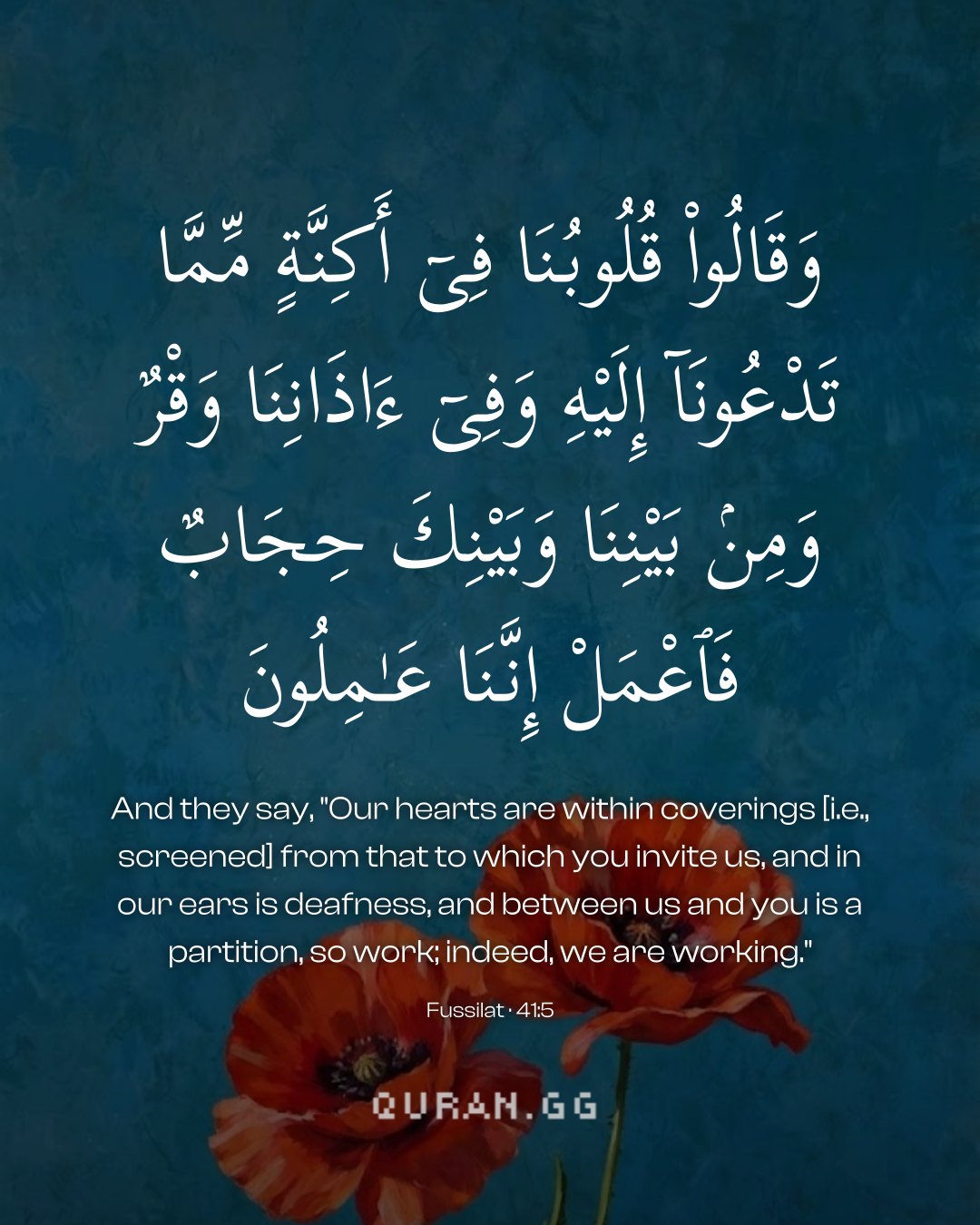
And they say, "Our hearts are within coverings [i.e., screened] from that to which you invite us, and in our ears is deafness, and between us and you is a partition, so work; indeed, we are working."
In the Name of Allah, the Most Gracious, the Most Merciful.
Description of the Qur'an, and what Those Who turn away from it say.
حـم - تَنزِيلٌ مِّنَ الرَّحْمَنِ الرَّحِيمِ
(Ha Mim. A revelation from the Most Gracious, the Most Merciful.) means, the Qur'an is revealed from the Most Gracious, Most Merciful. This is like the Ayat:
(And truly, this is a revelation from the Lord of all that exists, Which the trustworthy Ruh (Jibril) has brought down upon your heart that you may be (one) of the warners.) (26:192-194).
وَقَالُوا قُلُوبُنَا فِي أَكِنَّةٍ - (And they say, " Our hearts are [ wrapped ] in covers against that to which you invite us 41:5) Here three statements of the infidels of Quraysh are reproduced. Firstly, they said that there was a cover on their hearts against his discourse, and therefore they do not understand what he says. Secondly, that their ears are deaf to listen to his speech. Thirdly, that there are barriers between him and them. The Holy Qur'an has reproduced this statement of theirs in the context of denouncing it, which indicates that these statements are wrong. But at another place, Qur'an has also stated their condition to be the same. A verse of Surah An'am states:
But We have put coverings on their hearts, so that they do not understand, and heaviness in their ears. - 6:25.
One may doubt that there is a conflict between this verse and that of Surah An'am in this respect. But the answer is that the infidels, by saying the above, meant that they were helpless and excusable, because their hearts were curtained, their ears were leaden and there were barriers between them and him. So how could they listen to him and accept what he said? This is how they proved themselves to be helpless. And when the Holy Qur'an stated their condition (in Surah An'am) to be the same, it did not consider them to be helpless, rather held them fully capable of hearing and understanding. It is when they refused even to hear, and had no intention of understanding, then as a punishment, heedlessness and ignorance were imposed upon them, but not to the degree that they were deprived of their volition; rather if they had changed their minds even then, their abilities of hearing and understanding would have been restored fully. (Bayan-ul-Qur’ an)
Tazkirul Quran
Maulana Wahiduddin KhanOn ayahs 5–7
The call of a prophet is the pure call of religion. However, people mostly follow the religion of their forebears. Their thinking is dominated by their national traditions and contemporary mores. For this reason, the prophet’s unadulterated religion does not fit the pattern or mould of their thought. He appears a stranger to them. This difference acts as a mental barrier between the prophet and the common people. Unable to see the prophet’s call in its proper perspective, they are not prepared to accept it. The prophet’s call is in itself extremely rational. It is in itself a proof that it has come from God. But the aforesaid mental barrier proves so impregnable that a man is unable to penetrate it in order to grasp the meaning of the prophet’s call. Thus God opens the doors of His Grace to man, but he does not pass through them.
Uthmani text of the Madinah mushaf (King Fahd Complex). Translation: Saheeh International. Tafsir via Quran.com.