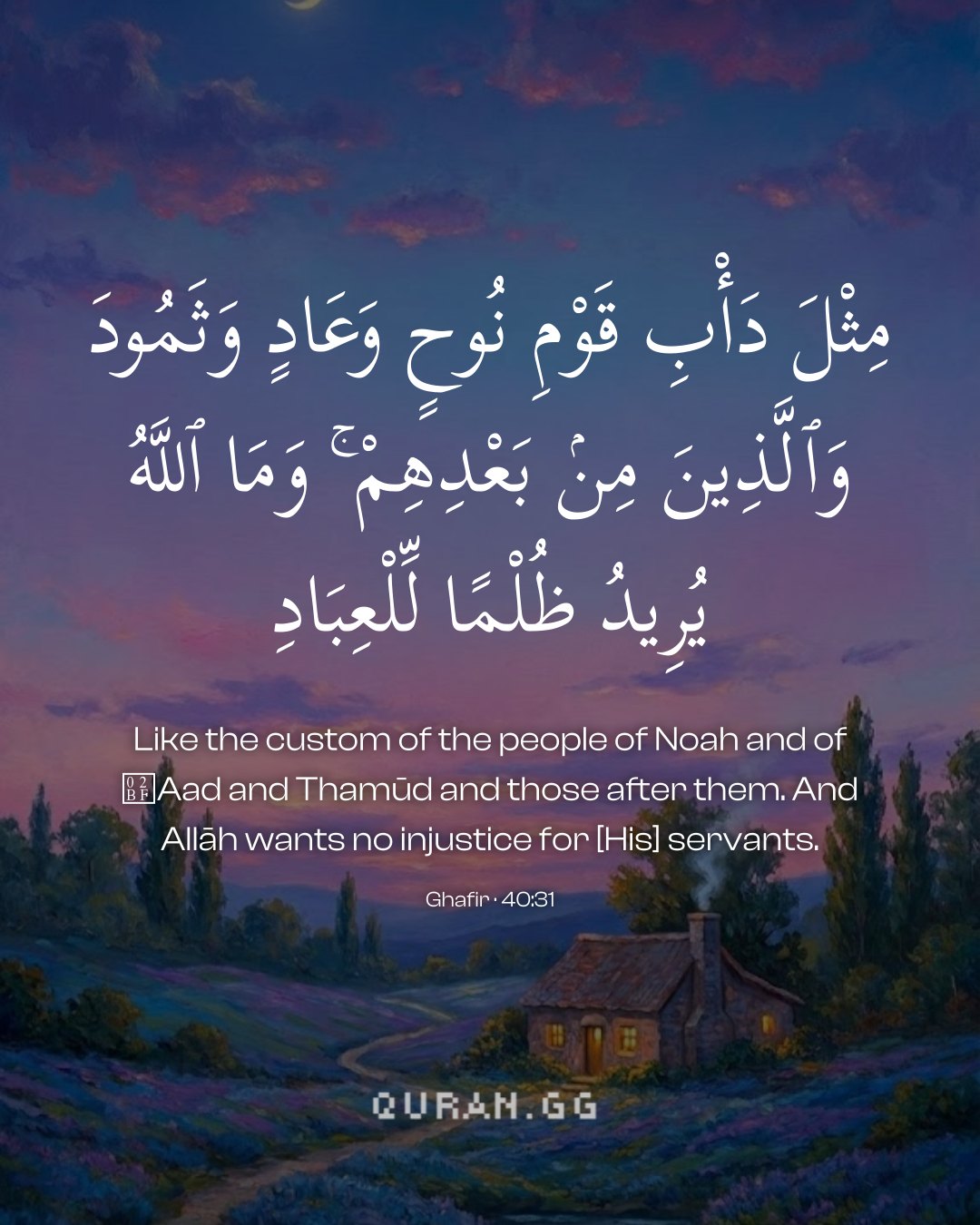
(O my people! Verily, I fear for you an end like that day (of disaster) of the groups (of old)!) meaning, those of the earlier nations who disbelieved the Messengers of Allah, such as the people of Nuh, `Ad, Thamud and the disbelieving nations who came after them, how the punishment of Allah came upon them and they had no one to protect them or ward off that punishment.
وَمَا اللَّهُ يُرِيدُ ظُلْماً لِّلْعِبَادِ
(And Allah wills no injustice for (His) servants.) means, Allah destroyed them for their sins and for their disbelief in and rejection of His Messengers; this was His command and His decree concerning them that was fulfilled. Then he said:
In verse 28, it was said: يَكْتُمُ إِيمَانَهُ (who had kept his faith secret). This tells us that a person who does not declare his 'iman (faith) before people, yet remains staunch in his faith by heart, then, this person is a believer. But, it stands proved from clear textual authority (of the Qur'an and Hadith) that, for 'iman to be acceptable, the simple certitude of the heart is not enough, instead, it is subject to the condition of a verbal confession and declaration. Unless the person concerned declares it verbally, he or she will not be regarded as a believer. However, making this verbal declaration before people publicly is not necessary. The only reason why it is needed is that unless people come to know about the person's 'iman, they would remain unable to interact with him or her in the same way as they do with Muslims. (Qurtubi)
Earlier in the verse, by saying: مُّؤْمِنٌ مِّنْ آلِ فِرْعَوْنَ (a believing man from the House of the Pharaoh), it is virtually demonstrated that the believer, in his ensuing dialogue with Pharaoh and his people, invited them toward truth and faith as well as restrained them from killing Sayyidna Musa (علیہ السلام) .
Tazkirul Quran
Maulana Wahiduddin KhanOn ayahs 29–32
The true believer mentioned here was a member of the royal family of Pharaoh and was probably one of the high-ranking officials of the court. This venerable gentleman had been influenced by Moses’ call to the Unity of God. However, he had kept his faith a secret. But, when he saw that Pharaoh intended to kill Moses, he openly came to his support. He defended Moses in a very wise and effective manner. This event teaches us that the dawah process is in itself a power which creates its sympathisers and supporters in the camp of dire opponents also, even if the enemy be as tyrannical as Pharaoh.
Uthmani text of the Madinah mushaf (King Fahd Complex). Translation: Saheeh International. Tafsir via Quran.com.