يقَوْمِ إِنِّى أَخَافُ عَلَيْكُمْ مِّثْلَ يَوْمِ الاٌّحْزَابِ
(O my people! Verily, I fear for you an end like that day (of disaster) of the groups (of old)!) meaning, those of the earlier nations who disbelieved the Messengers of Allah, such as the people of Nuh, `Ad, Thamud and the disbelieving nations who came after them, how the punishment of Allah came upon them and they had no one to protect them or ward off that punishment.
وَمَا اللَّهُ يُرِيدُ ظُلْماً لِّلْعِبَادِ
(And Allah wills no injustice for (His) servants.) means, Allah destroyed them for their sins and for their disbelief in and rejection of His Messengers; this was His command and His decree concerning them that was fulfilled. Then he said:
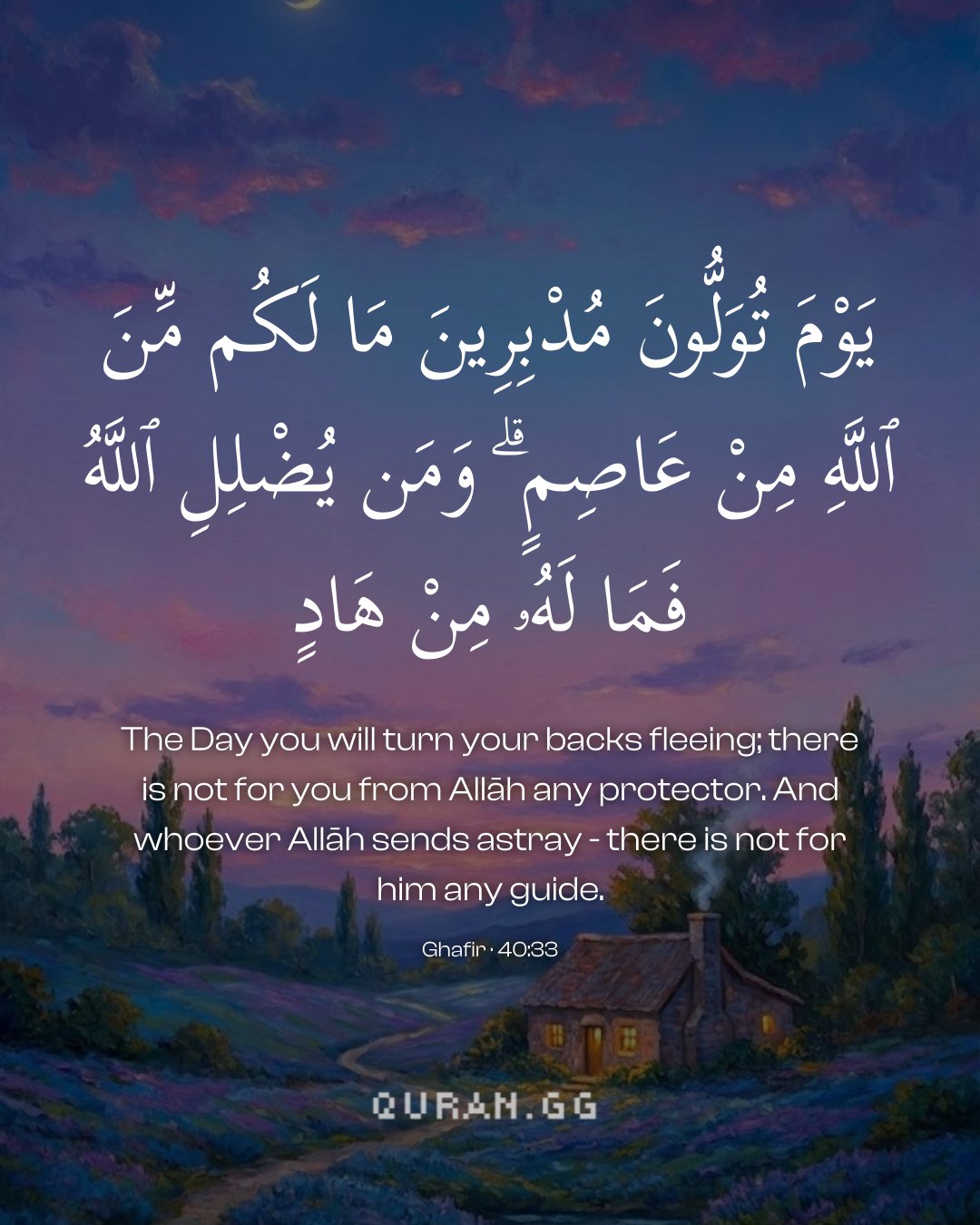
Continue reading the tafsir of ayahs 30–35 In verse 33, it was said: يَوْمَ تُوَلُّونَ مُدْبِرِينَ (a day when you will turn backon your heels,). In the summary of tafsir from Bayan-ul-Qur'an of Maulana Ashraf Thanavi (رح) (forming a part of the original Urdu edition of Ma’ ariful-Qur'an), it has been said with reference to Imam al-Baghawi that this is a description of the state in which culprits will be taken from the locale of reckoning out to the Jahannam. The outcome is that all calls and announcements mentioned in the explanation of 'yowm-ut-tanad' ('a day when people will call one another' ) would have been made and, after that, these people will be made to detour from the locale of reckoning on to their final destination towards the Jahannam.
And according to some commentators, this reflects the state that will prevail in the world at the time of the first blowing of the Horn, that is, when the Horn will be blown the first time, the earth will crack open, and they will start running here and there but there will be angels on every outlet, and there will be no way of escape. In the view of these commentators, this يَوْمَ التَّنَادِ (yowm-ut-tanad) too means the time of the first blowing of the Horn, for here too there will be calls and cries coming from all corners. This view finds it support from another قِرأت (qira'ah: rendition) of this verse reported from Sayyidna Ibn ` Abbas ؓ and Dahhak who used to recite the words: يَوْمَ التَّنَادِ (yowm-ut-tanad) with a tashdid (double sound) on the last letter: دال (dal) which is a derivation from the infinitive: ندّ (nadd) meaning to run away. Hence, according to this Tafsir, يَوْمَ التَّنَادِ will mean 'the day of running' and the expression: تُوَلُّونَ مُدْبِرِينَ (you will turn back on your heels 33) will become its explanation.
There is a lengthy Hadith in Tafsir Mazhari. It has been reported from Sayyidna Abu Hurairah ؓ with reference to Ibn Jarir, Musnad Abu Ya'la, al-Baihaqi, Musnad ` Abd Ibn Humaid and others. It mentions three soundings of the Horn on the day of Qiyamah. The first blowing of the Horn will cause consternation, the second, unconsciousness and the third, resurrection. The sonic outburst causing consternation will make the entire creation panic, then, this very outburst will become long enough to make everyone unconscious following which everyone will die. Generally, the combination of these two sonic outbursts has been called the first blowing of the Horn for the obvious reason that a single blowing will bring forth two manifestations, first - panic, then - swoon or unconsciousness. In this Hadith too, it has been mentioned that, at the time of the blowing causing consternation, people would be running around in panic: وَھُوَ الَّذِی یَقُولُ اللہ يَوْمَ التَّنَادِ (And that is what Allah says the day of myriad calls is) which tells us that, in this verse, the statement: يَوْمَ التَّنَادِ (yowm-ut-tanad) means people running around in panic at the time of the first blowing of the Horn. And Allah is Pure and High who knows best.
Pharaoh had threatened Moses with worldly punishment. In reply to this, the True Believer warned Pharaoh of the punishment of the Hereafter. This is always the method of the preacher of Truth. People fret about worldly affairs, but the preacher is focused on the Hereafter. People talk in terms of the world, while the preacher’s discourse is always about the Hereafter. People consider worldly problems to be the most pressing, while, for the preacher, the most pressing problem is that which is connected with the Hereafter.
Uthmani text of the Madinah mushaf (King Fahd Complex). Translation: Saheeh International. Tafsir via Quran.com.