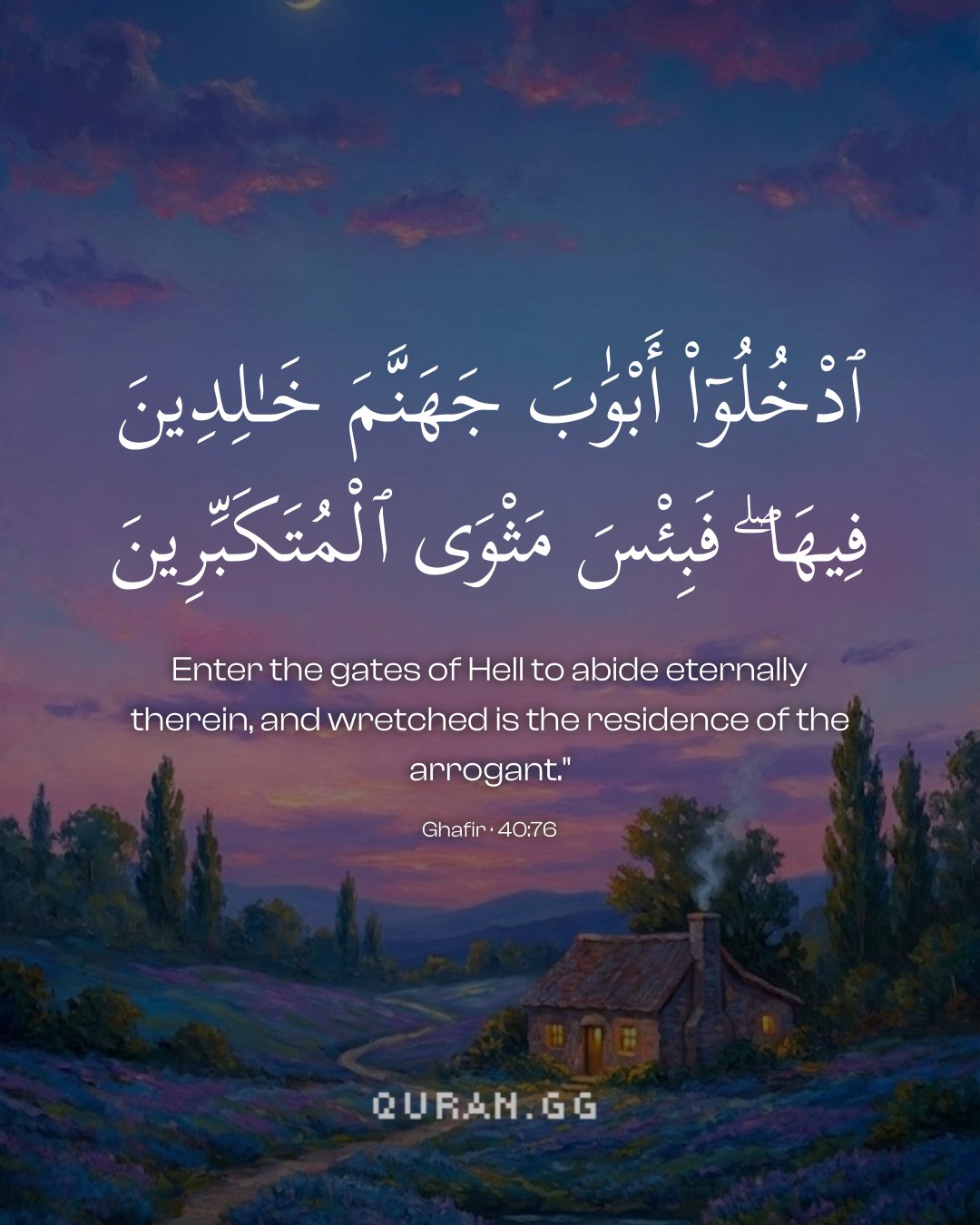
The End of Those Who dispute and deny the Signs of Allah
Allah says, `do you not wonder, O Muhammad, at those who deny the signs of Allah and dispute the truth by means of falsehood, how their minds are diverted from the truth and are misguided'
The word: تَفْرَحُونَ (tafrahun) in verse 75: (This is because you used to rejoice on the earth wrongfully,
and because you used to show arrogance.) has been derived from: فَرَح (farah) which means to be happy while the word: تَمْرَحُونَ (tamrahun) is from: مَرَح (marah) which means to exult unduly or to trample over the rights of others by priding on one's wealth and power. Hence, this kind of marah or undue exultation is absolutely blameworthy and Haram (unlawful). As for farah or marah, it can be explained by saying that seeking enjoyment out of sinfulness under the intoxication of wealth coupled with the absence of any thought of there being a God is certainly Haram and impermissible. Meant in this verse is this kind of farah - as it also appears in the story of Qarun (Korah) in the same sense: لَا تَفْرَحْ إِنَّ اللَّـهَ لَا يُحِبُّ الْفَرِحِينَ ("Do not exult. Surely, Allah does not like the exultant.-a1-Qasas, 28:76). There is another degree of farah - that one takes good things of life as blessings from Allah Ta’ ala, and expresses his or her joy on having these - this is permissible, in fact, is recommended (mustahabb), and desirable. It is about such farah that the Qur'an has said: فَبِذَٰلِكَ فَلْيَفْرَحُوا (with these they should rejoice Yunus, 10:58). As for marah, it is a cause of punishment absolutely, without any restriction. Therefore, no qualifying words were added to it. But, in the case of farah, the words: بِغَیرِالحَقِ (bi ghayril-haqq: wrongfully) are added. It was thus pointed out that jubilating over the undue and the impermissible was forbidden (Haram) while being pleased with blessings that are rightful and permissible as an expression of gratitude was an act of ` ibadah (worship of Allah) and thawab (reward from Him).
Who were the ones who were happy with untruth and indulged in false pride? These were men who held great stature in their times. They attained some worldly elevation, which alongwith their material possessions made them arrogant and vain. Their success in worldly matters had developed in them a false impression that they were the ones who had attained success, though in actual fact they were the truly deprived people. As the high ranking men of a society become the rejecters of the Truth, the common people also follow them and start denying the Truth. In these verses, a scene of the world Hereafter has been described, when these people will be cast into Hell to be punished for their arrogant behaviour. Their overweening pride would have ultimately dragged them to such low levels that they will find no way to uplift themselves from their position.
Uthmani text of the Madinah mushaf (King Fahd Complex). Translation: Saheeh International. Tafsir via Quran.com.