There must be a Group of People Who forbid Lewdness
Allah, the Exalted, says that there should have been a group of wise people present among the past generations who called to good and forbade the evil and corruption that took place among them in the land. His statement,
إِلاَّ قَلِيلاً
(except a few) This means that there were only a small number of people present among them who were of this caliber. They were those whom Allah saved at the sudden striking of His vengeance, when His anger was let lose. For this reason Allah commanded this noble Ummah (followers of Muhammad ) to always have among them those who command the good and forbid the evil. This is as Allah says,
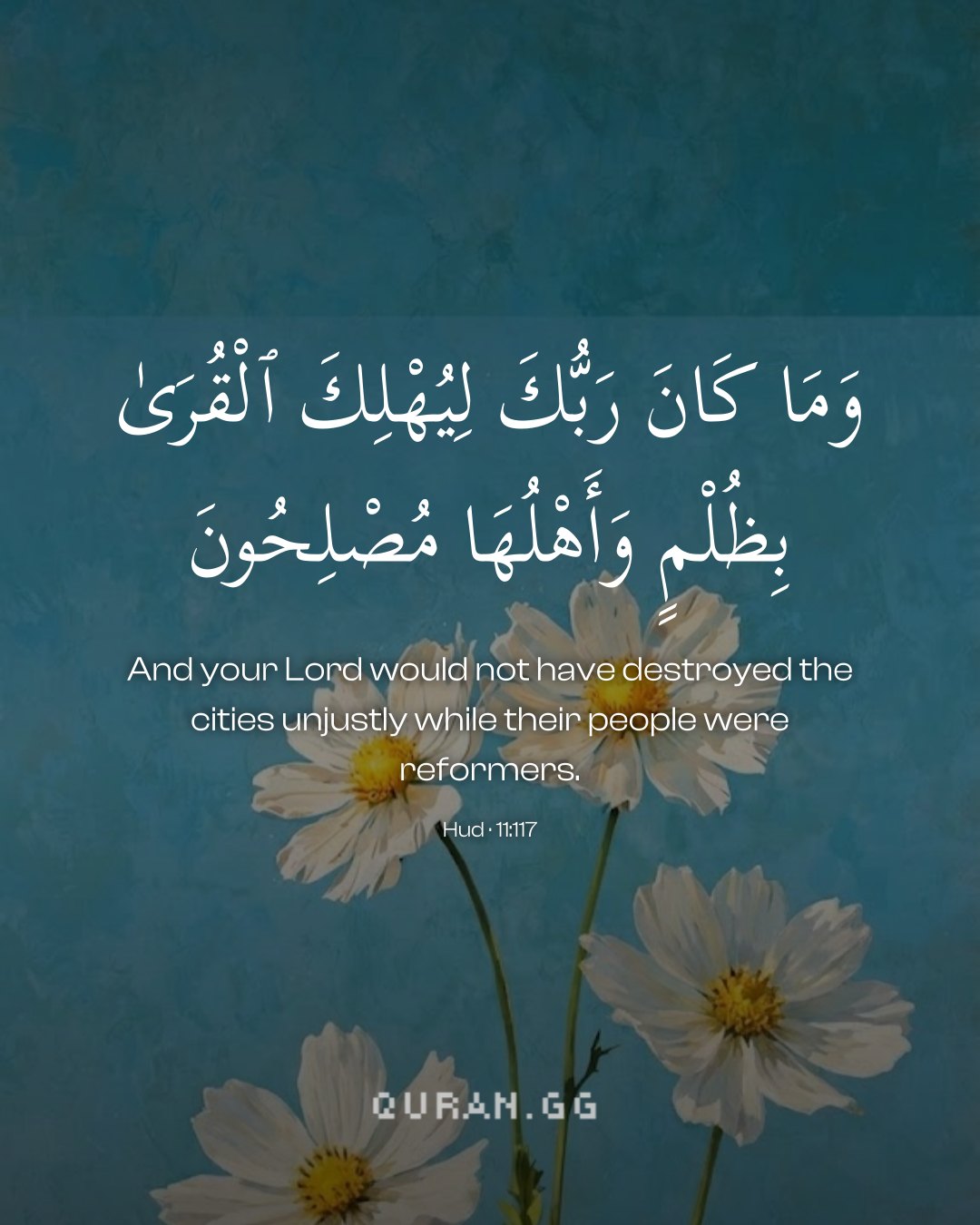
It was said in the fourth verse (117) that Allah does not destroy towns and habitations unjustly while people living there are good in their ways, that is, they are believing Muslims. The sense is that the probability of injustice and oppression does not exist with Allah Ta` ala. Those destroyed deserve being destroyed. Some early commentators have said that the word: ظُلُم ` zulm' (injustice) in this verse means shirk (ascribing of partners in the pristine divinity of Allah) and مُصلِحُون ` muslihun' (people good in their ways) refers to people who, de-spite being Mushriks and Kafirs, are good in morals and dealings, do not hurt and cause pain to anyone, do not lie and do not cheat. Thus, the sense of the verse comes to be that the punishment of the world does not fall on a people simply because of their being Mushriks and Kafirs - unless they were to spread disorder in the land by their very deeds and morals. The cause of all punishments that came upon the past peoples was but their particular evil deeds. The people of Sayyidna Nub (علیہ السلام) caused him all sorts of pains. The people of Sayyidna Shu'aib ؓ spread disorder by weighing and measuring short. The people of Sayyidna Lut (علیہ السلام) ، took to the worst type of evil act. The people of Sayyidna Musa and ` Isa (علیہما السلام) oppressed their prophets. The Holy Qur'an says that these very misdeeds were the reason why punishment came upon them. Divine punishment does not come in this world because of bland Kufr and Shirk. The everlasting punishment of the fire of Hell is its punishment. Therefore, some ` Ulama' have said that countries and governments can survive with Kufr and Shirk, but they cannot survive with injustice and oppression.
Tazkirul Quran
Maulana Wahiduddin KhanOn ayahs 117–118
Here ‘generation before you’ means previous People of the Book, i.e. believing communities. A community faces ruination when the worldly good things given by God to its people with the purpose of developing feelings of gratitude in them, become instead a source of lust and create the urge to seek after material things. Under these circumstances, the tasks which need to be carried out for the reformation of the Muslim community are known in the terminology of the Islamic law as al-Amr bi’l-Ma‘ruf wa’n-Nahy ‘an al-Munkar, that is, exhorting righteousness and preventing individuals from indulging in sinful acts. This admonition specifies the responsibility placed on a Muslim with regard to his immediate neighbours. This means that in a Muslim society, there should always be some individuals who should remind Muslims of God and the Hereafter, who should keep a watch on people’s morals and who should try to keep them on the right path in all their dealings. The non-existence of such righteous individuals in a community is generally for one of two reasons—either the whole community has morally deteriorated and there is not a single righteous person left in it. Or else, there may still be certain righteous people, but due to the all-pervasive evil, they may not be able to find the courage to open their mouths. They may be afraid that if they spoke the Truth, they would lose the respect of their community. In both the above-mentioned cases, the community loses God’s esteem and becomes liable to be afflicted by God’s retribution in one form or the other.
Uthmani text of the Madinah mushaf (King Fahd Complex). Translation: Saheeh International. Tafsir via Quran.com.