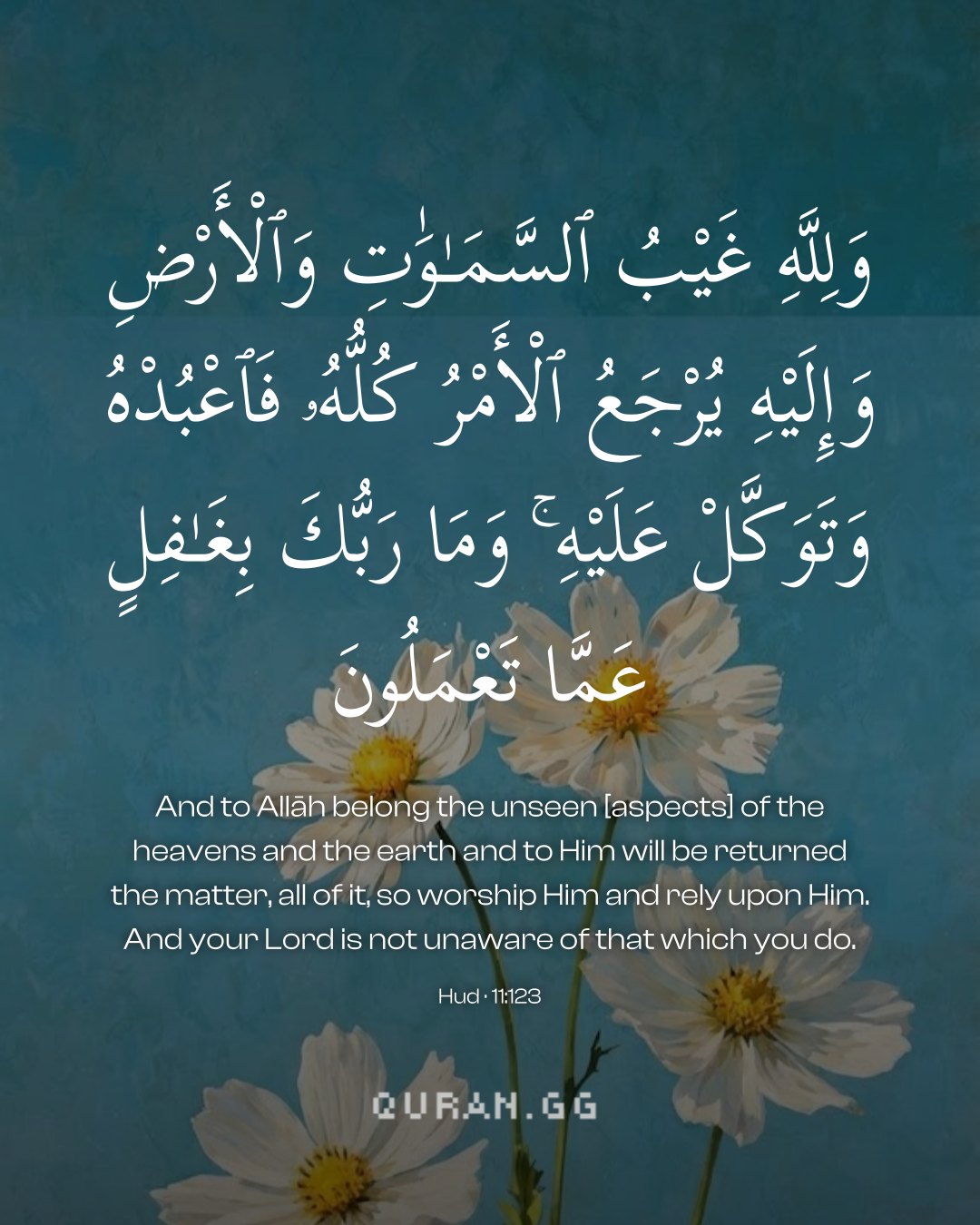
And to Allāh belong the unseen [aspects] of the heavens and the earth and to Him will be returned the matter, all of it, so worship Him and rely upon Him. And your Lord is not unaware of that which you do.
Allah, the Exalted, informs that He is the All-Knower of the unseenof the heavens and the earth and that unto Him is the final return.
He explains that everyone who does a deed, He will give them their deed (reward for it) on the Day of Reckoning. Unto Him belongs the creation and the command. Then He, the Exalted, commands that He should be worshipped and relied upon, for verily, He is sufficient for whoever trusts and turns to Him. Concerning His statement,
وَمَا رَبُّكَ بِغَـفِلٍ عَمَّا تَعْمَلُونَ
(And your Lord is not unaware of what you do.) This means, `The lies (of the disbelievers) against you O Muhammad are not hidden from Him. He is the All-Knower of the conditions of His creatures and He will give them the perfect recompense for their deeds in this life and the Hereafter. He will aid you (Muhammad) and His party over the disbelievers in this life and in the Hereafter.' This is the end of the Tafsir of Surah Hud, and all praises and thanks are due to Allah.
Ma'arif al-Qur'an
Mufti Muhammad ShafiOn ayahs 118–123
Difference: Blameworthy and Praiseworthy
When it was said in the fifth verse (118) - ` had your Lord willed, He would have made all the people a single community' - the sense is that had it been the will of Allah, He would have made all human beings accept Islam by force. All of them would have then become nothing but Muslims without any difference remaining between them. But, such are the dictates of His wisdom that, in this world, Allah Ta` ala does not compel anyone to do something. Instead, He has entrusted man with a kind of choice under which he could do whatever good or bad he wishes to do. Then, human temperaments differ, ways differ and deeds differ. The outcome is that there always will be some people who would keep at loggerheads against the true faith - of course, with the exception of those whom Allah Ta` ala has blessed with His mercy, that is, those who have been following the noble prophets.
The events in the lives of the prophets have been narrated in the Quran, so that the later dayees should learn a lesson from them. In these events the preacher sees that their addressee-communities quarrelled with them, abused them by giving a twist to their straightforward discourses, subjected them to all sorts of hardship and rejected them as if they had no value at all. But, finally God helped them and their word carried the day. All the attacks of their opponents failed. The different fates of the believers and unbelievers became manifest in their initial form in this world itself, and will appear in their most perfect form in the Hereafter. With the help of these examples, the call-giver acquires the confidence, based on history, that there is no question of his being disappointed by or being terrified of the difficulties faced by him while calling for the Truth. Such difficulties always arise in dawah work, but he knows that he too will finally be successful, just as success was achieved by all the previous prophets.
Uthmani text of the Madinah mushaf (King Fahd Complex). Translation: Saheeh International. Tafsir via Quran.com.