Surah Hud Ayah 23 (11:23) — Meaning & Tafsir | Quran.GG

Surah Hud, Ayah 23

11:23 · Meaning and tafsir

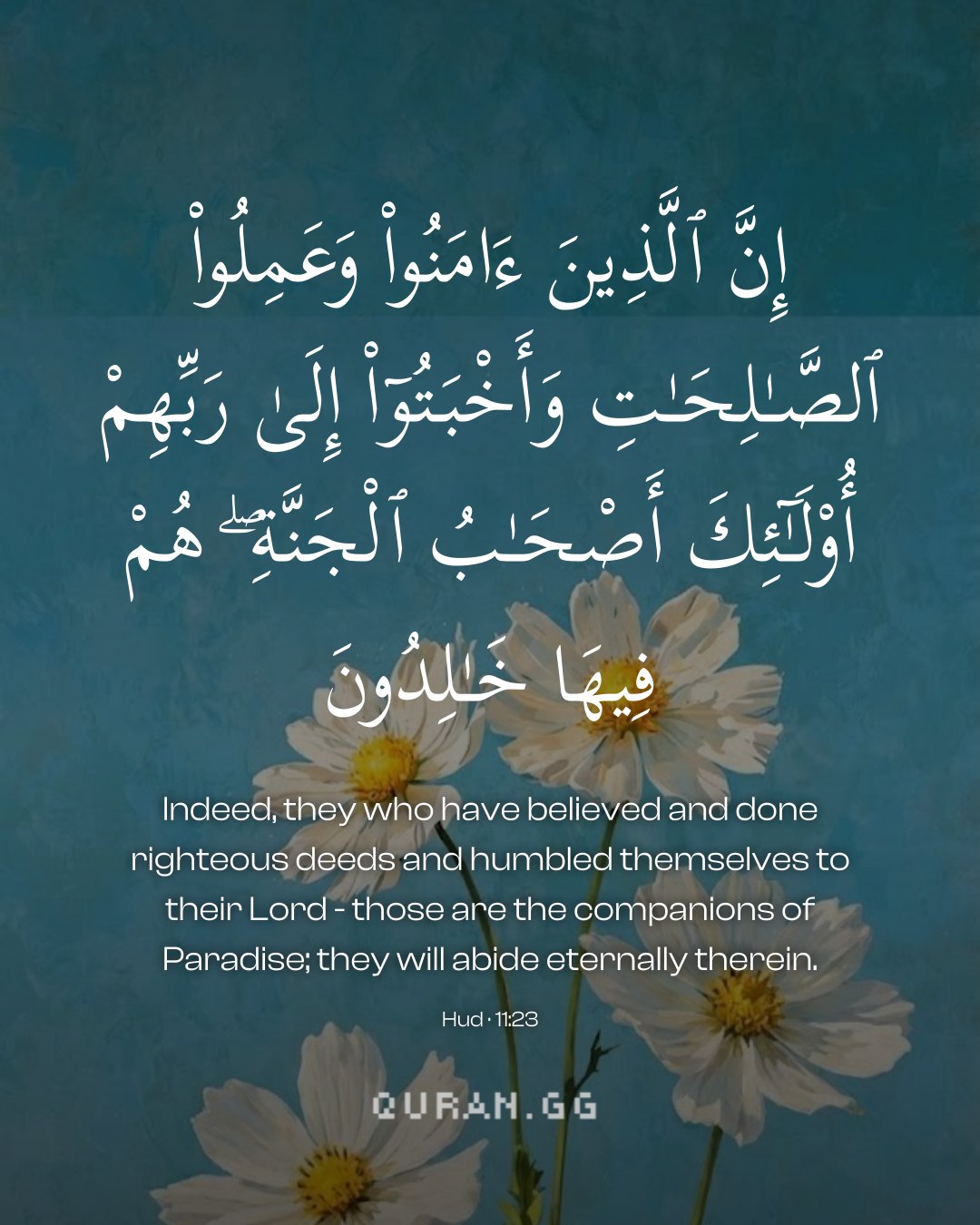
إِنَّ ٱلَّذِينَ ءَامَنُوا۟ وَعَمِلُوا۟ ٱلصَّـٰلِحَـٰتِ وَأَخْبَتُوٓا۟ إِلَىٰ رَبِّهِمْ أُو۟لَـٰٓئِكَ أَصْحَـٰبُ ٱلْجَنَّةِ ۖ هُمْ فِيهَا خَـٰلِدُونَ ٢٣

Indeed, they who have believed and done righteous deeds and humbled themselves to their Lord - those are the companions of Paradise; they will abide eternally therein.

Surah Hud 11:23 in Arabic with its translation: “Indeed, they who have believed and done righteous deeds and humbled themselves to their Lord - those are the…”

Make something with this ayah

Turn it into a video for Stories, Reels or TikTok, recited by the reciter you pick, or an image on a background you choose. Free, in your browser.

Download this image

Tafsir Ibn Kathir (abridged)

Rewarding the People of Faith

When Allah, the Exalted, mentioned the condition of the wretched, He also commended the people of delight (the believers). They are those who believe and work righteous deeds. Thus, their hearts believed and their limbs worked righteous deeds, both in statements and actions. This includes their performance of deeds of obedience and their abandonment of evils. In this way they are the inheritors of Gardens (of Paradise), which contain lofty rooms and seats arranged in rows. Therein they will find bunches of fruit near to them, elevated couches, fair and beautiful wives, various types of fruit, desired kinds of food and delicious drinks. They also will be allowed to see the Creator of the heavens and the earth and they will be in this state of pleasure forever. They will not die, nor will they grow old. They will not experience sickness, nor will they sleep. They will not have excrement, nor will they spit or snot. Their sweat will be the perfume of musk.

The Parable of the Believers and the Disbelievers

Then, Allah, the Exalted, makes a parable of the disbelievers and the believers. He says,

مَثَلُ الْفَرِيقَيْنِ

(The likeness of the two parties) This refers to those disbelievers whom Allah first described as wretched, and then those believers whom He described with delightfulness. The first group is like one who is blind and deaf, while the second group is like he who sees and hears. Thus, the disbeliever is blind from the truth in this life and in the Hereafter. He is not guided to goodness, nor does he recognize it. He is deaf from hearing the proofs, thus he does not hear that which would benefit him. As Allah says,

وَلَوْ عَلِمَ اللَّهُ فِيهِمْ خَيْرًا لأَسْمَعَهُمْ

(Had Allah known of any good in them, He would indeed have made them listen.)8:23 The believer is smart, bright and clever. He sees the truth and distinguishes between the truth and falsehood. Thus, he follows the good and abandons the evil. He hears and distinguishes between the proof and scepticism. Therefore, falsehood does not overcome him. Are these two types of people alike

أَفَلاَ تَذَكَّرُونَ

(Will you not then take heed) This statement means, "Will you not consider, so that you may distinguish between these two categories of people." This is as Allah mentions in another verse,

لاَ يَسْتَوِى أَصْحَـبُ النَّارِ وَأَصْحَـبُ الْجَنَّةِ أَصْحَـبُ الْجَنَّةِ هُمُ الْفَآئِزُونَ

(Not equal are the dwellers of the Fire and the dwellers of the Paradise. It is the dwellers of Paradise that will be successful.)59:20 Allah also says,

وَمَا يَسْتَوِى الاٌّعْمَى وَالْبَصِيرُ - وَلاَ الظُّلُمَاتُ وَلاَ النُّورُ - وَلاَ الظِّلُّ وَلاَ الْحَرُورُ - وَمَا يَسْتَوِى الاٌّحْيَآءُ وَلاَ الاٌّمْوَاتُ إِنَّ اللَّهَ يُسْمِعُ مَن يَشَآءُ وَمَآ أَنتَ بِمُسْمِعٍ مَّن فِى الْقُبُورِ - إِنْ أَنتَ إِلاَّ نَذِيرٌ - إِنَّآ أَرْسَلْنَـكَ بِالْحَقِّ بَشِيراً وَنَذِيراً وَإِن مِّنْ أُمَّةٍ إِلاَّ خَلاَ فِيهَا نَذِيرٌ

(Not alike are the blind and the seeing. Nor are (alike) darkness and light. Nor are (alike) the shade and the sun's heat. Nor are (alike) the living and the dead. Verily, Allah makes whom He wills to hear, but you cannot make hear those who are in graves. You are only a warner. Verily, We have sent you with the truth, a bearer of glad tidings and a warner. And there never was a nation but a warner had passed among them.)35:19-24

Ma'arif al-Qur'an

The word: bayyinah (بینہ) appearing in this verse refers to the Qur'an. As for the meaning of ` shahid' (شاھِد evidence), statements of Tafsir authorities differ. The author of Bay-an a1-Qur'an takes ` shahid' to mean the miracle of the Qur'an that is present in the Qur'an as such. Thus, it comes to mean that those who adhere to the Qur'an, they already have a witness to the veracity of the Qur'an within it, that is, its miracle. Then, the other witness has already come in the form of Torah. Sayyidna Musa (علیہ السلام) had brought it as guidance and mercy for people. The reason is that the Torah confirms the truth of the Qur'an clearly.

Continue reading the tafsir of ayahs 17–24

Tazkirul Quran

The real reasons for people’s sinful behaviour and their failure to treat the divine message with due respect were their lack of any firm belief in the Hereafter and their having no fear in their hearts for Almighty God. It was this fearlessness which caused them to treat the divine message without the seriousness it deserved. And anything about which an individual is not serious will fail to elicit the correct response from him. But such insincerity and lack of seriousness will vanish when people stand before the Lord of the Universe on the Day of Judgement. At that time they will have lost their present freedom. The worldly goods and resources on the strength of which they had become arrogant, will turn into God’s tape-recorders, which will start giving evidence against them. At that time it will be abundantly clear that the reason for their rejection of God’s preacher was not that they were unable to understand him, but rather that they were not serious about him. The horror of Doomsday will suddenly make them serious. At that time, in the face of their own helplessness, they will understand all that they had been unable to understand while living in the world in an atmosphere of freedom. God has blessed man with fine capabilities and talents. If he utilises them, he can understand any subject in depth. In his worldly matters, he actually utilises these talents, but when it comes to the Hereafter, he becomes deaf, in spite of having ears. He becomes blind, in spite of having eyes. Man’s success depends entirely upon his sincerity. Those who are sincere in worldly matters are successful in them. Similarly, those who are sincere in matters of the Hereafter will be successful in the Hereafter.

Continue reading the tafsir of ayahs 22–23

Uthmani text of the Madinah mushaf (King Fahd Complex). Translation: Saheeh International. Tafsir via Quran.com.