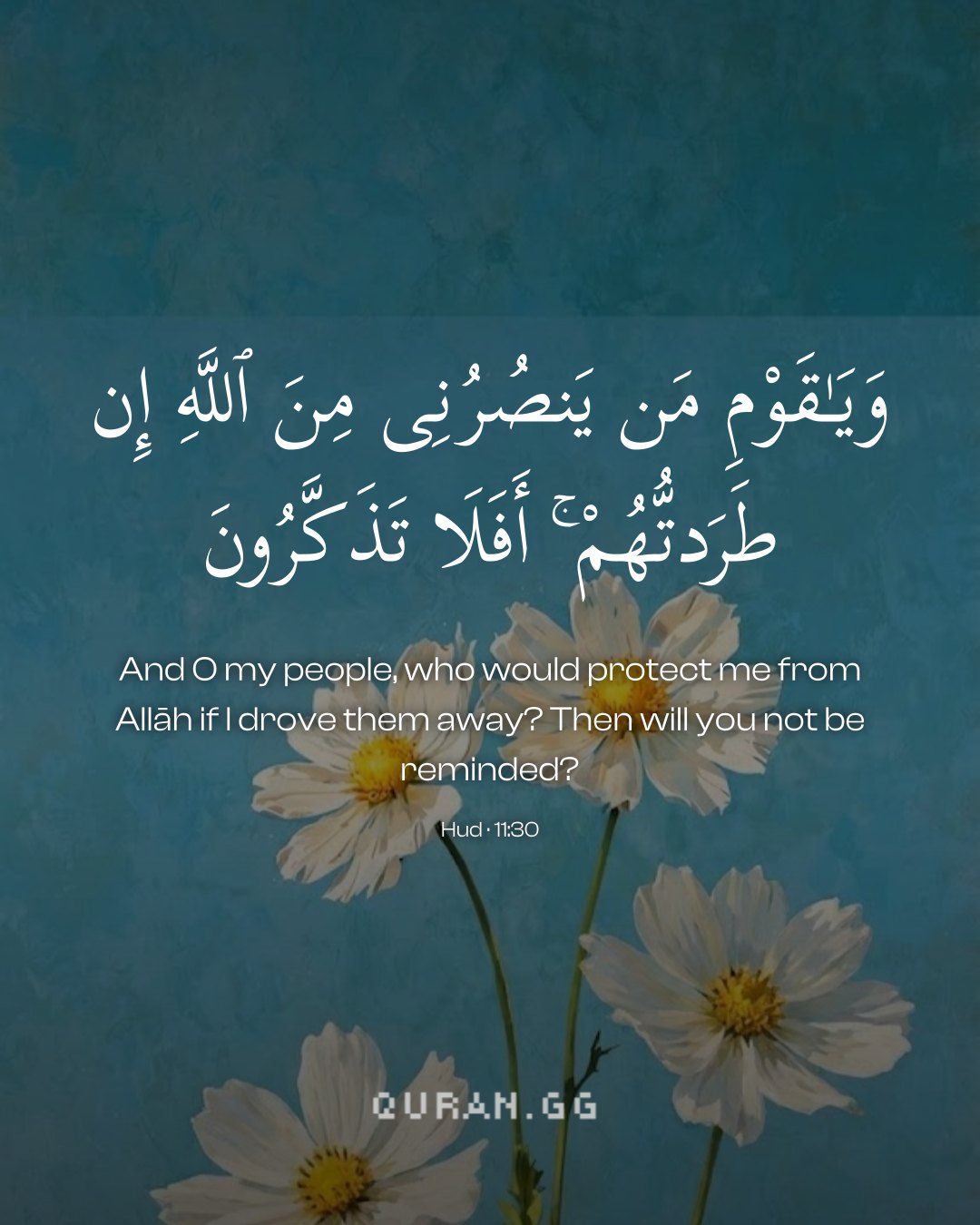
(I am not going to drive away those who have believed.) This alludes to the fact that they (the disbelievers) requested Nuh to disassociate himself from the believers, because they were averse to them and felt themselves too important to sit with them. This is similar to the request of disbelievers to the seal of the Messengers ﷺ to disassociate himself from a group of the people who were considered weak in their social status. They wanted the Prophet to sit with them in a special gathering of the elite. Therefore, Allah revealed,
(Thus We have tried some of them with others, that they might say: "Is it these (poor believers) whom Allah has favored from among us" Does not Allah know best those who are grateful)6:53
Ma'arif al-Qur'an
Mufti Muhammad ShafiOn ayahs 29–30
Then, they were told: ` As for the condition you impose that I should remove the poor from my company in order that you could believe, then let it be very clear that I cannot do that. They may be poor but they are close to the Highest of the high, the greatest honor one can have. Turning such people out is not a right thing to do.'
And: مُّلَاقُو رَبِّهِمْ (They are surely to meet their Lord) could also mean: If, supposedly, I were to turn them out, when they go to their Lord on the day of Qiyamah and complain, what would I have to say? The subject continues in the fourth verse (30): If I were to turn them out, who would save me from Divine punishment? At the end, it was said: All this is nothing but your ignorance and heedlessness. To you being a man is counter to being a prophet, or you go to the other extreme and demand that poor people should be driven away from his company.
Tazkirul Quran
Maulana Wahiduddin KhanOn ayahs 29–30
Here ‘baiyyinah’ means argument, while ‘rahmah’ means prophethood. (Tafsir an-Nafasi). When a prophet preaches to a community, he takes a stand on these two things. After the Prophet, a preacher will be a true preacher only when he takes a stand on precisely these two things, with the difference that whatever inspiration he has will be what he indirectly received from the Prophet, while the Prophet received it directly from God. When a community ignores the messenger of God, thinking that from the worldly point of view he has nothing of value for them, at that very time he is in a position to give them very great and valuable things, i.e. argument and guidance. The greatness of reasoning and guidance is totally at the command of the messenger. This is an important part of his inner and intangible greatness, but how can those whose eyes are fixed on outward glamour appreciate it?
Uthmani text of the Madinah mushaf (King Fahd Complex). Translation: Saheeh International. Tafsir via Quran.com.