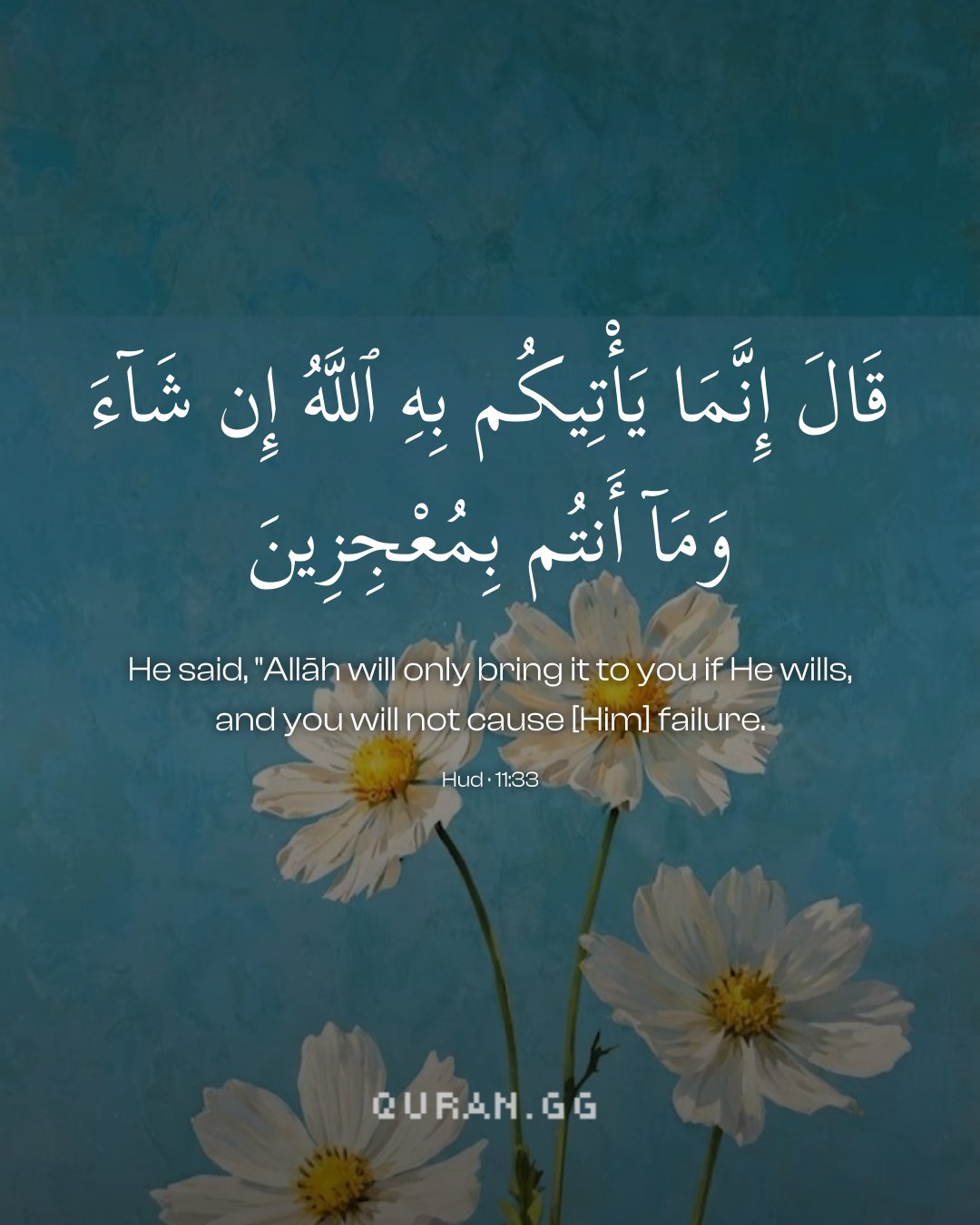
The People's Request of Nuh to bring the Torment and His Response to Them
Allah, the Exalted, informs that the people of Nuh sought to hasten Allah's vengeance, torment, anger and the trial (His punishment). This is based on their saying,
(They said: "O Nuh! You have disputed with us and much have you prolonged the dispute with us...") They meant by this, "You (Nuh) have argued with us long enough, and we are still not going to follow you."
فَأْتِنَا بِمَا تَعِدُنَآ
(now bring upon us what you threaten us with,) What he (Nuh) promised is referring to the vengeance and torment (from Allah). They were actually saying, "Supplicate against us however you wish, and let whatever you have supplicated come to us."
Fourthly, it was stated: In your sight these poor people may appear lowly and disgraceful. But, I cannot say as you say that Allah Ta'ala will not bless them with what is good, because good relates to one's heart, not wealth, and only Allah knows the secrets of hearts and He knows whose heart is worthy of receiving good and whose heart is not.
Then, it was said: If I too were to start calling them lowly and disgraceful, I too would become unjust.
Tazkirul Quran
Maulana Wahiduddin KhanOn ayahs 31–33
The task of calling upon people to bow to God relates purely to the Hereafter. In order to ensure its success, it is absolutely necessary that there should be no disputes relating to money, land or property between the call-giver and his addressees. The call-giver himself has to shoulder the responsibility of maintaining a normal atmosphere between himself and his addressees, and for that purpose, he should unilaterally put an end to all types of material and economic disputes. That preacher who, on the one hand, makes a plea for the acceptance of Truth and, on the other, agitates and makes demands about worldly things is not a preacher in the real sense but a charlatan. He can have no value in the eyes either of his addressees or of God. The test of the addressee is that he should be able to see the greatness of Truth in an ordinary man. Conversely, the preacher should not welcome an irreligious person simply because he possesses property and status, nor should he disregard a religious person simply because he does not possess the trappings of worldly pomp and glory. If a preacher does so, it means that by word of mouth he delivers sermons about the importance of the Hereafter, while in practice he proves himself to be one who attaches greater importance to the world. Obviously, this amounts to contradicting oneself, and the word of such a person has no value in the eyes of others.
Uthmani text of the Madinah mushaf (King Fahd Complex). Translation: Saheeh International. Tafsir via Quran.com.