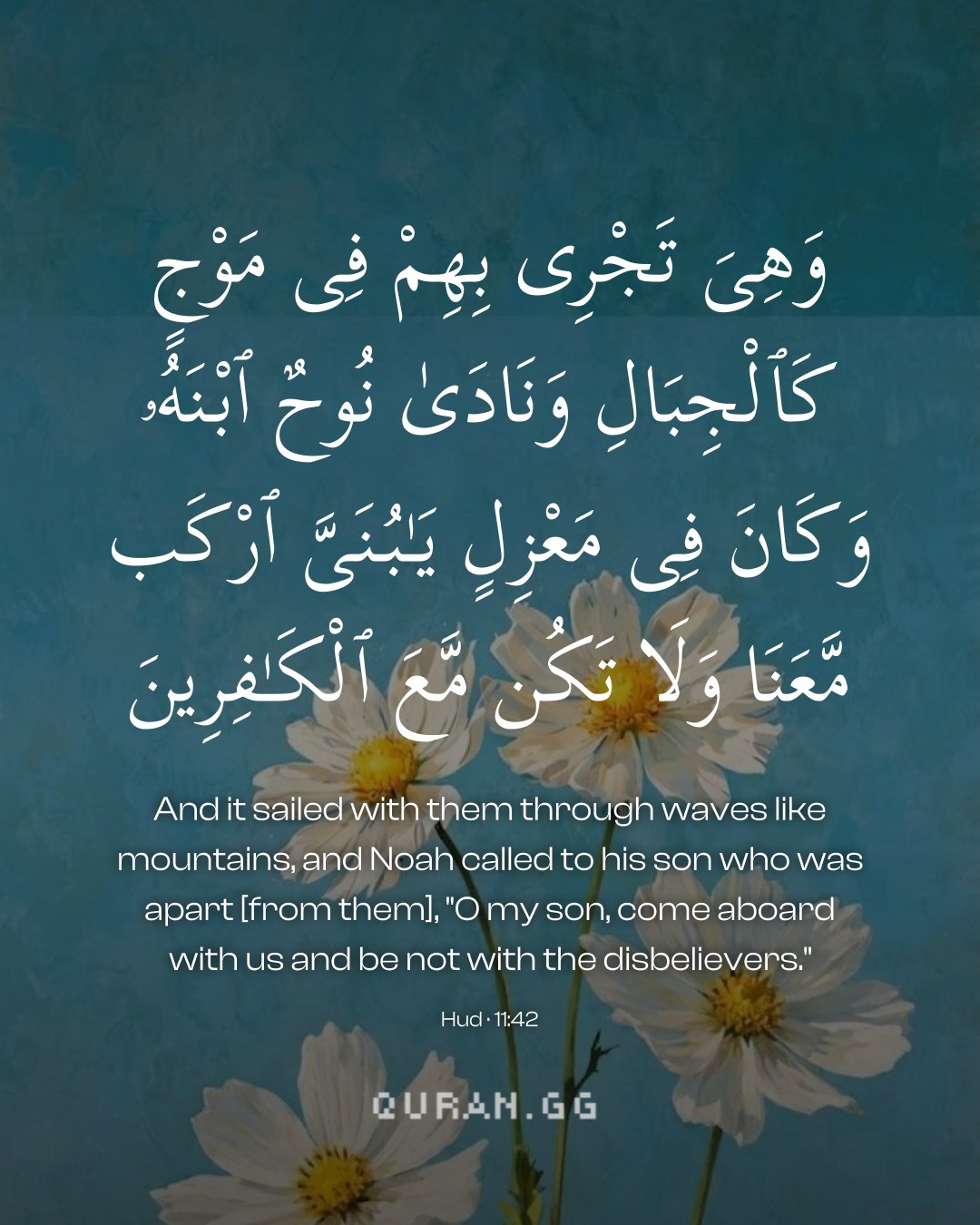
The beginning of the Flood and Nuh loads Every Creature in Pairs upon the Ship
This was the promise of Allah to Nuh , when the command of Allah came, the rain was continuous and there was a severe storm which did not slacken or subside, as Allah said,
فَفَتَحْنَآ أَبْوَبَ السَّمَآءِ بِمَاءٍ مُّنْهَمِرٍ - وَفَجَّرْنَا الاٌّرْضَ عُيُوناً فَالْتَقَى المَآءُ عَلَى أَمْرٍ قَدْ قُدِرَ - وَحَمَلْنَاهُ عَلَى ذَاتِ أَلْوَحٍ وَدُسُرٍ - تَجْرِى بِأَعْيُنِنَا جَزَآءً لِّمَن كَانَ كُفِرَ
(So We opened the gates of the heaven with water pouring forth. And We caused springs to gush forth from the earth. So the waters (of the heaven and the earth) met for a matter predestined. And We carried him on a (ship) made of planks and nails. Floating under Our Eyes: a reward for him who had been rejected!)54:11-14 In reference to Allah's statement,
Continue reading the tafsir of ayahs 40–43 As stated in the second (42) and third (43) verse, when the whole family of Sayyidna Nuh (علیہ السلام) had boarded the ark, a son whose name has been reported as Kin` an (Canaan) was left out. Out of his paternal compassion, Sayyidna Nuh (علیہ السلام) called out to him asking him to come on board and warning him that he should not stay in the company of disbelievers otherwise he would be drowned with them. This young man was already in league with those disbelieving enemies, in fact, was himself a disbeliever. But, in all likelihood, Sayyidna Nuh (علیہ السلام) did not know that he was a disbeliever. And even if he did know that, the good counsel he gave to his son to board the boat and leave the company of the disbelievers was in the spirit of asking him to repent from disbelief and enter the fold of faith. But, the unfortunate son still took the flood to be something that will pass away and told him not to worry about him for he would be safe from the flood by climbing a mountain. Sayyidna Nuh warned him again that nothing was going to save anyone, not even a mountain, from the punishment of Allah on that day and that there was no way one could remain safe from it unless Allah Himself were to show mercy to him. This father-son di-alogue was on from a distance when rose a wave of the flood and took him down and away. Historical reports say that the level of the Flood was fifteen yards above the highest mountain peak and according to some other reports, it was forty yards high.
In the fourth verse (44), the recession of the flood and the return of things to normal conditions has been described in a particular manner. Addressing the earth, Allah Ta` ala commanded: يَا أَرْضُ ابْلَعِي مَاءَكِ (0 earth, suck in your water). The sense was that the amount of water which had bulged out from the earth was to be taken back in by the earth. The sky was commanded to stop raining. The water from rains that had already accumulated on the earth, nature channeled it into rivers and streams for human beings to benefit by it. (Tafsir Qurtubi, Mazhari)
In this verse, Allah Ta` ala has given His commands by addressing the heaven and the earth, although these are no sensate entities, at least outwardly. Therefore, some commentators have taken it in a figurative sense. But, the fact of the matter is that, in terms of our perception, things in the world which appear non-conscious, insensate, and lifeless are, in all reality, live and conscious. Yes, their consciousness and perception are not of a level as given to humankind and others, therefore, by declaring them to be inanimate, they were not obligated with the percepts and injunctions of the Shari'ah. Many verses of the Holy Qur'an confirm it, such as: وَإِن مِّن شَيْءٍ إِلَّا يُسَبِّحُ بِحَمْدِهِ (and there is no such thing which does not glorify Him with praises - 17:44). And it is obvious that the glorification of Allah Ta` ala depends on knowing Him, and knowing, on reason and consciousness. This tells us that everything has reason and consciousness according to its respective capacity. From it, it recognizes its creator and whatever it has been as-signed to do by Him. Everything knows it fully well and keeps doing it staunchly as due. The verse of the Qur'an: أَعْطَىٰ كُلَّ شَيْءٍ خَلْقَهُ ثُمَّ هَدَىٰ (gave each thing its form then guided [ it ] - Taba, 20:50) means exactly this. Therefore, in this verse, if the address to the heaven and the earth is taken in the real sense, it does not matter. Sage Rumi said:
خاک و باد و آب و آتش بندہ اند بامن و تو مردہ باحق زندہ اند
Dust, air, water and fire are all 'servants'
For you and me, dead, but with Him, live.
Uthmani text of the Madinah mushaf (King Fahd Complex). Translation: Saheeh International. Tafsir via Quran.com.