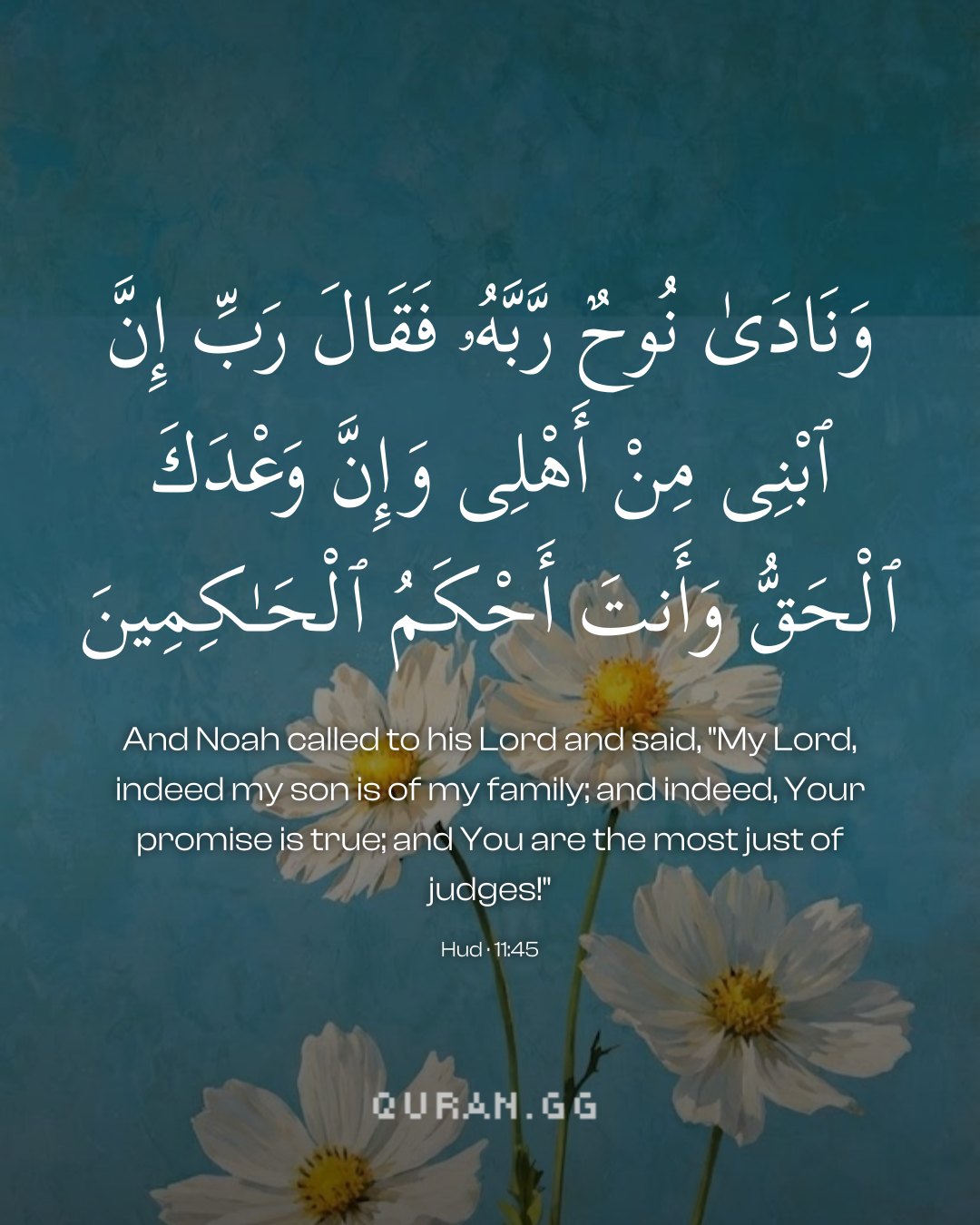
A Return to the Story of the Son of Nuh and mentioning what transpired between Nuh and Allah concerning Him
This was a request for information and an inquiry from Nuh concerning the cirumstances of his son's drowning.
فَقَالَ رَبِّ إِنَّ ابُنِى مِنْ أَهْلِى
(and said, "O my Lord! Verily, my son is of my family!") This means, "Verily, You promised to save my family and Your promise is the truth that does not fail. Therefore, how can he (my son) be drowned and You are the Most Just of the judges"
قَالَ ينُوحُ إِنَّهُ لَيْسَ مِنْ أَهْلِكَ
(He (Allah) said: "O Nuh! Surely, he is not of your family...") This means, "He (your son) is not of those whom I promised to save. I only promised you that I would save those of your family who believe." For this reason Allah said,
وَأَهْلَكَ إِلاَّ مَن سَبَقَ عَلَيْهِ الْقَوْلُ مِنْهُمْ
l(and your family except him against whom the Word has already gone forth.) 11:40 Thus, for his son, it had already been decreed that he would be drowned due to his disbelief and his opposition to his father, the Prophet of Allah, Nuh peace be upon him. Concerning Allah's statement,
إِنَّهُ لَيْسَ مِنْ أَهْلِكَ
(Surely, he is not of your family;) meaning that he (Nuh's son) was not among those whom Allah promised to save. `Abdur-Razzaq recorded that Ibn `Abbas said, "He was the son of Nuh, but he opposed him in deeds and intention." `Ikrimah said in some of the modes of recitation it said here, (إِنَّهُ عَمِلَ عَمَلًا غَيْرَ صَالِحٍ) "Verily, he (Nuh's son) worked deeds that were not righteous."
Ma'arif al-Qur'an
Mufti Muhammad Shafi
Commentary
The remaining account of the flood associated with the name of Sayyidna Nuh along with instructions related to it, appears in the five verses cited above.
When Canaan, the son of Sayyidna Nuh (علیہ السلام) did not board the ark despite the counsel and call of his esteemed father who was still concerned emotionally as he saw his son surrounded by the waves of the flood. His filial love knocked at another door. He turned to his Lord and prayed to Him on the basis of His promise that He would save his family from the flood, and that His promise was true. But, conditions were alarming and his son who was part of his family was going to be swallowed by the flood. The only court of appeal he could now go to was the court of the most just of judges for everything was in His power and control and that He could still save him from the flood.
On the occasion of Noah’s flood, a strange happening was to be seen: those who had taken refuge by climbing tall peaks were drowned, while those who boarded the Ark were safe, in spite of the fact that the boat had been tossed about on a terrible stormy sea. The reason for this was neither in the peaks themselves nor in the Ark itself. The reason was that this was a matter of God’s will. Had God’s command focussed on the peaks, they would have saved those who had taken refuge on them, while those who had boarded the Ark would have lost their lives. But on this occasion, God’s command focussed on the Ark. So, those who were on it were safe and those who sought refuge in other things were drowned. The system of ‘cause and effect’ in this world is only a veil; otherwise, whatever is happening happens by the direct orders of God. It is the test of a human being that he should be able to tear asunder the outward veil and see the reality; he should discover the divine powers working behind the screen of cause and effect.
Uthmani text of the Madinah mushaf (King Fahd Complex). Translation: Saheeh International. Tafsir via Quran.com.