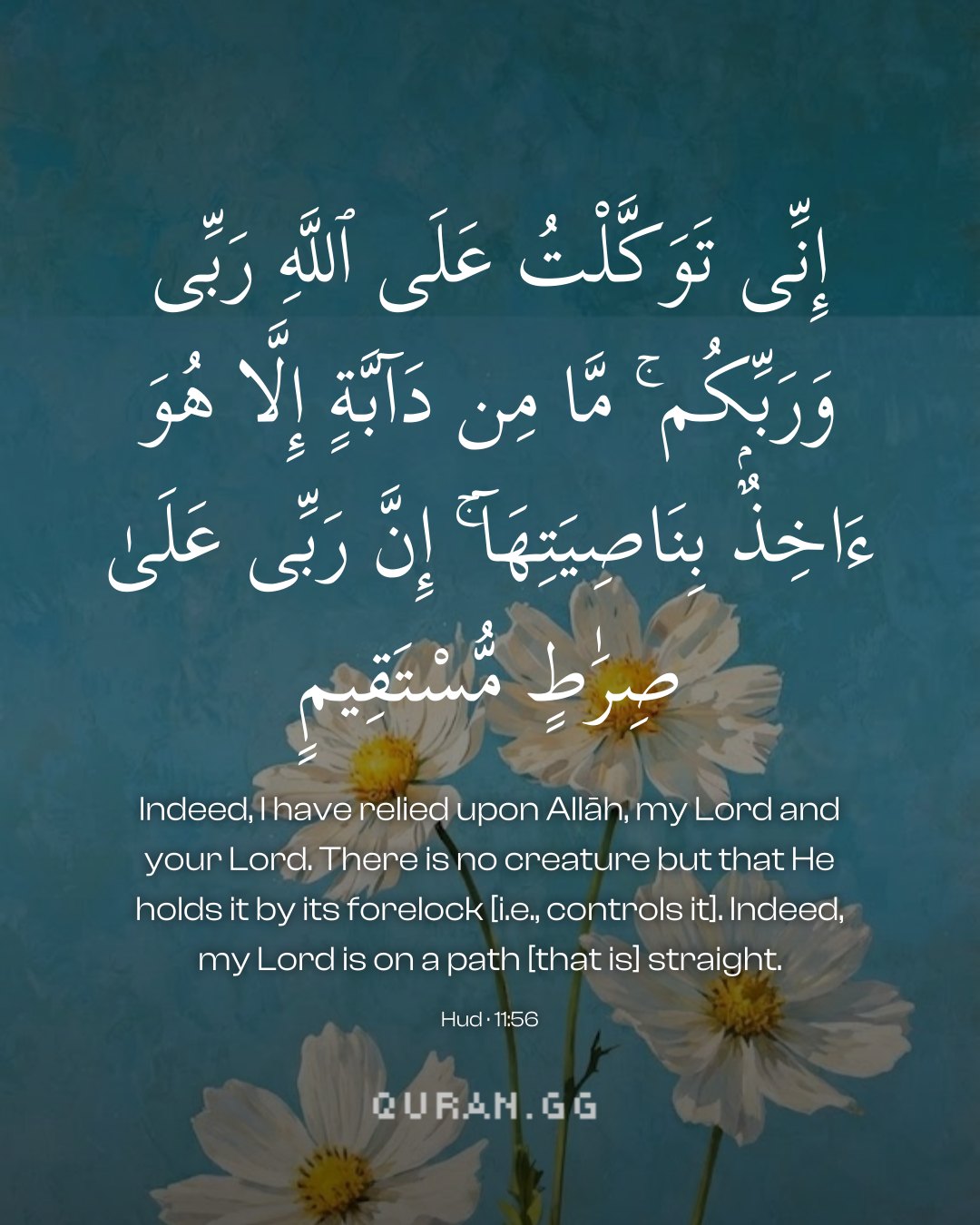
Indeed, I have relied upon Allāh, my Lord and your Lord. There is no creature but that He holds it by its forelock [i.e., controls it]. Indeed, my Lord is on a path [that is] straight.
The Conversation between (the People of) `Ad and Hud
Allah, the Exalted, informs that they said to their Prophet,
مَا جِئْتَنَا بِبَيِّنَةٍ
(No evidence have you brought us.) This means that they claimed that Hud had not brought them any proof or evidence for what he claimed.
وَمَا نَحْنُ بِتَارِكِى ءالِهَتِنَا عَن قَوْلِكَ
(and we shall not leave our gods for your (mere) saying!) They were saying how could his mere statement, "Leave these gods," be sufficient proof for them to leave their idols
وَمَا نَحْنُ لَكَ بِمُؤْمِنِينَ
(and we are not believers in you.) This means that they did not believe what he was saying was true.
After that, the next eight verses (61-68) carry the story of Sayyidna Salih peace be upon him. He was sent to the people of Thamud, another branch of the tribe of ` Ad. He too invited his people to believe in Tauhid, the Oneness of Allah. As customary, his people belied him and insisted that he must first make a she-camel of a specified description come out from the rock of the mountain in front of them in order to have them believe that he was a true prophet of Allah.
Sayyidna Salih (علیہ السلام) warned them: If Allah Ta` ala shows you your custom-ordered miracles, and you still fail to believe, then, according to the customary practice of Allah, the punishment will come and destroy all of you. But, they remained obstinate and Allah Ta` a1a, in His perfect power, made the miracle they demanded manifest before them. The rock of the mountain in front of them split asunder. Out from it came the she-camel bearing the features specified by them. Allah Ta` ala ordered them not to harm that she-camel in any manner, otherwise the punishment will come upon them. But, they disobeyed this order as well, and killed the she-camel. Consequently, they were seized by Allah Ta` ala, Sayyidna Salih (علیہ السلام) and his companions were saved from the punishment, and the rest of those people were destroyed by a Sound which was severe and terrifying.
Tazkirul Quran
Maulana Wahiduddin KhanOn ayahs 56–59
The communities into which God’s prophets had come were all believers in God. In other words, the missionary projected himself as a God-worshipper, while his addressees also made the same claim. So the question arises: in which group is God present? The simple answer to this question is that God is on a straight highway (as-sirat al-mustaqim). So, the religion which is going on the straight path will directly reach God and that which is going on crooked paths will be diverted on to by-paths and can never be successful in reaching God. When Hud said, ‘My Lord is on the straight path,’ he was saying in other words that the path towards which he was calling them was ‘the highway of religion.’ But his people, in the name of religion, had adopted by-ways around the highway of religion and were running headlong along them. Such a headlong course does not take a man towards God; it takes him here and there and leaves him astray. In the light of these verses, the straight path shown by Hud comprises the following: belief in the unity of God, worship of God, seeking God’s pardon, repentance, turning towards God (tawbah), gratitude for God’s grace, placing trust in God, treating God as our Sustainer, treating God as the only possessor of all power, accepting God’s watchfulness over oneself, and remaining humble. All these are the basic teachings of religion. Following these teachings and making them the centre of one’s attention amounts to treading the highway of religion. One who treads this path straightaway reaches God. On the contrary, if a man gives importance to other things, it is as if he is taking the side paths to the right or the left of the highway and hastening along them. Such a course takes a man away from God, not closer to God.
Uthmani text of the Madinah mushaf (King Fahd Complex). Translation: Saheeh International. Tafsir via Quran.com.