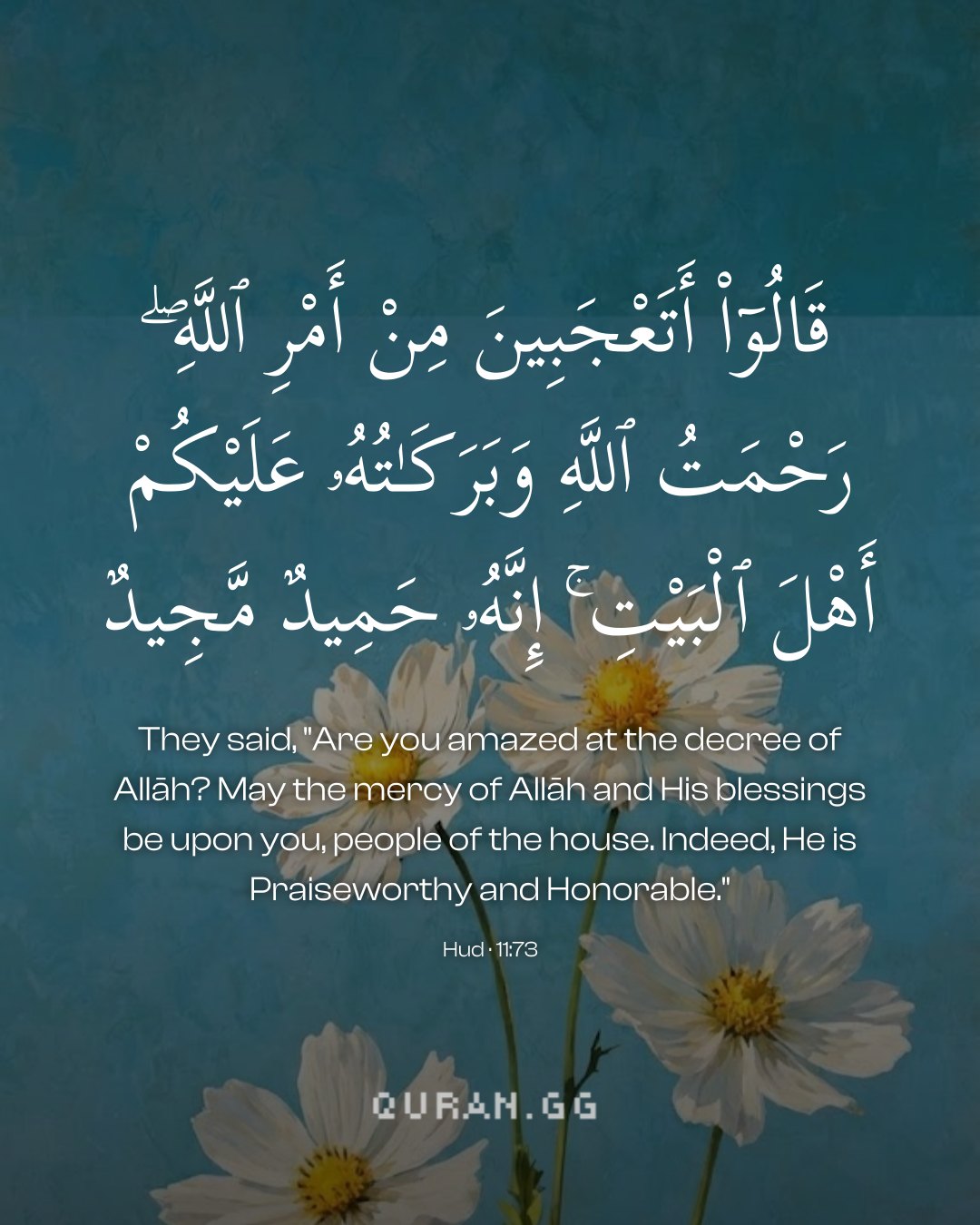
They said, "Are you amazed at the decree of Allāh? May the mercy of Allāh and His blessings be upon you, people of the house. Indeed, He is Praiseworthy and Honorable."
The Coming of the Angels to Ibrahim and Their Glad Tidings to Him of Ishaq and Ya`qub
Allah, the Exalted, says,
وَلَقَدْ جَآءَتْ رُسُلُنَآ
(And verily, there came Our messengers) The word "messengers" here means angels.
إِبْرَهِيمَ بِالْبُشْرَى
(to Ibrahim with the glad tidings.) It has been said that the word "the glad tidings" means, "Receive the glad tidings of Ishaq." Others have said that it means, "The destruction of the people of Prophet Lut." The proof of the correctness of the first view is in Allah's statement,
(Then when the fear had gone away from (the mind of) Ibrahim, and the glad tidings had reached him, he began to plead with Us for the people of Lut.)11:74
In verse 70, it was said: فَلَمَّا رَأَىٰ أَيْدِيَهُمْ لَا تَصِلُ إِلَيْهِ نَكِرَهُمْ (So, when he noticed their hands not reaching for it, he found them strange and felt a bit of fright from them).
From here we learn that there are rules of etiquette for guests as well. A guest should accept whatever is offered. Let him partake from it a little bit to please the host, even if not willing to eat because of unfavorable taste or apprehended harm.
This very sentence also tells us that the host should not consider himself absolved after having placed the food before the guest. In-stead, he should be benignly watching whether or not the guest is par-taking of the food, as was done by Sayyidna Ibrahim when he noticed that the angels were not eating.
Once when Abraham was about a hundred years old, several very handsome young men entered his house. Considering them as guests, he immediately arranged for their food. They were not human beings, but angels of God. They had come with the dual purpose of giving the good news of children to Abraham, and destroying Lot’s community, who had gone to the furthest extremes in their arrogance and rejection of the Truth. Conveying to Abraham and his wife the good news of Isaac (Ishaq), a son, and Jacob (Ya‘qub), a grandson, did not simply mean giving the good news of children in the usual sense. No, indeed, this amounted to the bringing into existence of a line of righteous and mission-oriented human beings. It is a matter of historical record that generally it is a ‘family’ that rises in the service of religion. The history of the prophets and the events in the lives of the true followers who came after them demonstrate this fact. This is because one to whom Truth is revealed is an ordinary person in the eyes of his contemporaries, and this makes it difficult for the common people to recognise his status and support him. But from within his own family, personal relationships become an additional force. What outsiders are unable to see—due to their love of externals—the family members clearly appreciate, thanks to the element of attachment. Not finding it difficult to understand his real position, they become supporters of his mission.
Uthmani text of the Madinah mushaf (King Fahd Complex). Translation: Saheeh International. Tafsir via Quran.com.