The Town of Lut's People is overturned and Their Destruction
Allah, the Exalted, says,
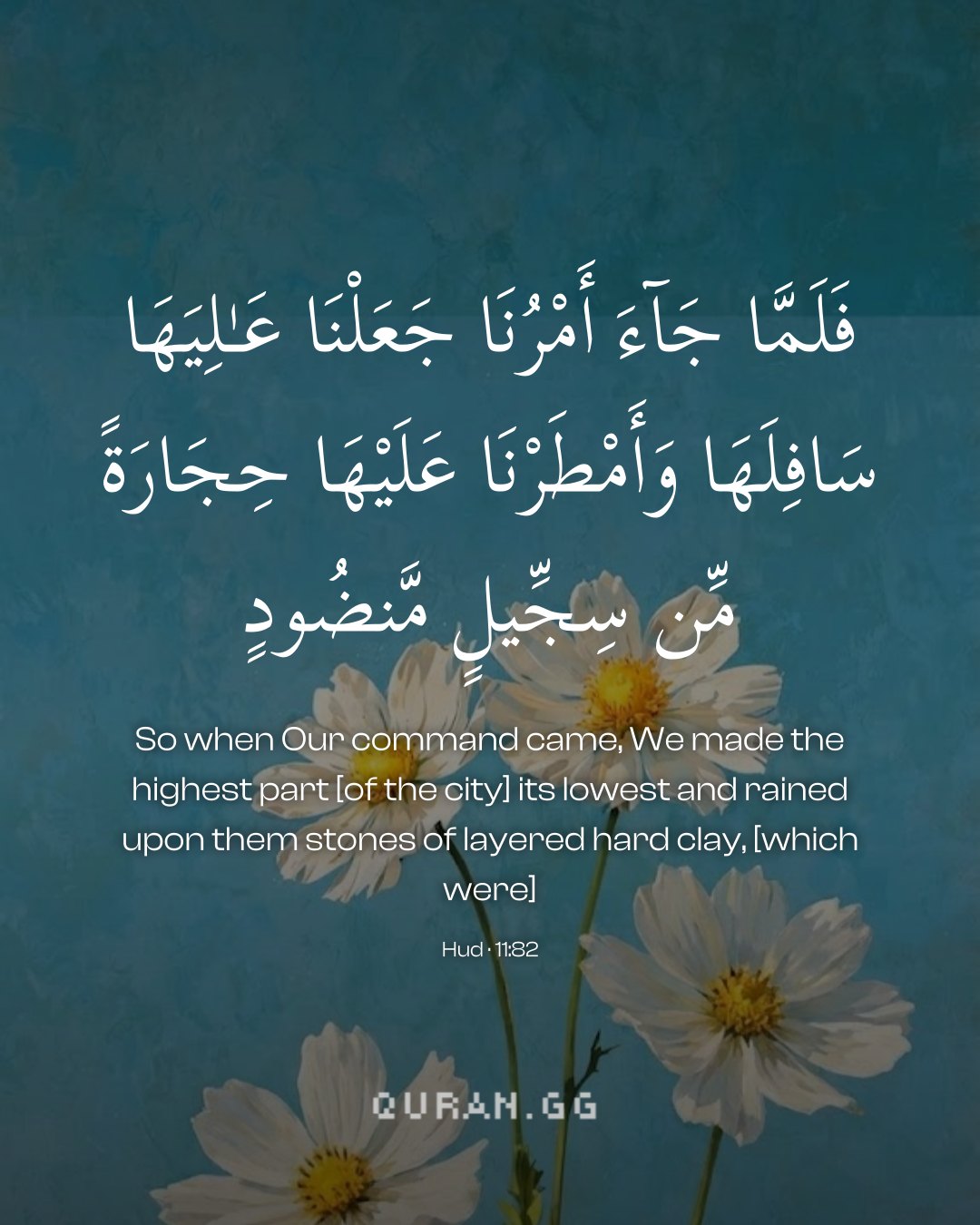
فَلَمَّا جَآءَ أَمْرُنَا
(So when Our commandment came,) This happened at sunrise.
جَعَلْنَا عَـلِيَهَا
(We turned it...) The city of Sadum (Sodom)
سَافِلَهَا
(upside down,) This is similar to Allah's statement,
فَغَشَّـهَا مَا غَشَّى
(So there covered them that which did cover (torment with stones).)53:54 This means, "We rained upon it with stones made of Sijjil." Sijjil is a Persian word meaning stones made of clay. This definition has been mentioned by Ibn `Abbas and others. Some of the scholars said that it (Sijjil) derived from the word Sang, which means a stone. Some others said it means Wakil, which is clay. In another verse Allah says,
حِجَارَةً مِّن طِينٍ
(the stones of clay,) This means clay made into strong, hard stone. Some of the scholars said it means baked clay. Al-Bukhari said, "Sijjil means that which is big and strong." Concerning Allah's statement,
مَّنْضُودٍ
(in an array. ) Some of the scholars said that Mandud means the stones were arranged in the heavens and prepared for that (destruction). Others said,
مَّنْضُودٍ
(in an array.) This word means that some of them (the stones) followed others in their descent upon the people of Lut. Concerning the statement,
مُّسَوَّمَةً
(Marked) meaning the stones were marked and sealed, all of them having the names of their victims written on them. Qatadah and `Ikrimah both said, "Musawwamah means each stone was encompassed by a sprinkling of red coloring." The commentators have mentioned that it (the shower of stones) descended upon the people of the town and upon the various villages around it. One of them would be speaking with some people when a stone would strike him from the sky and kill him while he was among the people. Thus, the stones followed them, striking the people in the entire land until they destroyed them all. Not a single one of them remained. Concerning Allah's statement,
وَمَا هِى مِنَ الظَّـلِمِينَ بِبَعِيدٍ
(and they are not ever far from the wrongdoers.) This means that this vengeance (of Allah) is not far from similar wrongdoers. Verily, it has been reported in a Hadith of the Sunan collections, from Ibn `Abbas, which he attributed to the Prophet ,
«مَنْ وَجَدْتُمُوهُ يَعْمَلُ عَمَلَ قَوْمِ لُوطٍ فَاقْتُلُوا الْفَاعِلَ وَالْمَفْعُولَ بِه»
(Whoever you find doing the deed of Lut's people homosexuality, then kill the doer and the one who allows it to be done to him (both partners).)
At that time, the angels under Divine command said to Sayyidna Lut (علیہ السلام) : فَأَسْرِ بِأَهْلِكَ بِقِطْعٍ مِّنَ اللَّيْلِ (So, move with your family in a part of night). And asked him to instruct everyone in his family not to turn and look back with the exception of his wife because she was going to be hit by the same punishment that was to fall on his people.
This could also mean that he was not to take his wife along with him. And it could also mean that, being his wife, she was to go along as part of his family, but she would not obey the instruction of not looking back he would give to his family. According to some reports, this is what happened. This wife started off with others, but when she heard the big bang of the punishment given to her people, she looked back and felt sorry at their destruction. At that moment there came a splintered rock and finished her off like others. (Qurtubi, Mazhari)
Continue reading the tafsir of ayahs 81–82 The angels who had come to Lot were the angels of retribution. But they entered the town in the shape of very handsome youths. This was intended to establish the guilt of Lot’s community quite finally. When a man continuously indulges in an evil, he becomes completely insensitive about it. This was the case with Lot’s community. They were now openly indulging in evil deeds. So, when they saw that handsome young men had come to Lot’s house, they rushed to his house full of lustful, lewd feelings. With utter shamelessness, they started demanding that the young men be handed over to them. When Lot saw the miscreants coming in this manner, he was extremely ashamed. He said, ‘Here are the daughters of the community. You may marry any of them you like and satisfy your natural instincts.’ The elderly persons of a community speak of the daughters of the community as if they were their own offspring. In this sense, Lot referred to the daughters of the community as his own daughters. But they rejected Lot’s legitimate offer, and continued to press for what was illegitimate. This finally established that these were evil, guilty people and certainly deserved to be destroyed. So, thereafter, all of them were annihilated. ‘Is there not a single right-minded man among you?’ This is generally the last utterance of a servant of God who has no material power to restrain miscreants, when all rational persuasion has failed to hold them back. At that time, by uttering such words, he invokes the prestige of the community and awakens its conscience. In spite of this, if his hearers remain insensitive, it means that there is not an iota of humanity or honour left in them.
Continue reading the tafsir of ayahs 79–82 Uthmani text of the Madinah mushaf (King Fahd Complex). Translation: Saheeh International. Tafsir via Quran.com.