Allah created the Heavens and the Earth in Six Days
Allah, the Exalted, informs of His power over all things, and that He created the heavens and the earth in six days. He mentions that His Throne was over the water before that, just as Imam Ahmad recorded that `Imran bin Husayn said, "The Messenger of Allah ﷺ said,
«اقْبَلُوا الْبُشْرَى يَا بَنِي تَمِيم»
(Accept the glad tidings, O tribe of Tamim!) They said, `Verily you have brought us glad tidings and you have given us.' Then he said,
«اقْبَلُوا الْبُشْرَى يَا أَهْلَ الْيَمَن»
(Accept the glad tidings, O people of Yemen!) They said, `We accept. Therefore, inform us about the beginning of this matter and how it was.' He said,
In the verses appearing above, it has been confirmed that the Holy Prophet ﷺ is a Messenger of Allah and an answer has been given to those who engineer doubts about it. At the beginning, in the first three verses (9-11), an instinctively bad human habit has been mentioned with an instruction to Muslims that they should stay away from it.
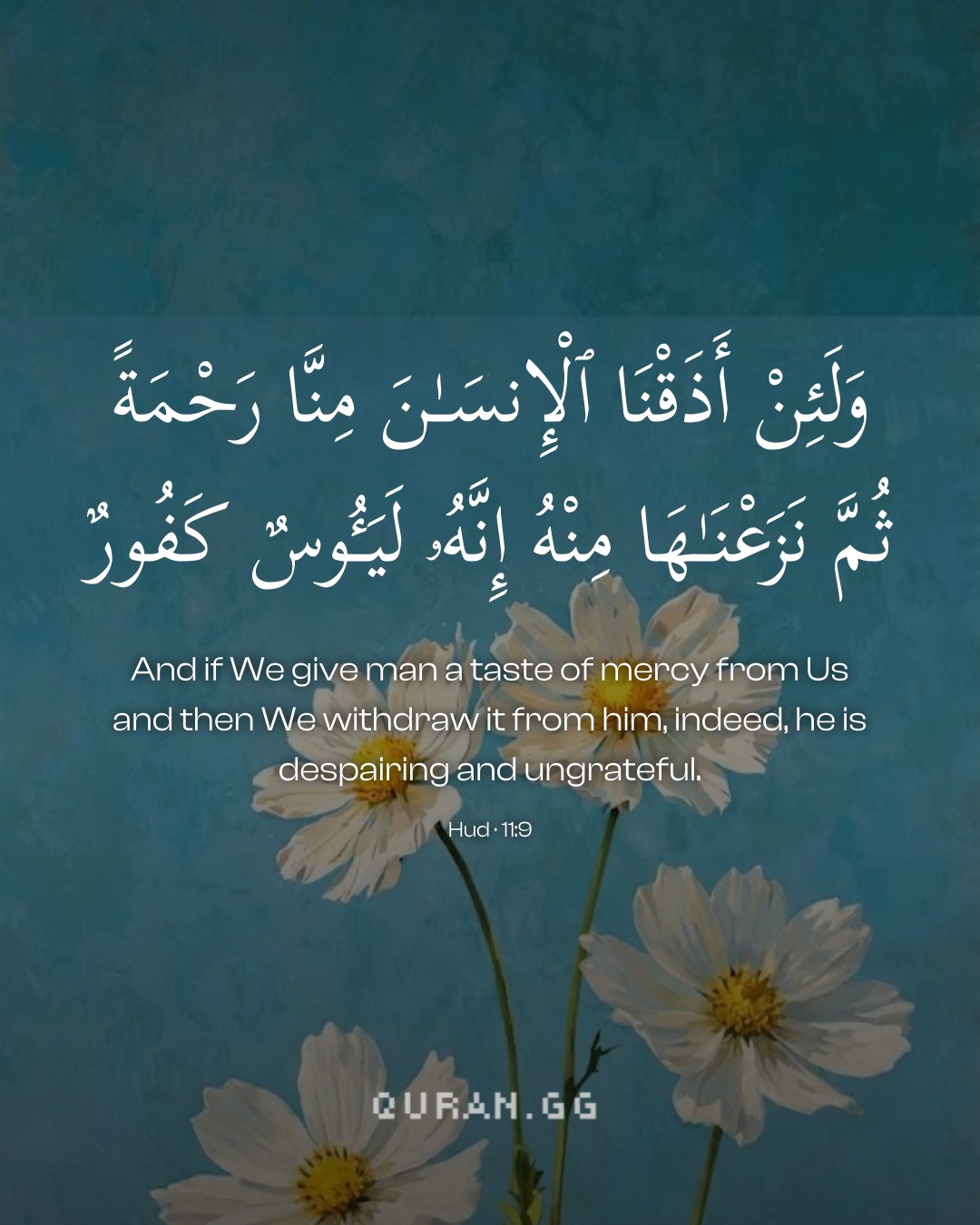
That man is naturally fickle-minded and haste-prone, and that he tends to be consumed by his immediate condition and puts all concerns of the past and future out of his mind, has been described in the first two verses (9, 10). It has been said: If We let man taste a blessing and then take it back, he loses courage and hope and turns ungrateful. And if We let him taste a blessing after he has suffered from some hardship, he forgets all about his suffering and starts bragging and boasting.
In other words, man is given to hurry things, takes the present as everything, does not bother to refer to the past or show concern for the future, therefore, a suffering after a blessing makes him lose hope and slide into ungratefulness. He never thinks that Allah who blessed him first could bless him again. Similarly, if one gets comfort after suffering, then he, rather than recall his past suffering, turn to Allah and be grateful to Him, starts waxing more proud and arrogant. In that state, he forgets his past and goes about thinking that Allah's blessings were his right, he has to have these, and that he remains under the impression that this was how he would continue for the rest of his life. So heedless he becomes that it just does not occur to him that the way the days of suffering did not continue any more, the same thing could hap-pen to the days of comfort and they too could vanish.
Such is the state of human worship of the present and so tragic is the penchant for forgetting the past and the present that a power-hungry man would not even blink to raise the edifice of his power on the blood and dust of another man of power. Always looking up, he would never look down to recall that this had been the fate of the man of power before him. Sad ends and ill fates make no effect on him for power in the present tastes good.
When people start worshipping the present and elect to remain drunk with the state they are in, that is high time for Books of Allah and His Messengers to come. When they do, they bring the lesson-oriented events of the past into sharp focus for heedless man to see things in this perspective and have a little concern for what would happen to them in the future. The lesson they teach is: Ponder over the changing conditions of the universe you are in and get to know the power working behind these - great sermonizers from the Lord!
A perfect believer, in fact, a perfect human being is one who is able to perceive the hidden Power behind every change, revolution, sorrow and comfort, ignore their transitory phases, dismiss their material causes as the sole explanation. The mark of an intelligent person is that he looks at the originator or causer of causes more than he would look at causes, and it is with Him alone that he would relate to as firmly as possible.
Tazkirul Quran
Maulana Wahiduddin KhanOn ayahs 8–10
The present world was created by God in six days, that is, in six stages or six periods. There was a period when its surface was covered with water. In this part of God’s domain, only water was seen everywhere at that time. Then, at God’s behest, patches of land emerged and water filled the great hollows which became the seas and the oceans. In this way it was possible for various species of life to come into existence on the earth. God has the power to give an ideal shape to things and events, but He has chosen to fashion this world in a less than ideal way, so that it may serve as a testing ground for man. Indeed, God’s purpose in creating the world and settling human beings upon it was to single out the doers of good deeds. ‘Good deed’ is actually another name for a realistic deed, i.e. one which a man is required to perform in accordance with reality, without there being any pressure upon him to do. The realistic person is one who appreciates the hidden hand of God by peering through the cause-and-effect veil which, by design, He has drawn over His creations; he is one who, in spite of apparently having power, renders himself powerless; one who, in spite of having the option of leading an arrogant life, becomes obedient to God. In the present world, the selection of such realistic persons continues unremittingly. When the period of this selection is over, the present system will be replaced by another standard system in which all good things will be allotted only to those who perform good deeds, leaving all bad things for the wrongdoers. Almighty God does not immediately catch hold of those who deny the truth and the arrogant in view of His rule of giving respite; i.e. He gives them respite to the fullest possible extent, so that they may be warned and reform themselves, or finally prove themselves guilty. This rule of respite becomes a cause of misunderstanding to certain arrogant people. They forget their real position of powerlessness and start indulging in tall talk. But, when they are smitten by God’s scourge, they will there and then come to know how helpless they are in comparison to God.