Shu` ayb's threatening of His People When the Prophet of Allah,Shu` ayb, despaired of their response to him, he said, "O mypeople
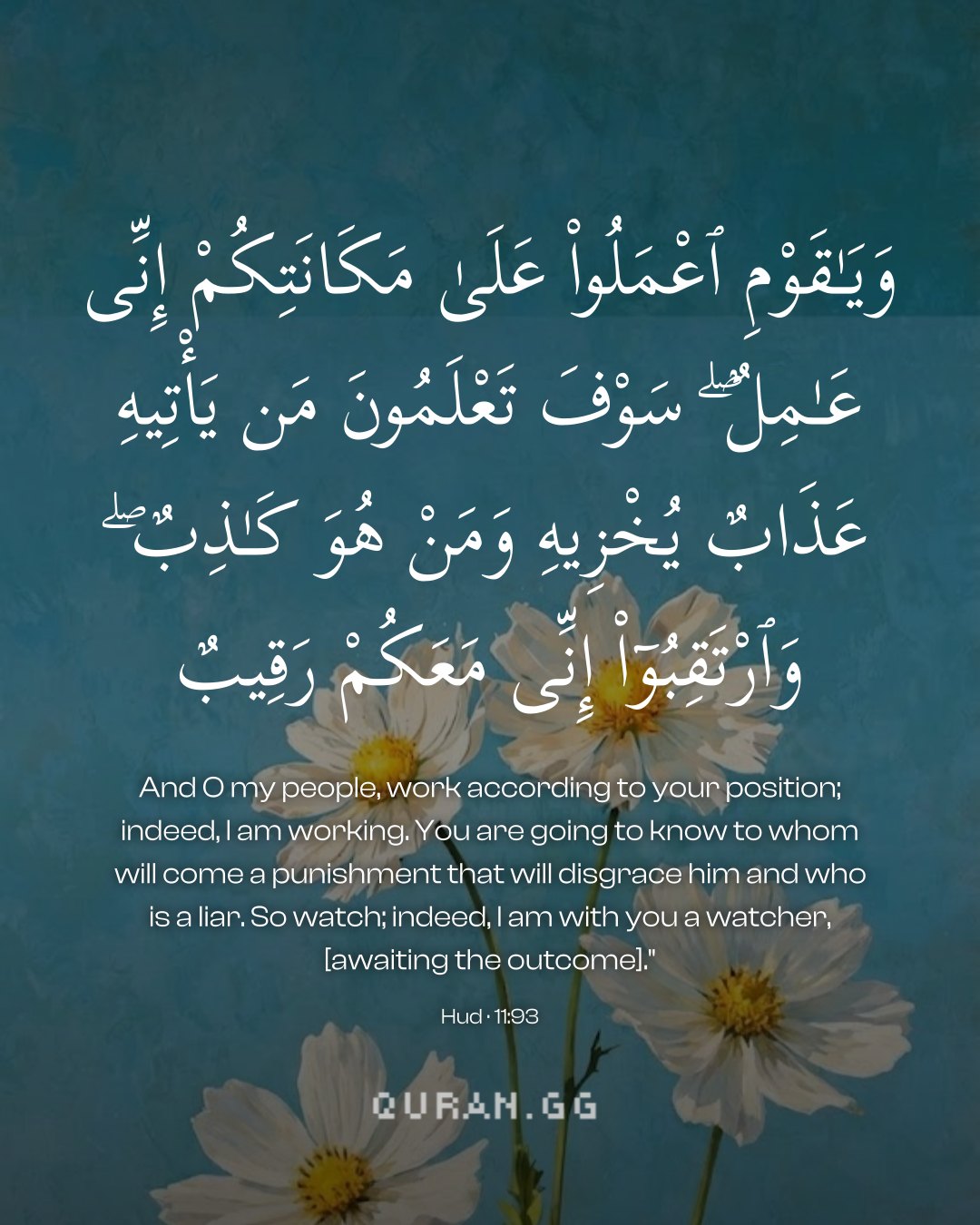
اعْمَلُواْ عَلَى مَكَانَتِكُمْ
(Act according to your ability,) This means, "Act according to your current ways." This is actually a severe threat.
إِنِّى عَـمِلٌ
(I am acting.) according to my way.
سَوْفَ تَعْلَمُونَ مَن يَأْتِيهِ عَذَابٌ يُخْزِيهِ وَمَنْ هُوَ كَاذِبٌ
(You will come to know who it is on whom descends the torment that will cover him with ignominy, and who is a liar!) meaning, between me and you.
وَارْتَقِبُواْ
(And watch you!) This means to wait.
إِنِّى مَعَكُمْ رَقِيبٌ
(I too am watching with you.) Allah then says,
وَلَمَّا جَآءَ أَمْرُنَا نَجَّيْنَا شُعَيْبًا وَالَّذِينَ ءَامَنُواْ مَعَهُ بِرَحْمَةٍ مِّنَّا وَأَخَذَتِ الَّذِينَ ظَلَمُواْ الصَّيْحَةُ فَأَصْبَحُواْ فِى دِيَـرِهِمْ جَـثِمِينَ
(And when Our commandment came, We saved Shu`ayb and those who believed with him by a mercy from Us. And As-Sayhah (awful cry) seized the wrongdoers, and they lay (Jathimin) in their homes.) His saying Jathimin means extinct and lifeless without any movement. Here Allah mentions that a loud cry (Sayhah) came to them. In Surat Al-A`raf He says a severe quake (Rajfah) came to them. In Surat Ash-Shu`ara', He said it was a torment of a cloudy day. They were one nation upon which all of these punishments were gathered on the day of their destruction. In each context, Allah only mentioned that which was suitable. In Surat Al-A`raf when they said,
لَنُخْرِجَنَّكَ يـشُعَيْبُ وَالَّذِينَ ءَامَنُواْ مَعَكَ مِن قَرْيَتِنَآ
(We shall certainly drive you out, O Shu`ayb, and those who have believed with you from our town.)7:88 In this verse it was suitable to mention a tremor, or quake (Rajfah). The earth in which they practiced their wrongdoing and they wanted to expel their Prophet from it, shook them. Here, due to their disrespectful manners in speaking to their Prophet, Allah mentioned the awful cry (Sayhah) which overcame them and killed them. In Surat Ash-Shu`ara' when they said,
فَأَسْقِطْ عَلَيْنَا كِسَفاً مِّنَ السَّمَآءِ إِن كُنتَ مِنَ الصَّـدِقِينَ
(So cause a piece of the heaven to fall on us, if you are of the truthful!)26:187 Allah said in response,
فَأَخَذَهُمْ عَذَابُ يَوْمِ الظُّلَّةِ إِنَّهُ كَانَ عَذَابَ يَوْمٍ عَظِيمٍ
(So the torment of the day of Shadow seized them. Indeed that was the torment of a Great Day.)26:189 This is from the intricate secrets and to Allah belongs all praise and much bounty forever. Concerning the statement,
كَأَن لَّمْ يَغْنَوْاْ فِيهَآ
(As if they had never lived there!) This means it was as if they had not lived in their homes before that.
أَلاَ بُعْدًا لِّمَدْيَنَ كَمَا بَعِدَتْ ثَمُودُ
(So away with Madyan as just as Thamud went away!) They (Thamud) were their neighbors and they did not live far from the homes of the people of Madyan. They were similar in their disbelief and their highway robbery. They were also both Arabs.
After having given this good counsel to them, he warned them of the punishment of Allah Ta` ala. He said:
وَيَا قَوْمِ لَا يَجْرِمَنَّكُمْ شِقَاقِي أَن يُصِيبَكُم مِّثْلُ مَا أَصَابَ قَوْمَ نُوحٍ أَوْ قَوْمَ هُودٍ أَوْ قَوْمَ صَالِحٍ ۚ وَمَا قَوْمُ لُوطٍ مِّنكُم بِبَعِيدٍ
And 0 my people, let not your hostility towards me cause you to suffer what was suffered by the people of Nuh, or the people of Hud, or the people of Salih. And the people of Lut are not far from you.
The sense of the last sentence is that the overturned habitations of the people of Sayyidna Lut (علیہ السلام) were close to Madyan where they were. Then, in terms of time, the punishment that came upon them was very close. From this they could learn their lesson and leave their obstinacy.
Continue reading the tafsir of ayahs 89–111 In a tradition of the Prophet Muhammad, Shu‘ayb has been called the orator among the prophets (khatib al-ambiya’). He used to explain facts to the people of his community in their own understandable language in the most effective manner. Then, why did they not understand what he said? The reason for this was that the mindset of the community had been so vitiated that their way of thinking was quite different from that of Shu‘ayb. Therefore, what he had to say seemed incomprehensible. The community was engrossed in obeisance to human beings whereas Shu‘ayb called upon them to do obeisance to the one and only God. They were under the impression that belief in saints or great ones was enough for their salvation. But Shu‘ayb’s dictum was that salvation can be attained only through the belief in the one God and the performance of good deeds. The community members thought that since they considered themselves believers, they really were believers. Shu‘ayb said however, that a believer was one who was so by God’s assessment. In the eyes of the community salat (prayer) was merely a sort of ineffective formal supplement. Shu‘ayb declared, on the contrary, that salat was a reckoner of man’s life, his income and expenditure. The community thought that Faith was merely a spiritless acceptance, whereas he said that faith was that which was acquired by a live consciousness. In this way, a barrier had developed between Shu‘ayb and the community when it came to understanding his true and straightforward words. ‘Were it not for your clan, we would have stoned you.’ This statement reveals the great extent to which Shu‘ayb’s community had grown insensitive and become immersed in the love of outward, showy con-cerns. The truth of the matter was that when Shu‘ayb exposed the religious pretensions of the communi-ty, its members became his enemies. At that time he had no crowds surrounding him to deter them from attacking him. He did not possess wealth and status with which to impress his listeners. He had at his command only the strength of Truth and reasonableness, but with such people Truth and reasonableness did not carry any weight. In these circumstances, they would have certainly made a fatal attack on him, had it not been for the fear of tribal revenge. In the tribal era, the killing of a member of a tribe meant that, according to tribal custom, the entire tribe would rise to avenge that killing. This fear restrained Shu‘ayb’s community from taking any extreme step, just as in the present age people remain safe from the mischief of miscreants, because the latter fear that if they commit a crime, they will have to face the police force and the courts.
Continue reading the tafsir of ayahs 91–94 Uthmani text of the Madinah mushaf (King Fahd Complex). Translation: Saheeh International. Tafsir via Quran.com.