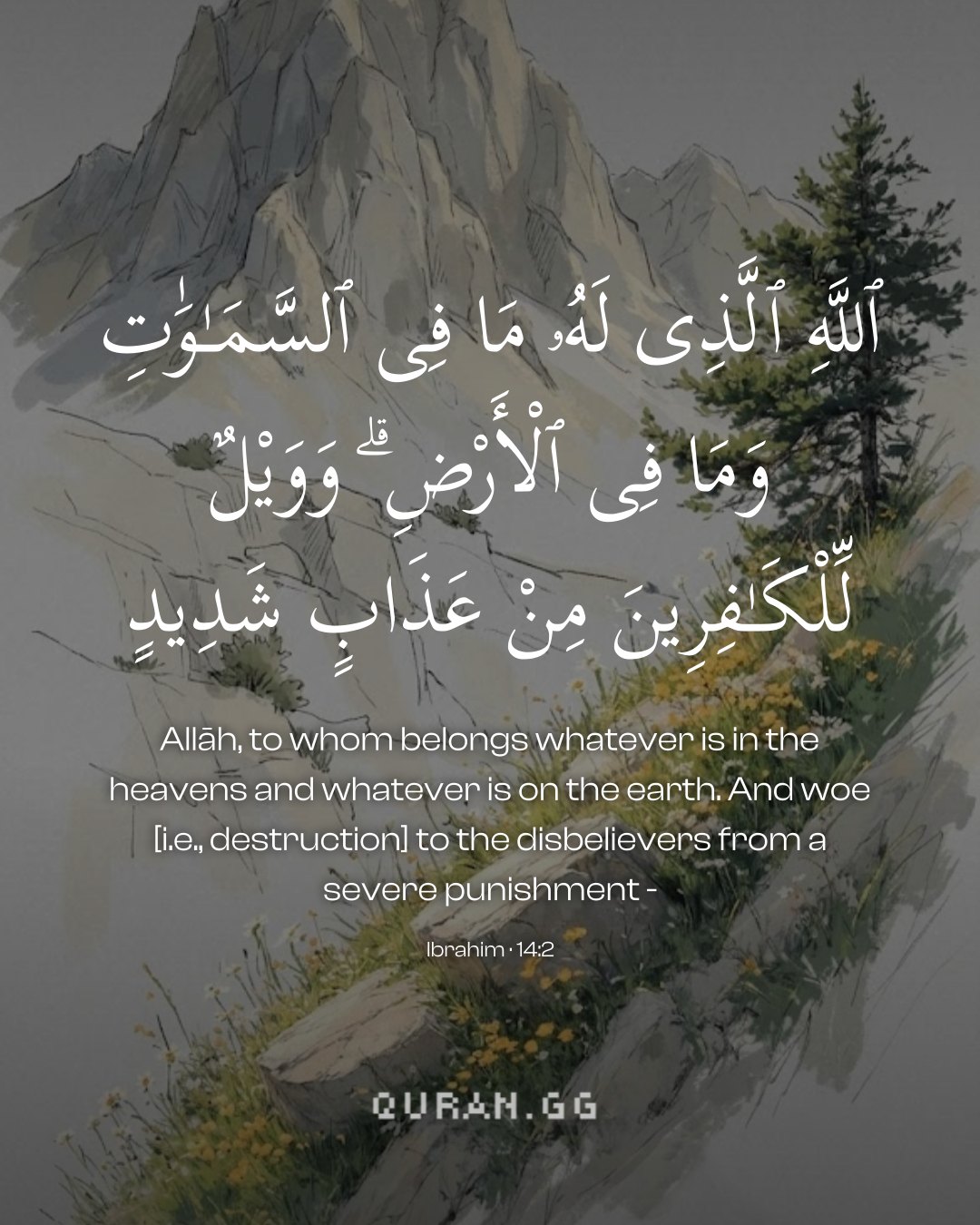
Allāh, to whom belongs whatever is in the heavens and whatever is on the earth. And woe [i.e., destruction] to the disbelievers from a severe punishment -
In the Name of Allah, the Most Gracious, the Most Merciful.
Describing the Qur'an and warning Those Who defy it
Previously we discussed the meaning of the separate letters that appear in the beginnings of some Surahs.
كِتَابٌ أَنزَلْنَـهُ إِلَيْكَ
((This is) a Book which We have revealed unto you...) Allah says, `This is a Book that We have revealed to you, O Muhammad. This `Book', is the Glorious Qur'an, the most honored Book, that Allah sent down from heaven to the most honored Messenger of Allah ﷺ sent to all the people of the earth, Arabs and non-Arabs alike,
After having mentioned these two attributes of Allah Ta’ ala earlier, it was said: اللَّـهِ الَّذِي لَهُ مَا فِي السَّمَاوَاتِ وَمَا فِي الْأَرْضِ (Allah, the One to whom be-longs what is in the heavens and what is in the earth). In other words, Allah is that particular Being who is the Creator of everything in the heavens and the earth and He is the absolute Sovereign having no partners or associates.
Said in the concluding sentence of verse 2 was: وَوَيْلٌ لِّلْكَافِرِينَ مِنْ عَذَابٍ شَدِيدٍ (Woe is to the disbelievers from a severe punishment). The word: وَيْلٌ (waiyl : woe to) is used in the sense of severe punishment and fatal consequence. The verse means that those who dismiss and deny this blessing of the Qur’ an, and prefer to go on living in a multiplicity of darkness, should know that there is for them the darkest of destruction, and the severe punishment which is about to visit them.
The Meaning in Summation
The gist of the verse is that the Qur'an has been revealed so that it rescues all human beings from darkness and brings them into the light of the way of Allah. But, certainly unfortunate are those who reject the Qur'an itself - they, by doing so, are bringing punishment on themselves with their own hands. So, those who deny from the very outset that the Qur’ an is the Divine Word, are the targets of this warning of punishment obviously. But, those who, despite their belief in the Holy Qur'an, have abandoned it in their practical life, in the sense that they never re-cite it, nor try to understand it, nor act upon its teachings, they too can-not be considered totally free and safe from becoming targets of this warning.
Tazkirul Quran
Maulana Wahiduddin Khan
Faith enables man to discover God as a Being who is all powerful and possessed of all the good attributes. Such a mental state is not merely a formal belief. It, in fact, signals the emergence of a man from the darkness of ignorance and his entering into the light of knowledge. It amounts to the observation and realization of the Hereafter, while actually remaining in this world. Faith in reality is a conscious attainment and not the spiritless repetition of certain combinations of words. The Book of God aims to lead man to this higher stage of consciousness. Receiving guidance at the command of God would appear to attribute the matter of guidance to God. But these words are, in fact, aimed at man himself. There is an immutable law of God, which He has established for the guidance or misguidance of man. According to this law, a man’s serious desire for guidance is the only condition which will take him towards it. When a man receives guidance in this world, it is not simply because of the efforts of the missionary, but because it is available to him by the law of God which lays down that only that person will receive the bounty of guidance who himself is desirous of receiving it. Nobody can receive guidance without his own personal desire to have it.
Uthmani text of the Madinah mushaf (King Fahd Complex). Translation: Saheeh International. Tafsir via Quran.com.