Surah Ibrahim Ayah 28 (14:28) — Meaning & Tafsir | Quran.GG

Surah Ibrahim, Ayah 28

14:28 · Meaning and tafsir

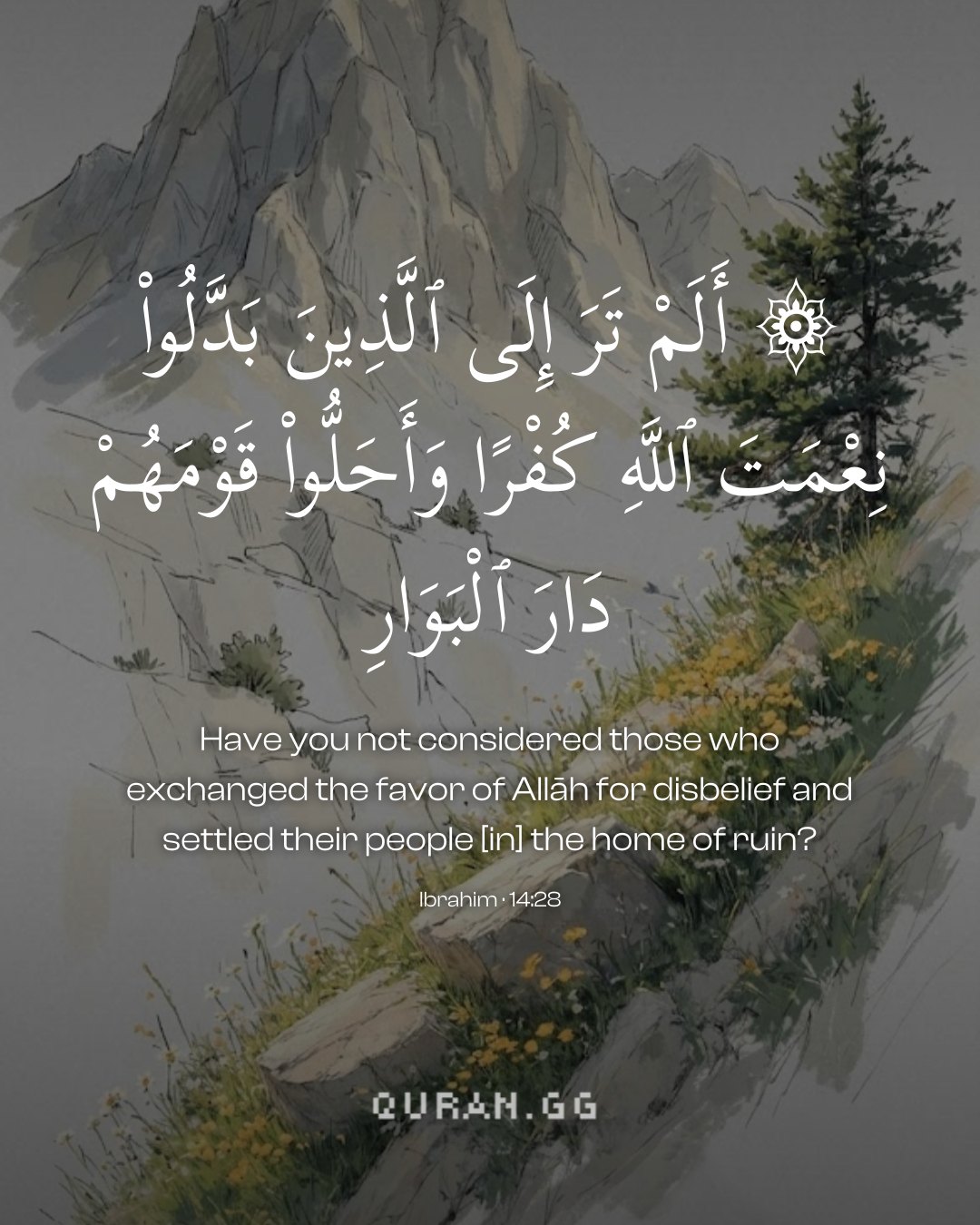
۞ أَلَمْ تَرَ إِلَى ٱلَّذِينَ بَدَّلُوا۟ نِعْمَتَ ٱللَّهِ كُفْرًا وَأَحَلُّوا۟ قَوْمَهُمْ دَارَ ٱلْبَوَارِ ٢٨

Have you not considered those who exchanged the favor of Allāh for disbelief and settled their people [in] the home of ruin?

Surah Ibrahim 14:28 in Arabic with its translation: “Have you not considered those who exchanged the favor of Allāh for disbelief and settled their people [in]…”

Make something with this ayah

Turn it into a video for Stories, Reels or TikTok, recited by the reciter you pick, or an image on a background you choose. Free, in your browser.

Download this image

Tafsir Ibn Kathir (abridged)

The Recompense of Those Who have changed the Blessings of Allah into Disbelief

Al-Bukhari said, "Allah's statement,

أَلَمْ تَرَ إِلَى الَّذِينَ بَدَّلُواْ نِعْمَتَ اللَّهِ كُفْرًا

Have you not seen those who have changed the blessings of Allah into disbelief..., means, do you have knowledge in. Allah said in other Aya0t,

أَلَمْ تَرَ كَيْفَ

(Saw you not how.) and,

أَلَمْ تَرَ إِلَى الَّذِينَ خَرَجُواْ

(Did you not think of those who went forth.)

قَوْماً بُوراً

(A lost people) 25:18 Ali bin `Abdullah narrated that Sufyan said that `Amr said that `Ata said that he heard Ibn `Abbas saying that,

أَلَمْ تَرَ إِلَى الَّذِينَ بَدَّلُواْ نِعْمَتَ اللَّهِ كُفْرًا

"(Have you not seen those who have changed the blessings of Allah into disbelief), is in reference to the people of Makkah." Ibn Abi Hatim recorded that Abu At-Tufayl said that Ibn Al-Kawwa' asked `Ali about Allah's statement,

الَّذِينَ بَدَّلُواْ نِعْمَتَ اللَّهِ كُفْرًا وَأَحَلُّواْ قَوْمَهُمْ دَارَ الْبَوَارِ

(those who have changed the blessings of Allah into disbelief, and caused their people to dwell in the house of destruction) and `Ali said that it refers to the disbelievers of Quraysh on the day of Badr. He also said that the blessing of Allah was faith that came to the polytheists of Quraysh, and they changed this blessing into disbelief and led their people to utter destruction. This includes all disbelievers, for Allah sent Muhammad ﷺ as a mercy and a blessing to all mankind. Those who accepted this blessing and were thankful for it, will enter Paradise, while those who denied it and disbelieved in it, will enter the Fire. Allah said next,

وَجَعَلُواْ للَّهِ أَندَادًا لِّيُضِلُّواْ عَن سَبِيلِهِ

(And they set up rivals to Allah, to mislead from His path!) meaning, they set up partners to Allah whom they worship besides Him and called the people to worship them. Allah threatened them and warned them by the words of His Prophet ,

قُلْ تَمَتَّعُواْ فَإِنَّ مَصِيرَكُمْ إِلَى النَّارِ

(Say: "Enjoy (your brief life)! But certainly, your destination is the (Hell) Fire!") `Whatever you are able to do in this life, then do it, for no matter what will happen,

فَإِنَّ مَصِيرَكُمْ إِلَى النَّارِ

(But certainly, your destination is the (Hell) Fire!) for to Us will be your destination and end.' Allah said in other Ayat,

نُمَتِّعُهُمْ قَلِيلاً ثُمَّ نَضْطَرُّهُمْ إِلَى عَذَابٍ غَلِيظٍ

(We let them enjoy for a little while, then in the end We shall force them to (enter) a great torment.)31:24 and,

مَتَـعٌ فِى الدُّنْيَا ثُمَّ إِلَيْنَا مَرْجِعُهُمْ ثُمَّ نُذِيقُهُمُ الْعَذَابَ الشَّدِيدَ بِمَا كَانُواْ يَكْفُرُونَ

((A brief) enjoyment in this world! And then unto Us will be their return, then We shall make them taste the severest torment because they used to disbelieve.)10:70

Ma'arif al-Qur'an

Finally, said in verses 28 and 29 was:

أَلَمْ تَرَ‌ إِلَى الَّذِينَ بَدَّلُوا نِعْمَتَ اللَّـهِ كُفْرً‌ا وَأَحَلُّوا قَوْمَهُمْ دَارَ‌ الْبَوَارِ‌ جَهَنَّمَ يَصْلَوْنَهَا ۖ وَبِئْسَ الْقَرَ‌ارُ‌

Have you not seen those who changed the favour of Allah with disbelief and landed their people in the house of destruction, the Jahannam? They shall enter it. And it is an evil abode.

Here, نِعمَۃ اللہ (the favour of Allah) could mean the common physical blessings of Allah Ta’ ala. These are tangible and perceptible and relate to outward benefits of human beings such as food, drink, land, home and things like that. Then it could also mean spiritual blessings and favours as well which have come from Allah Ta’ ala for the guidance of human beings, for example, the prophets, the scriptures, and the signs of Divine power and wisdom which have been placed in every inch of the human existence, and in its countless creations, and in the heavens and its unfathomable and incomprehensible universe. All these serve as logistics for the guidance of human beings.

These two kinds of blessings and favours demanded that human beings should have recognized the greatness and the power of Allah Ta’ ala, been grateful to His gifts and devoted to His command. But, the disbelievers and the polytheists elected to shun gratitude and obedience and opted for ingratitude and disobedience. The result was that they led their people to their mutual abode of destruction, that is, in Hell.

The Lesson given by these verses

Described in these verses is the greatness, virtues, blissfulness and fruitfulness of the belief in the Oneness of Allah and in the Kalimah Taiyyibah: لا إله إلا اللہ (la ilaha illallah). Also identified there are the ill effect and evil outcome of refusing to believe in them. It goes without saying that Tauhid, the belief in the Oneness of Allah, is an everlasting treasure which is full of barakah in many ways. In the present world of our experience, it brings Divine support with it, and which continues after that too, in the 'Akhirah and the grave. And the act of rejecting them amounts to changing what was the blessing and favour of Allah into what is punishment.

Tazkirul Quran

Being steadfast in the world means persevering in righteousness and doing good deeds at every turn in one’s life. Being steadfast in the Hereafter means having been successful at the time of questions and answers in the grave. Man is at every moment in the position of being put to the test. He faces different types of favourable and unfavourable events. On these occasions, only those who have grown ‘the tree of faith’ inside themselves behave in a correct and godly way. In the prevailing circumstances, they manifest the most appropriate reaction expected of them according to the will of God. In contrast to this, the man whose personality has grown like a wild bush evinces bitterness at every event; on every occasion he proves to be a thorn and emits a bad smell. When these two types of person are tested finally at the stage of the grave, the one who proves himself to be the ‘good tree’ will be ushered into the Garden of Paradise. And the one who proves to be the ‘evil tree’ will receive the appropriate punishment of being uprooted from this world in order to be thrown as fuel into the fire of Hell.

Uthmani text of the Madinah mushaf (King Fahd Complex). Translation: Saheeh International. Tafsir via Quran.com.