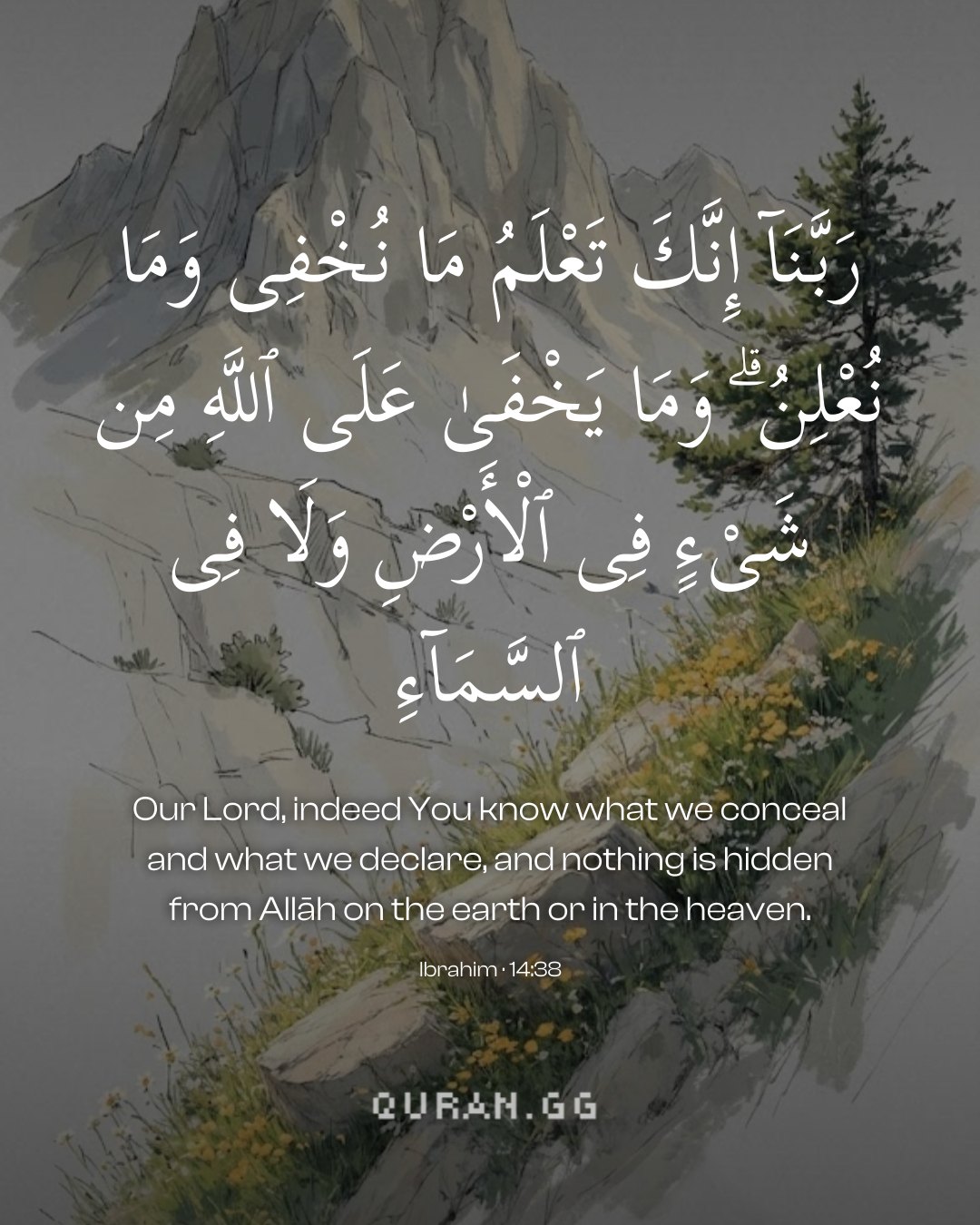
رَبَّنَآ إِنَّكَ تَعْلَمُ مَا نُخْفِى وَمَا نُعْلِنُ
(O our Lord! Certainly, You know what we conceal and what we reveal.) meaning, `You know the intention behind my supplication for the people of this town, seeking Your pleasure in sincerity to You. You know all things, apparent and hidden, and nothing escapes Your knowledge on the earth or in heaven."' He next praised and thanked his Lord the Exalted and Most Honored for granting him offspring after he became old,
الْحَمْدُ للَّهِ الَّذِى وَهَبَ لِى عَلَى الْكِبَرِ إِسْمَـعِيلَ وَإِسْحَـقَ إِنَّ رَبِّى لَسَمِيعُ الدُّعَآءِ
(All praise is due to Allah, Who has given me in old age Isma'il (Ishmael) and Ishaq (Isaac). Verily, my Lord is indeed the All-Hearer of invocations.) `He accepts the supplication of those who invoke Him, and has accepted my invocation when I asked Him to grant me offspring. ' Ibrahim said next,
رَبِّ اجْعَلْنِى مُقِيمَ الصَّلوةِ
(O my Lord! Make me one who performs Salah,), preserving its obligations and limits,
وَمِن ذُرِّيَتِى
(and (also) from my offspring,), make them among those who establish the prayer, as well,
رَبَّنَا وَتَقَبَّلْ دُعَآءِ
(our Lord! And accept my invocation.), all of my invocation which I invoked You with herein,
رَبَّنَا اغْفِرْ لِى وَلِوَالِدَىَّ
(Our Lord! Forgive me and my parents,) Ibrahim said this before he declared himself innocent from his father, after he became sure that he was an enemy of Allah,
وَلِلْمُؤْمِنِينَ
(and the believers), all of them,
يَوْمَ يَقُومُ الْحِسَابُ
(on the Day when the reckoning will be established.) on the Day when You will reckon Your servants and recompense or reward them for their deeds - good for good and evil for evil.
Brimming with wisdom, there is another prayer of Sayyidna Ibrahim (علیہ السلام) which appears in the third verse (37) as follows: رَّبَّنَا إِنِّي أَسْكَنتُ مِن ذُرِّيَّتِي بِوَادٍ غَيْرِ ذِي زَرْعٍ عِندَ بَيْتِكَ الْمُحَرَّمِ رَبَّنَا لِيُقِيمُوا الصَّلَاةَ فَاجْعَلْ أَفْئِدَةً مِّنَ النَّاسِ تَهْوِي إِلَيْهِمْ وَارْزُقْهُم مِّنَ الثَّمَرَاتِ لَعَلَّهُمْ يَشْكُرُونَ : 'Our Lord, I have settled some of my children in a valley of no vegetation [ nor any other obvious life support system ] close to Your sanctified House, so that, Our Lord, they may establish Salah. So, make hearts of a number of people yearn towards them [ to make them familiar with each other ], and provide them with fruits, so that they may be grateful.'
Continue reading the tafsir of ayahs 37–41 The hilly and desert world of ancient Makkah was a natural training ground for the realization of God; the entire panorama of nature was an encouragement to man to remember Him. The only sign of human construction here, which claimed man’s attention, was the stone mosque, the Ka‘bah, built by Abraham and Ishmael. Here man could enter and engage in the remembrance of God. In this atmosphere, the children of Ishmael were miraculously provided with water from the Zamzam spring. Moreover, it was so arranged that they received sustenance (rizq) from produce which was not grown there. This was, in fact, a special arrangement to make them grateful. With the provision of extraordinary bounties, extraordinary feelings of gratefulness arise in man. This was the wisdom which was hidden in Abraham’s prayer that in the desert they should be provided with sustenance in the shape of fruits.
Uthmani text of the Madinah mushaf (King Fahd Complex). Translation: Saheeh International. Tafsir via Quran.com.